According to the latest figures published by HMRC, around 2 million companies submit Corporation Tax returns every year in the UK. This figure is based on HMRC Corporation Tax statistics. HMRC Corporation Tax Statistics 2025 is an accredited official statistics publication that provides a breakdown of receipts and liabilities from Corporate Taxes by number of companies, income, deductions, industry sector, company size and financial year. Missing deadlines or filing incorrect information can lead to penalties, interest charges and unwanted stress for business owners. Yet many small companies still struggle to understand how to file their Company Tax Return correctly and on time.
If you run a limited company, filing your Company Tax Return is one of the most important financial tasks you must complete each year. Whether your business made a profit, made a loss or even stayed inactive, HMRC still expects you to submit the correct documents. Understanding the CT600 form UK process can help you avoid late filing penalties, keep your business compliant and manage your tax responsibilities with confidence.
A Company Tax Return, also known as a CT600 form UK, is a document limited companies must submit to HMRC to report profits, losses and Corporation Tax owed. Most companies must file CT600 online along with iXBRL accounts and tax computations before the Company Tax Return deadline UK to avoid penalties. Paper filing is no longer accepted for most companies.
In this blog, you will learn:
- What is a Company Tax Return (CT600)
- Who needs to file a Company Tax Return
- Company Tax Return deadlines in the UK
- How to file Company Tax Return step by step
- CT600 late filing penalties and how to avoid them
- Whether you can amend a Company Tax Return
- Common FAQs business owners ask about HMRC Corporation Tax
What Is a Company Tax Return (CT600)?
A Company Tax Return, also called the CT600 form UK, is the document limited companies use to report their income, expenses, profits and Corporation Tax liability to HMRC. It tells HMRC how much Corporation Tax your business owes for a specific accounting period. Every active limited company registered in the UK usually needs to complete this return, even if no tax is due.
The return includes financial details such as turnover, allowable expenses, taxable profits and Corporation Tax calculations. Companies must also submit supporting accounts and tax computations with the return. In most cases, businesses need to file CT600 online using HMRC compatible software because paper filing is no longer accepted for most standard submissions.
A Company Tax Return is different from filing annual accounts with Companies House. Both submissions are important and missing either one can result in penalties. The main takeaway is simple: if you operate a limited company in the UK, understanding how to file your Company Tax Return correctly is necessary to stay compliant with HMRC Corporation Tax rules.
The Two Key Submissions You Can’t Ignore
Company Tax Return Submission to HMRC
This includes your CT600 form UK, tax calculations and supporting iXBRL-formatted accounts and computations. The return must be submitted before the Company Tax Return deadline UK, usually 12 months after the end of your accounting period. Late filing can lead to penalties and interest charges.
Annual Accounts Submission to Companies House
Limited companies must also file annual accounts with Companies House. These accounts show your company’s financial position and are separate from your HMRC Corporation Tax return. Missing this filing deadline can also result in financial penalties.
Who Needs to File a Company Tax Return?
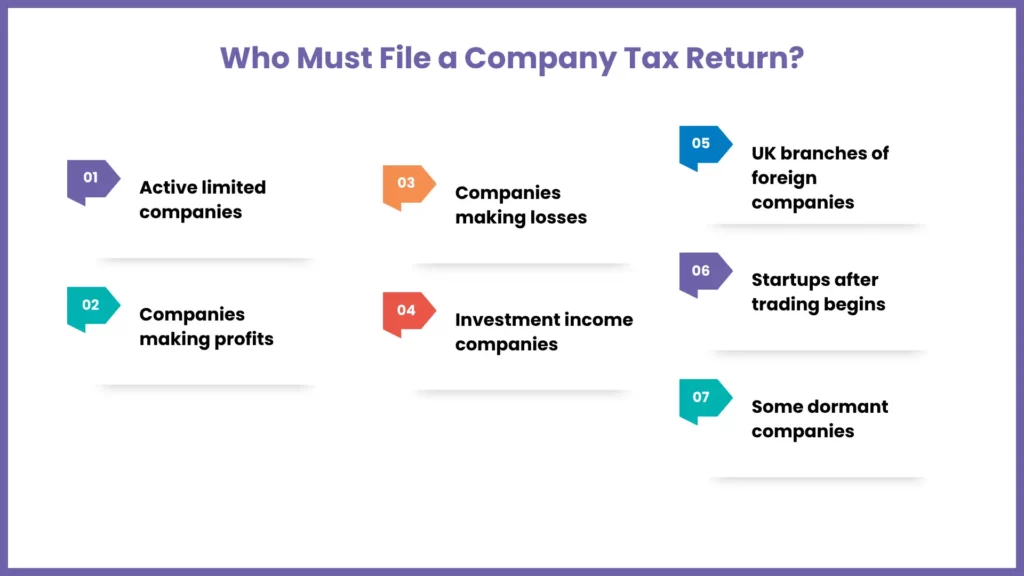
Many business owners assume they only need to submit a Company Tax Return if their company made a profit. However, HMRC requires most registered limited companies to file a Limited company tax return UK regardless of trading activity. Even dormant companies may still need to meet certain filing requirements depending on their status with HMRC and Companies House.
For companies that are dormant for Corporation Tax purposes, HMRC may tell them they do not need to file a CT600, but they must still notify HMRC of their dormant status and file Companies House accounts.
Businesses That Usually Need to File a Company Tax Return
- Active limited companies trading in the UK
- Companies making profits or losses
- Businesses receiving income from investments
- Companies registered with HMRC for Corporation Tax
- Foreign companies with a UK branch or office
- Some dormant companies if HMRC requests a return
- Startups and newly formed limited companies after trading begins
If your company receives a notice from HMRC to deliver a return, you normally must file it even if no Corporation Tax is due. Ignoring HMRC notices can result in automatic penalties. Understanding your filing responsibilities early helps avoid unnecessary problems later.
When Are Company Tax Returns Due?
The Company Tax Return deadline UK depends on your accounting period end date. Most limited companies must submit their CT600 form UK within 12 months of the end of their accounting period. However, the Corporation Tax payment deadline arrives earlier than the filing deadline, which often catches business owners off guard.
For most companies, Corporation Tax must be paid within 9 months and 1 day after the end of the accounting period. This means you usually need to calculate your tax bill well before the final return submission date. Filing late or paying late can both result in penalties and interest charges from HMRC Corporation Tax.
Here is a simple example of the main deadlines:
| Requirement | Deadline |
| Corporation Tax payment | 9 months and 1 day after accounting period end |
| CT600 filing deadline | 12 months after accounting period end |
| Amend Company Tax Return | Within 12 months of the original filing deadline |
For accounting periods longer than 12 months, HMRC splits the period into two or more accounting periods, and each has its own filing deadline.
The key takeaway is that businesses should prepare their records early instead of waiting until the last minute. Proper planning makes it easier to file CT600 online accurately and avoid unnecessary stress.
How to File Company Tax Return (Step by Step)
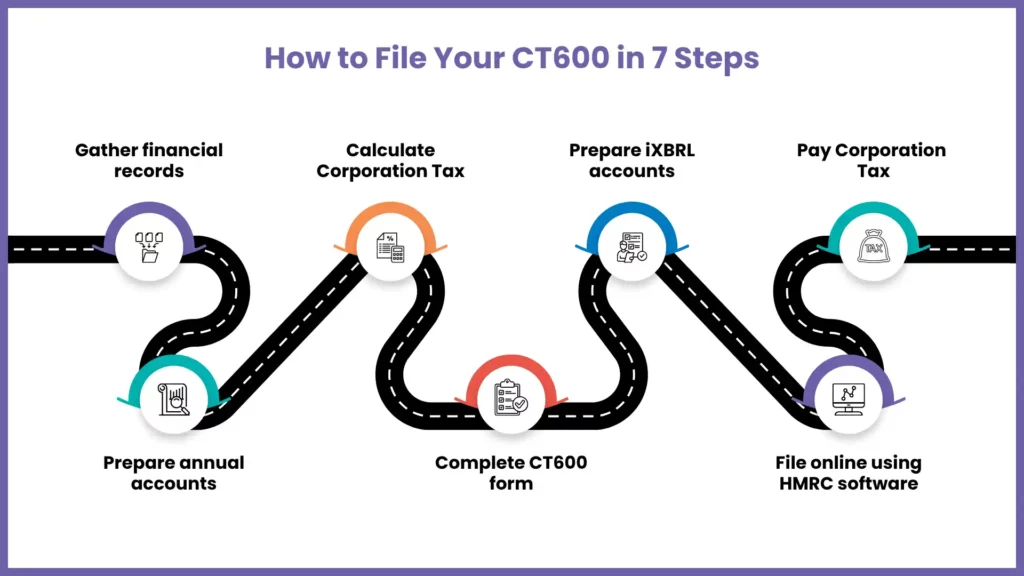
Filing your Company Tax Return on time helps you avoid penalties, maintain accurate records and keep your business financially organised. It also reduces the risk of HMRC enquiries caused by incorrect or rushed submissions. Learning how to file Company Tax Return properly can save time and prevent mistakes that become expensive later.
Step 1: Prepare Your Financial Records
Gather all business records including sales invoices, expenses, payroll records, bank statements and receipts. Accurate records make it easier to calculate profits and complete your CT600 form UK correctly.
Step 2: Prepare Your Annual Accounts
Your company accounts must show income, expenses, assets and liabilities for the accounting period. These accounts will support your HMRC Corporation Tax return and Companies House filing. Accounts submitted to HMRC must be in iXBRL format.
Step 3: Calculate Corporation Tax
Work out how much Corporation Tax your company owes after allowable business expenses and tax reliefs. This calculation forms part of your Company Tax Return submission.
Step 4: Complete the CT600 Form
Fill in the CT600 form UK with your company details, profits, tax calculations and relief claims. Accuracy is important because incorrect information can trigger delays or HMRC checks.
Step 5: Prepare iXBRL Accounts Submission
Most companies must submit accounts and computations in iXBRL format. This is a digital reporting format required by HMRC for online submissions.
Step 6: File CT600 Online
Submit your return using HMRC-compatible software. HMRC no longer accepts standard paper returns, so most businesses must file CT600 online. HMRC publishes a list of compatible software on GOV.UK.
Step 7: Pay Corporation Tax
Make sure your Corporation Tax bill is paid before the Corporation Tax payment deadline to avoid interest and penalties.
Filing early gives you more time to fix errors, arrange tax payments and deal with unexpected issues. Many businesses also choose professional support to ensure their Limited company tax return UK is accurate and fully compliant.
Exemptions from Online Filing
Most companies must file online, but there are a few exceptions where paper filing may still be accepted by HMRC. These exemptions usually apply in rare situations where software cannot support specific requirements or company structures.
Who May Be Exempt from Online Filing
- Companies where HMRC has explicitly agreed an exception to online filing, for example in certain insolvency procedures or where HMRC software requirements cannot support the filing.
- “Reasonable excuse” and religious objections are not standard exemptions for online filing; they may be relevant for appeal against late filing penalties, but do not automatically allow paper filing.
Even if an exemption applies, businesses must still meet the filing deadline. It is important to confirm eligibility with HMRC before submitting paper returns.
Company Tax Return Late Filing Penalties (CT600)
A late Company Tax Return happens when a business fails to submit its CT600 form UK before the official filing deadline. HMRC automatically applies penalties even if no Corporation Tax is owed. Many small businesses underestimate how quickly these penalties increase over time.
Late filing does not only lead to financial penalties. Repeated delays can increase the chance of HMRC compliance checks and create unnecessary pressure on your business finances. Missing the Corporation Tax payment deadline can also result in interest charges on unpaid tax amounts.
| Delay Length | CT600 Late Filing Penalties |
| 1 day late | £100 |
| 3 months late | Additional £100 |
| 6 months late | 10% of any unpaid Corporation Tax on top of fixed penalties |
| 12 months late | Another 10% of any unpaid Corporation Tax |
If your return is late three times within three consecutive years, the fixed penalties increase to £500 (within 3 months) and £1,000 (more than 3 months).
Late filing penalties for returns with a filing date on or after 1 April 2026
From 1 April 2026, HMRC is doubling fixed late filing penalties:
- Within 3 months: £200 (instead of £100)
- More than 3 months: £400 (instead of £200)
- Repeat offender (3+ late returns in 3 years): £1,000 / £2,000 instead of £500 / £1,000
Filing on time is always cheaper and easier than dealing with penalties later.
Can You Amend a Company Tax Return?
Yes, companies can amend a submitted Company Tax Return if mistakes are discovered after filing. HMRC allows businesses to correct errors such as missing expenses, incorrect figures or updated financial information. This helps ensure the correct amount of Corporation Tax is paid.
Most amendments must be made within 12 months of the original filing deadline. Businesses can usually amend returns online using the same software used for the original submission. If the amendment changes the Corporation Tax amount owed, additional tax may need to be paid or a refund may be issued.
For accounting periods ending after 30 June 2024, HMRC generally will not accept electronic amendments more than two years from the end of the corporation tax accounting period; later amendments may need to be submitted by paper.
| Amendment Type | Time Limit |
| Standard CT600 amendment | Within 12 months of the original filing deadline |
| HMRC correction enquiries | Varies depending on enquiry |
Correcting mistakes quickly helps reduce the risk of penalties and future HMRC issues. Businesses should always keep clear records to support any changes made after filing.

Need Help Filing Your CT600?
Avoid costly penalties and filing mistakes with expert support from MyIVA. Whether you’re filing your first Company Tax Return or need help with Corporation Tax compliance, our specialists are here to help.
FAQs: Frequently Asked Questions
When Can I File a Company Tax Return (CT600) Myself?
You can file your own CT600 form UK if you understand HMRC Corporation Tax rules and use HMRC-compatible filing software. Many small business owners do this themselves, but professional support can help reduce errors and save time.
What If I Can’t Afford to Pay My Corporation Tax Bill?
If you cannot pay your Corporation Tax on time, contact HMRC as soon as possible. HMRC may offer a payment arrangement through its Time to Pay service depending on your circumstances.
How Long Does It Take to File a Company Tax Return?
The time depends on your business records and company size. Small businesses with organised accounts may complete the process within a few hours, while more complex businesses can take much longer.
How Much Does It Cost to File a Company Tax Return in the UK?
How much does it cost to file a Company Tax Return depends on whether you file yourself or hire an accountant. Software-only filing typically costs around £30–£150 per year, while accountant fees for a small limited company usually range from £300–£1,000+ depending on complexity.
What Records Must a Limited Company Keep for Tax Purposes?
Companies should keep invoices, receipts, payroll records, bank statements, expense details and VAT records where applicable. HMRC generally requires records to be kept for at least six years from the end of the accounting period.
Should I Appoint an Accountant to File My Company Tax Return?
Many businesses choose accountants because Corporation Tax rules can be confusing. Professional support can help reduce filing errors, identify tax saving opportunities and ensure deadlines are met properly.
Conclusion
Understanding how to file your Company Tax Return correctly is important for every limited company in the UK. From preparing accounts and completing the CT600 form UK to meeting the Company Tax Return deadline UK, each step plays a part in keeping your business compliant and avoiding penalties. Filing on time also helps you stay in control of your business finances and avoid unnecessary stress.
For many small businesses, tax filing can feel confusing and time consuming, especially when deadlines, tax calculations and iXBRL accounts submission are involved. Working with experienced professionals can make the process easier, reduce mistakes and help ensure your company meets all HMRC Corporation Tax requirements properly.
Need help with your CT600 filing?
Speak with MyIVA today for reliable support with your Limited company tax return UK and keep your business tax compliant with confidence.