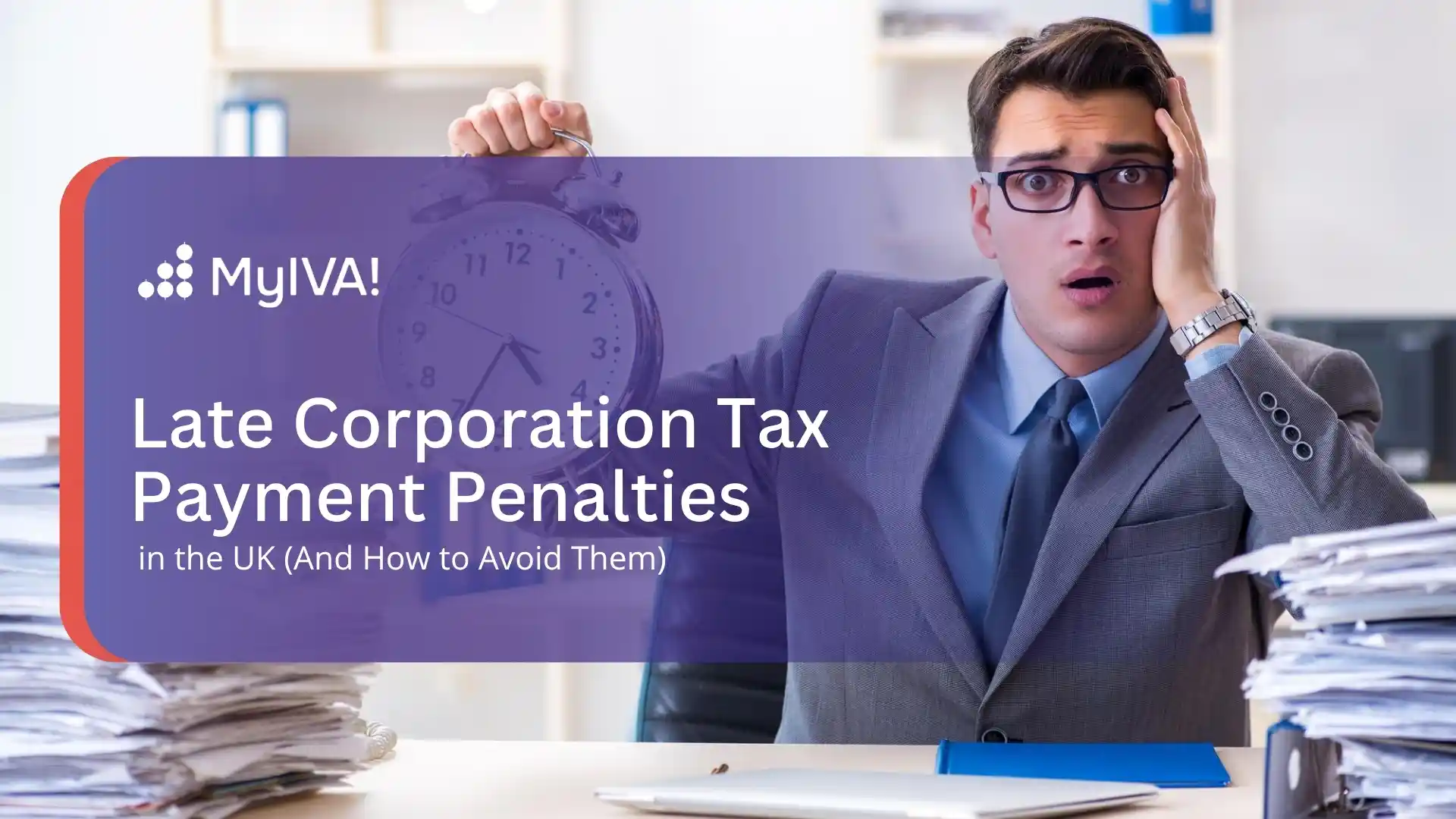
Managing a business in 2026 requires more than just a great product and a solid team; it demands rigorous financial discipline, especially when dealing with HM Revenue and Customs (HMRC). For UK limited companies, Corporation Tax is one of the most significant liabilities on the balance sheet.
While the primary focus is often on growth, missing a Corporation Tax payment deadline UK-wide can lead to a cascade of financial consequences. At MyIVA, we specialise in helping business owners navigate financial stress. In this blog post, we will explore what really happens when Corporation Tax is paid late, how interest accumulates, and the steps you can take to protect your company’s future.
What Is Corporation Tax? (Quick Refresher)
Before diving into the penalties, it is important to clarify what this tax covers. Corporation Tax is a levy on the taxable profits of:
- Limited companies.
- Foreign companies with a UK branch or office.
- Unincorporated associations (like clubs or cooperatives).
There is no tax-free allowance for companies, as is the case with personal income tax. You have to pay tax on all your profits earned through trading, investments, and the sale of assets (chargeable gains). The main rate has been kept at 25% on the profits exceeding £250,000 and a small profit rate of 19% on profits under £50,000, with the marginal relief in between.
When Is Corporation Tax Due? (Deadlines You Must Not Miss)
One of the most confusing aspects of UK business tax is that your payment deadline is usually earlier than your filing deadline.
- Payment Deadline: The tax should be paid 9 months and 1 day following the end of your accounting period to most small and medium-sized companies (taxable profits of up to £1.5 million).
- Filing Deadline (CT600): The Company Tax Return actually filed must be 12 months after the accounting period ends.
Example: When your financial year ending is 31st December 2025, you should pay by 1st October 2026, but you are allowed to submit the return by 31st December 2026.
Note on Quarterly Instalment Payments: When your company is thought to be a very large (profit over 20 million) or a large company (profit over 1.5 million), you must pay in instalments in the accounting period itself. This is a complex area where quarterly instalment payment corporation tax rules apply, often catching growing businesses off guard.
What Is the Penalty for Paying Corporation Tax Late?
If the deadline passes and the funds haven’t reached HMRC, the consequences begin immediately. HMRC charges daily interest on Corporation Tax that is paid late. However, it is important to distinguish between ‘penalties’ (which apply to late filing) and ‘interest’ (which applies to late payment).
Is There a Fixed Penalty for Late Corporation Tax Payment?
Unlike the CT600 filing penalties (which start at a fixed £200 for being even one day late), HMRC does not charge a ‘flat fee’ penalty for simply paying the tax late. They instead depend on a daily interest mechanism to promote compliance. The 10% tax-geared charges that some directors worry about are actually late-filing penalties, not late-payment ones: if your return is more than 6 months late, HMRC may issue a determination (an estimate of what you owe) and add 10% of the unpaid tax, with a further 10% at 12 months. If you have filed your return on time and only paid late, no such surcharge applies; only interest.
HMRC Interest on Late Corporation Tax Payments
The most important punishment for defaulting on payment is the late payment interest HMRC imposes. The interest rates on late payments are fixed at the base rate by the Bank of England, in addition to a high percentage (at the moment, it is 7.75%).
Interest is:
- Calculated daily from the day the tax was due.
- Applied to the outstanding balance until the debt is cleared in full.
- Deductible for the company as a non-trading loan relationship debit, so it does reduce your taxable profits (any interest HMRC later pays you on overpaid tax is, in turn, taxable).
How Much Will HMRC Charge for Paying Corporation Tax Late?
To visualise the impact, let’s look at a typical scenario for a small business in 2026.
Imagine Company A owes £20,000 in Corporation Tax. They miss the deadline and pay 90 days late.
- Debt: £20,000
- Interest Rate: 7.75% per annum
- Daily Interest: (£20,000 x 0.0775) / 365 = £4.25 per day
- Cost of 90-day delay: £382.50
While £382 might seem manageable, if the delay extends to a year and the debt is larger, the cost can easily spiral into the thousands—money that could have been reinvested into the business.
Penalties for Late Filing vs Late Payment (Important Difference)
Many directors mistakenly believe that if they haven’t filed their CT600, they don’t have to pay yet. This is a dangerous assumption.
| Feature | Late Filing (CT600) | Late Payment (Tax Owed) |
| Initial Charge | £200 fixed penalty (increases to £1,000 if late 3 times in a row). | Daily interest (currently 7.75%). |
| 3 Months Late | A further £200, taking the total to £400. | Daily interest continues. |
| 6 Months Late | HMRC estimates your tax and adds 10% of that estimate. | Daily interest continues. |
| 12 Months Late | Another 10% penalty on the unpaid tax. | Daily interest continues. |
In short, filing late is expensive, but paying late is cumulative. If you do both, you are being hit from two different directions simultaneously.
What Happens If You Can’t Afford to Pay Corporation Tax on Time?
Cash flow issues are a reality for many businesses. If you find your accounting period end date has passed and the coffers are empty, do not ignore HMRC.
Identifying the Red Flags
Before you even reach the deadline, there are early warning signs that your company might struggle with its Corporation Tax liability:
- Over-reliance on the “Tax Pot”: When you are using the cash that you had saved to pay taxes to meet your daily expenses or pay bills to suppliers, it is said to be Over-reliance on the Tax Pot.
- Decreasing Profit Margins: A high turnover rate with minimal cash reserves usually means the existence of uncollected tax liabilities.
- Late VAT or PAYE Payments: Typically, when a company is in difficulty in making Corporation Tax payments, it is already in arrears in respect of other HMRC liabilities.
Ignoring the problem converts a manageable tax issue into an HMRC debt recovery action. HMRC’s automated systems are designed to flag non-payment within days. If you don’t engage, they will move from sending “reminders” to “distraint” (seizing assets) or even issuing a winding-up petition to close your company down.
Time to Pay Arrangement: Can You Pay Corporation Tax in Instalments?
The most effective tool for a struggling business is the Time to Pay arrangement HMRC offers. This is a formal agreement that allows you to spread your Corporation Tax arrears over a period of time—usually up to 12 months.
How to Prepare for the TTP Negotiation
HMRC will not simply hand out an instalment plan because you asked. You need to prove that the company is experiencing a temporary setback but remains viable. Before calling the HMRC Payment Support Service, ensure you have the following ready:
- Reference Numbers: Your 10-digit Unique Taxpayer Reference (UTR).
- Cash Flow Forecast: A 6-12 month forecast of how you can settle the arrears and cover the current tax.
- The “Reason Why”: A straightforward explanation of why you cannot pay (e.g., a big customer collapsed, or there was a disruption of the supply chain, or it’s a low season).
- Proposed Repayment Amount: Be aware of how much you can afford to pay every month without default.
The catch: You will still be charged interest on the outstanding balance throughout the arrangement. However, by setting up a TTP, you stop HMRC from taking further enforcement action while you clear the balance. (If your return is also outstanding, filing it on time is what removes the risk of the 10% tax-geared late-filing penalties.)
What Enforcement Action Can HMRC Take for Unpaid Corporation Tax?
If you fail to pay and do not secure a TTP, HMRC has significant powers to recover the debt. The timeline usually looks like this:
1. The Warning Phase
You will receive several letters and potentially a telephone call from HMRC’s debt management department. They will warn you of the consequences of non-payment.
2. Direct Recovery of Debt (DRD)
HMRC has the legal authority to directly withdraw cash from the bank accounts of your company in case you have more than £1,000. They are obliged to retain at least £5,000 in all accounts, but this would still make a business unable to pay its staff.
3. Notice of Enforcement (Distraint)
A formal notice that they intend to visit your premises. Failure to pay within 7 clear days of this notice will result in an enforcement officer going into your premises and seizing equipment, vehicles, or stock to be auctioned (Controlled Goods Agreement).
4. Winding-Up Petition
The “nuclear option”: HMRC has the power to petition the court to wind up your company should you owe them more than £750 and you are insolvent. After advertising the petition, you will have your bank accounts frozen and probably lose control of the business to a liquidator.
Can HMRC Waive or Cancel Corporation Tax Penalties?
While interest is rarely waived (as it is considered “commercial restitution”), fixed penalties for late filing can sometimes be appealed if you have a reasonable excuse HMRC accepts.
Examples of a “Reasonable Excuse HMRC accepts” include:
- The death of a close relative or the director shortly before the deadline.
- An unexpected stay in the hospital that prevented you from dealing with tax affairs.
- Unpredictable postal delays or software failure.
- Serious fire, flood, or theft at the business premises.
“I forgot,” “My accountant let me down” or “I didn’t have the money” are not considered reasonable excuses. HMRC expects businesses to plan for these eventualities.
How to Avoid Penalties for Paying Corporation Tax Late
The best way to manage Corporation Tax is to treat it as a monthly expense rather than a yearly surprise.
- Set Up a Tax Pot: Each time a client makes a payment on an invoice, transfer the income by 19% or 25% to a high-interest business savings account. This makes sure that the money is out of sight, out of mind, till the deadline.
- Use Modern Accounting Software: Programs such as Xero or QuickBooks will give you the estimates of taxes in real time. In the year 2026, most of these platforms will have AI to forecast your end-of-year liability depending on current trends.
- File Early: You can file your CT600 as soon as your accounts are ready. Filing early gives you months of “notice” before the payment is actually due. This is the ultimate stress-reducer. Note that since HMRC’s free online filing service closed on 31 March 2026, CT600s must now be filed using commercial software.
- Review Director Loan Accounts: Take care not to take excess out of the company in the form of dividends or loans in such a way that the company is left without the ability to pay taxes.
- Communicate with HMRC: When you have a large contract that is behind schedule, and you are aware that you will run out of cash, call the HMRC Payment Support Service before the deadline. They have a high possibility of being lenient when you are proactive.
FAQs: Frequently Asked Questions
Does HMRC charge interest on the penalties too?
As a rule, no. Interest is paid on the outstanding tax itself. But when you receive a penalty and fail to pay it when it is due, you may ultimately receive the charges of interest, should it be outstanding long enough.
Can I pay my Corporation Tax in instalments without a TTP?
You can make “payments on account” whenever you like throughout the year. If you want to pay £500 a month toward your future bill to avoid a big hit at the end of the year, HMRC will gladly accept it. This is highly recommended for seasonal businesses.
What if I pay the wrong amount?
In case of underpayment, interest will be charged on the difference. In case of overpayment, HMRC will, in fact, pay you “repayment interest” (which is now about 2.75%). Not a superb investment as compared to a high-interest account, but better than nothing.
Is the director personally liable for Corporation Tax?
In a small business, the debt is the company’s. But if you keep trading while insolvent, or pay dividends instead of tax, HMRC may pursue you personally through wrongful or fraudulent trading claims, misfeasance proceedings, or a joint and several liability notice, putting your personal assets at risk.
How long does HMRC have to collect unpaid Corporation Tax?
HMRC can normally go back 4 years to assess underpaid Corporation Tax, extended to 6 years where the underpayment is due to carelessness and up to 20 years in cases of deliberate behaviour.
Can I pay Corporation Tax with a credit card?
No, HMRC no longer accepts personal credit cards for Corporation Tax payments. You can use a business credit card, but expect a non-refundable transaction fee.
Paying corporation tax by instalments
Yes, if your company’s taxable profits are over a certain threshold, HMRC may ask you to pay corporation tax in instalments. This typically applies if your tax bill is over £1.5 million. You can make these payments quarterly, which can help ease the financial burden. Be sure to follow the deadlines and payment schedule provided by HMRC.
How do I avoid penalties for late corporation tax payments?
To avoid penalties for late payments, make sure you submit your corporation tax return on time and pay any owed tax by the deadline. Setting reminders for important dates can help, or better yet, automate the process through accounting software. If you’re struggling to pay on time, it’s worth discussing installment options with HMRC to avoid penalties.
The cost of paying Corporation Tax late in 2026 is designed to be a significant deterrent. Late payment interest (HMRC) at 7.75% means it works like a high-interest loan, and the difference between a profitable year and a loss can come down to this hidden cost.
We have realised in MyIVA that occasionally, business challenges are too steep to be solo. When your company is having a hard time paying its Corporation Tax arrears and other business debts, then it might be time to consider a more organised solution. It can be negotiating a Time to Pay or venturing into insolvency as a means of safeguarding your future; there is no need to end up in an enforcement route by HMRC, and the only way is to do it now.
Engagement is the greatest lesson learned. HMRC is a titanic engine, but an engine that is more comfortable with a payment plan than a liquidation. Having clarity, initiative, and structure will help you sail through the most trying of times in tax years.
Do you have a tax debt or HMRC enforcement on your business? Contact MyIVA now to have expert and confidential guidance on how to put your business on a firmer footing.