If your company can’t pay its Corporation Tax on time, contact HMRC before the deadline and ask for a Time to Pay arrangement. This is an agreement that lets you settle the debt in monthly instalments, usually over six to twelve months. Interest (currently 7.75%) keeps running until the balance clears, but getting in early keeps enforcement off the table.
A Corporation Tax bill arriving from HMRC can feel stressful, especially if cash flow is already tight. Many directors only realise how serious it is when the payment deadline is close and there is not enough money in the business account. According to HMRC guidance, late Corporation Tax payments can lead to interest charges and enforcement action, even if the delay is short.
Every year, many UK businesses struggle with the same issue. Some miscalculate their tax bill, others face slow client payments, and some simply do not set enough money aside. Whatever the reason, the result is the same: pressure builds quickly when the bill falls due, and the money isn’t there
If you can’t pay your corporation tax bill, you should contact HMRC immediately and request a Time to Pay arrangement. Corporation Tax is due 9 months and 1 day after the end of your accounting period, and HMRC may allow you to spread payments over instalments depending on your situation, but daily late payment interest (currently 7.75%, from 9 January 2026) will still apply until the balance is cleared.
In this guide, you will learn what happens if you cannot pay, how HMRC deals with overdue tax, what options are available, and what steps directors should take right now to avoid further problems.
What Happens If You Can’t Pay Your Corporation Tax Bill?
If your company misses its Corporation Tax payment, HMRC will not ignore the situation. Even if you miss the deadline by a few days, action starts building up quickly. The earlier stages are manageable, but delays can escalate into serious financial pressure for your company.
Here is what can happen if the bill is not paid on time:
1. Late payment interest starts immediately
HMRC charges daily interest from the day after your payment deadline (9 months and 1 day after your accounting period ends). The current late payment interest rate is 7.75% (from 9 January 2026). This continues until the full amount is cleared, which means your debt increases even if no penalties are applied yet.
2. Late filing penalties are separate from late payment
Paying Corporation Tax late does not trigger penalties, only daily interest. Penalties apply separately if you file your Company Tax Return (CT600) late. From 1 April 2026, these fixed filing penalties doubled: £200 if you are one day late, a further £200 (£400 total) after three months, and up to £2,000 for repeat late filers. So even if you can’t pay, always file your return on time to avoid these charges.
3. HMRC reminders and warnings
You will receive letters and notices asking for payment. These reminders can become more serious over time, especially if no response is made.
4. Debt collection action
If the debt is still unpaid, HMRC may pass it to internal recovery teams or external debt collectors. This increases pressure on the business.
5. Asset seizure in serious cases
In rare situations, HMRC may take enforcement action against business assets. This usually happens when there is no communication or payment plan in place.
6. Impact on business cash flow
Ongoing interest and penalties can affect working capital, making it harder to pay suppliers, staff, and other business expenses.
7. Risk of company closure
If the debt remains unpaid for a long time, HMRC can apply to wind up the company. This is a serious step that can end business operations.
If you are in this position, MyIVA accountants can help you deal with HMRC, review your options, and support you through repayment planning before things escalate further.
How Much Interest Will HMRC Charge on a Late Corporation Tax Bill?
This is usually the first thing directors want to know, and it’s simpler than the penalty rules. HMRC charges daily interest on whatever you owe from the day after your payment deadline until the bill is cleared. There’s no grace period, so even a payment that’s a single day late picks up a charge. The rate is currently 7.75% a year (the Bank of England base rate plus 4%), and it’s simple interest rather than compound, so it doesn’t build up on itself.
To put that in real terms, say your company owes £15,000 and pays three months late. At 7.75%, that comes to roughly £285 in interest. That’s not disastrous, but it’s money you’d rather keep in the business. Leave the same bill unpaid for a full year and you’re looking at about £1,160. The longer it sits there, the more it costs, which is exactly why it pays to sort out an arrangement sooner rather than later. For a fuller breakdown of how these charges build up, see our guide to late Corporation Tax payment penalties.
Step 1 — Contact HMRC Before It Escalates
If you realise you can’t pay your corporation tax bill, the first and most important step is to contact HMRC straight away. Ignoring the problem will only make it worse. HMRC is more likely to help if you speak to them early.
You should explain your situation clearly, including why you cannot pay and when you expect to start payments. This could be due to late client payments, seasonal income drops, or unexpected business costs.
Key points to prepare before contacting HMRC:
- Your company details and UTR number
- The amount you owe
- Reason for non-payment
- Expected cash flow timeline
Early communication shows HMRC that you are taking responsibility, which improves your chances of getting support.
Step 2 — Time to Pay (TTP) Arrangement — The Main Option
If you can’t pay your corporation tax bill, the most common solution is an HMRC Time to Pay arrangement. This allows you to spread your tax debt into monthly instalments instead of paying everything at once.
HMRC will review your financial situation before approving the plan. They will check if your business can realistically meet monthly payments while continuing to operate. If approved, you will be given a structured repayment schedule.
A Time to Pay agreement usually includes:
- Fixed monthly instalments
- Ongoing late payment interest
- Requirement to stay up to date with new tax bills
This option helps many companies avoid enforcement action and gives breathing space to manage cash flow. MyIVA can help you prepare and negotiate a realistic corporation tax payment plan with HMRC.
Setting Up a Time to Pay Arrangement
For Corporation Tax, a Time to Pay plan is set up over the phone rather than online. You, or your accountant, call HMRC’s Business Payment Support Service on 0300 200 3835, ideally before the deadline, with your UTR and a realistic monthly figure to hand. The earlier you get in touch, the more open HMRC tends to be. We walk through the eligibility rules, what HMRC asks for, and the full negotiation in our guide to how a Time to Pay arrangement works.
It often plays out like this: a small company owes an £18,000 bill, a key customer is paying 60 days late, and the director calls HMRC a fortnight before the deadline. They agree a six-month plan, clear the debt steadily, and avoid any enforcement, simply because the call came early.
Other Options If You Can’t Pay in Full
If you can’t pay your corporation tax bill, a Time to Pay arrangement is not the only option. Depending on your situation, there are a few other routes worth considering.
1. Short-term business loan
Some companies choose short-term financing to clear HMRC debt quickly. This avoids ongoing interest from HMRC but requires careful repayment planning.
2. Director’s loan or funds injection
A director may choose to inject personal funds into the business. This clears immediate tax pressure but should be used carefully based on personal financial position.
3. Restructuring business expenses
Reducing non-essential costs can free up cash flow to meet HMRC obligations. This is often a short-term fix while arranging payment support.
4. HMRC payment support service
HMRC may offer additional support options depending on your circumstances. This can include extended payment arrangements or revised terms if your financial situation changes.
These options should always be reviewed carefully, as each one affects business cash flow differently. In many cases, professional advice helps choose the safest route.
Can HMRC Wind Up Your Company for Unpaid Corporation Tax?
If you can’t pay your corporation tax bill, one of the most serious risks is that HMRC can take legal action to close your company. This is known as a winding up petition, and it usually happens when tax debts remain unpaid for a long time without any arrangement in place.
In most cases, HMRC does not jump straight to closing a company. They usually send reminders, follow up with letters, and offer opportunities to set up a payment plan. However, if there is no response or payment, they can apply to court to force liquidation of the business.
This is why early action is important. Once a winding-up petition is issued, control over the company becomes limited, and bank accounts may be frozen. Speaking to HMRC or setting up a Time to Pay arrangement early can help avoid reaching this stage.
What Should a Director Do Right Now?
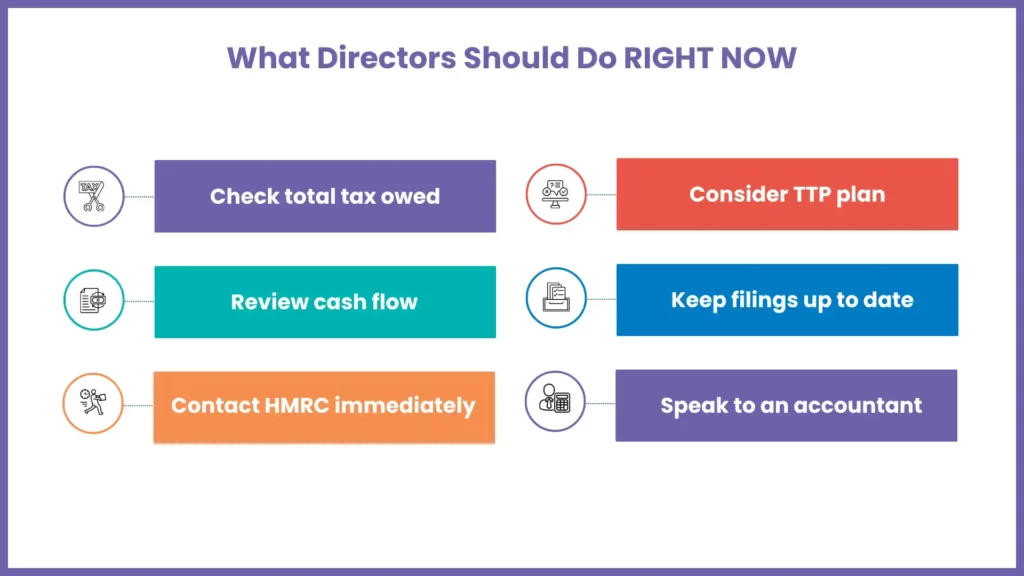
If you can’t pay your corporation tax bill, the worst thing you can do is delay action. The situation usually gets harder the longer it is ignored. Taking quick steps gives you more options and reduces penalties or enforcement risks.
Here is what directors should do immediately:
1. Check the exact amount owed
Review your HMRC account and confirm the total Corporation Tax due, including any interest already added. When you’re ready to clear it, our guide on how to pay your Corporation Tax online covers the quickest payment methods and how long each one takes.
2. Review your cash flow
Look at upcoming payments from customers and business expenses to understand what you can realistically afford.
3. Contact HMRC as soon as possible
Do not wait for reminders. Early communication increases the chance of getting a payment plan approved.
4. Consider a Time to Pay arrangement
If you cannot clear the full amount, ask HMRC for a structured repayment plan based on your situation.
5. Avoid taking on new debt without planning
Borrowing money to pay tax can help in some cases, but it should be carefully reviewed first.
6. Speak to an accountant
A professional can help you negotiate with HMRC and avoid mistakes in your repayment request.
7. Keep all filings up to date
Even if you are struggling, continue submitting returns on time to avoid additional penalties, which doubled from 1 April 2026 (£200 rising to as much as £2,000 for repeat late filers).
How to Avoid This Situation in Future
Most cases where a company can’t pay its corporation tax bill do not happen suddenly. They usually build up over time due to poor planning, unexpected expenses, or irregular income. With better financial habits, this situation can often be avoided.
Here are practical ways to reduce the risk:
1. Set aside tax money early
Put aside a percentage of your income each month so tax bills are easier to manage when they arrive.
2. Track business cash flow regularly
Do not wait until year end. Monthly reviews help you see problems early.
3. Use accounting software
Simple bookkeeping tools help you stay aware of profits and tax obligations in real time.
4. Plan for Corporation Tax in advance
Estimate your tax bill during the year so there are no surprises at the deadline. Our guide on how to calculate Corporation Tax walks through the steps, and claiming any reliefs you’re entitled to, such as R&D tax relief, can bring the final figure down.
5. Avoid mixing personal and business funds
Keeping finances separate makes it easier to manage tax obligations correctly.
6. Stay ahead of deadlines
Knowing your company’s tax return deadline helps you prepare funds early instead of rushing later.
7. Work with an accountant
Regular support from an accountant reduces errors and helps you stay compliant throughout the year.
Planning ahead makes tax payments less stressful and protects your business from unnecessary pressure.
FAQs: Frequently Asked Questions
Can I delay my Corporation Tax payment legally?
You cannot delay payment on your own, but HMRC may allow a Time to Pay arrangement. This must be agreed before or shortly after the deadline.
What happens if I pay Corporation Tax late but in full?
HMRC will still charge daily late payment interest (currently 7.75%) even if you eventually pay the full amount. Because Corporation Tax has no separate late-payment penalty, paying as soon as possible simply reduces the total interest that builds up.
Can I pay Corporation Tax in instalments?
Yes, but only if HMRC agrees to a Time to Pay arrangement based on your financial situation.
Will HMRC negotiate if this is my first time struggling to pay?
In many cases, yes. HMRC is often more flexible if it is your first issue and you contact them early.
Does a Time to Pay arrangement affect my credit rating?
It can affect your business credit profile, as it shows you have entered a payment plan. However, it is better than enforcement action or legal proceedings.
Can a director be personally liable for unpaid Corporation Tax?
Generally, the company is responsible, not the director. However, in cases of negligence or wrongdoing, HMRC may pursue directors personally.
Conclusion
If your company is struggling to pay its Corporation Tax, it’s important not to ignore it. HMRC has ways to recover unpaid tax, but most issues can be handled if you act quickly and communicate clearly.
The key is to understand your options, manage your cash flow, and prevent the situation from getting worse. Whether it’s a Time to Pay arrangement, changing payment schedules, or getting professional help, there are ways to reduce the stress without harming your business.
At MyIVA, our corporate tax services help directors who are facing tax issues, HMRC payment plans, and other financial challenges. Our team helps you communicate with HMRC, organise repayment plans, and keep your business stable during difficult periods.
If you are struggling with your tax bill, speak to MyIVA today and get the right support before the situation becomes more serious.