Key Takeaways
- HMRC wage raid payroll checks are unannounced or short-notice inspections covering PAYE, RTI submissions and National Minimum Wage (NMW) compliance.
- Since 7 April 2026, the Fair Work Agency (FWA) has taken over strategic responsibility for NMW enforcement, with HMRC officers now acting as FWA enforcement officers to carry out day to day checks.
- 389 employers were named and £12.6 million in penalties issued in HMRC’s naming round of 19 March 2026 (Round 23), affecting around 60,000 workers.
- NMW underpayment carries a penalty of up to 200% of arrears, capped at £20,000 per worker, halved to 100% if paid within 14 days.
- From 6 April 2026, holiday pay and annual leave records must also be retained for six years, alongside existing NMW and PAYE record rules.
- A proactive payroll review is consistently cheaper than correcting errors after HMRC or the FWA finds them first.
Imagine starting your Monday morning with a knock at the door. It is not a delivery driver. It is an HMRC compliance officer with a badge and a request to see your payroll records immediately. No warning. No appointment. No time to prepare.
HMRC wage raid payroll checks are increasing sharply in 2026. In March alone, 389 employers were publicly named for underpaying over 60,000 workers. HMRC recovered £12.6 million in penalties in addition to the wages owed, with around 40% of those cases caused by unlawful deductions rather than low headline pay. Many of those businesses were unaware they were doing anything wrong.
So, if HMRC came knocking tomorrow, would your payroll hold up?
This guide explains what these checks involve, who is most at risk, what happens during an inspection, and how to protect your business before it becomes a statistic.
What Are HMRC Wage Raid Payroll Checks?
An HMRC wage raid payroll check is a compliance visit, sometimes unannounced, where HMRC officers come to verify that your business is paying workers correctly and following payroll law.
The dramatic nickname aside, these are standard legal inspections. HMRC refers to them as “compliance checks.” Employers often refer to these unannounced demands as “wage raids”, because they can turn up out of the blue and suddenly want access to your sensitive payroll records right away.
Since 7 April 2026, it is also worth being precise about who is actually knocking. The Fair Work Agency now sets strategic policy for National Minimum Wage enforcement, and HMRC officers largely carry out these checks as FWA enforcement officers rather than purely on HMRC’s own authority. For your payroll obligations nothing changes, but the enforcement body behind the visit has.
There are two types of these audits
- Routine checks: Scheduled visits with advance notice, usually following a review of your submissions.
- Surprise inspections: Unannounced visits triggered by red flags in your data, employee complaints, or targeted enforcement campaigns.
Both carry exactly the same weight. Whether HMRC calls ahead or not, you are required to cooperate fully and produce your records on request.
Why Checks Are Increasing in 2026
HMRC’s enforcement activity has picked up speed, driven by a few key factors. Fair pay enforcement has become a political priority. Publicly naming employers who underpay workers is now a routine tool, and the reputational pressure that follows gives HMRC every reason to keep at it.
Real Time Information (RTI) submissions have made HMRC’s job considerably easier. Every time your business runs payroll, the data goes straight to HMRC. Their analytics systems now automatically flag wage patterns that look too low, hours that do not add up, and pay rates that fall below the minimum wage threshold. These flags can trigger an inspection without a single HMRC officer having read your returns.
The National Minimum Wage also increased on 1 April 2026, giving HMRC a very specific new benchmark to test every employer against. Here are the current rates:
| Worker Category | Previous Rate | Rate from 1 April 2026 | Increase |
| Aged 21 and over (National Living Wage) | £12.21 per hour | £12.71 per hour | +4.1% |
| Aged 18 to 20 | £10.00 per hour | £10.85 per hour | +8.5% |
| Aged 16 to 17 and apprentices | £7.55 per hour | £8.00 per hour | +6.0% |
| Accommodation offset (per day) | £10.66 | £11.10 | +4.1% |
Any employer still paying at the old rates is already non-compliant and already visible in HMRC’s data. Worth noting too: the new rates apply from 1 April, not 6 April when the wider PAYE year begins. Every year, that five-day gap manages to surprise employers again. A worker who turns 18, 20 or 21 also moves up a pay band from their next pay reference period after the birthday, not from the birthday date itself, which is worth building into your payroll checks as a control rather than leaving to HR to remember.
Right now, HMRC is paying particularly close attention to businesses in hospitality, retail, construction, and care services, along with cleaning and childcare. If you’re in one of these sectors, your risk is higher than most.
The Fair Work Agency: What It Changes for Payroll
From 7 April 2026, a new body called the Fair Work Agency (FWA) took on strategic responsibility for National Minimum Wage enforcement in the UK, under the Employment Rights Act 2025. It was created by merging together several separate enforcement functions that previously sat in different places:
- HMRC’s National Minimum Wage enforcement team
- The Employment Agency Standards Inspectorate (EASI)
- The Gangmasters and Labour Abuse Authority (GLAA)
- New enforcement powers over holiday pay and Statutory Sick Pay (SSP)
The FWA launched with more than 550 inspectors and £60.1 million in government funding. Practically, this means two things for your payroll. First, unannounced inspections are no longer triggered only by a worker complaint. Second, the scope of what can be checked has widened beyond wages into holiday pay and SSP, areas that historically saw far less scrutiny.
For the 2026/27 tax year, HMRC officers continue to carry out the day to day checks, acting on the FWA’s behalf. Full transfer of NMW enforcement to the FWA directly is expected in April 2027. Whichever body is technically in charge, the record-keeping standard you need to meet is the same one described throughout this guide.
One practical consequence: from 6 April 2026, employers must also retain holiday pay and annual leave records for a minimum of six years, matching the existing NMW retention rule. If your current record-keeping process only covers payslips, contracts and RTI data, this is a gap to close now rather than during an inspection.
Who is Most Likely to Get Caught Up in an HMRC Wage Raid?
It’s not like every business is equally likely to get hit. HMRC tends to target places where there’s a good chance of finding problems with the way they’re doing things.
Your business might be more at risk if :
- You run payroll manually without dedicated software
- Your RTI submissions have been late or inconsistent
- You pay some workers in cash without full reporting
- You classify workers as self-employed when they work more like employees
- You have received penalties from HMRC before
- You operate in hospitality, retail, construction, or care
- Your business has high staff turnover
- A current or former employee has made a complaint to HMRC about their pay
Quick risk check. Answer honestly:
| Question | Yes | No |
| Have you updated your pay rates to the new April 2026 rates? | ✓ | ✗ |
| Do you submit RTI returns on time, every time? | ✓ | ✗ |
| Can you produce payslips for every employee for the last six years? | ✓ | ✗ |
| Are all workers correctly classified as employed or self-employed? | ✓ | ✗ |
| Do your timesheets reflect all working hours, including prep and travel time? | ✓ | ✗ |
If you answered “No” to any of these, HMRC’s systems may already have flagged your business.
What Triggers an HMRC Payroll Inspection?
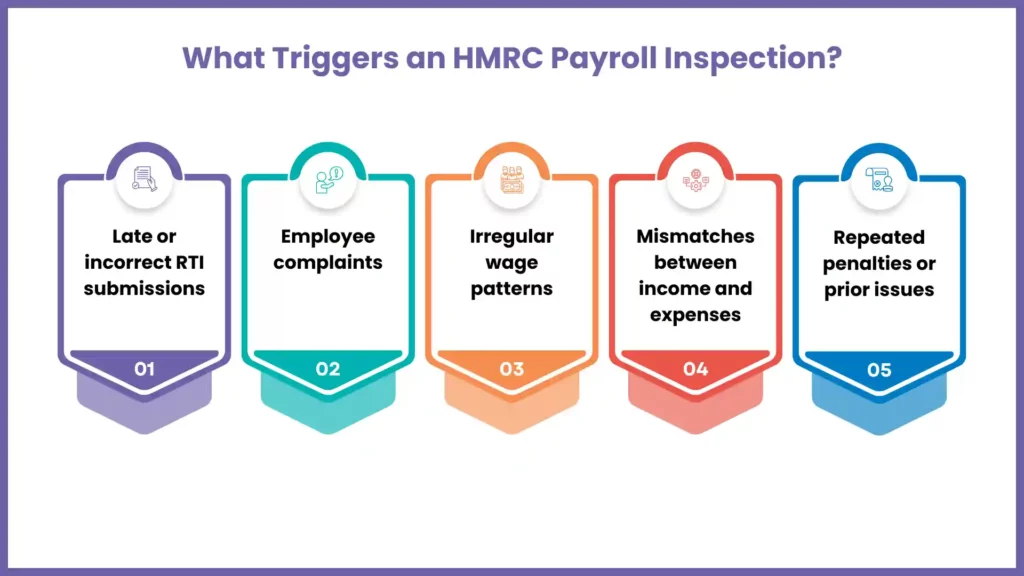
HMRC does not always act on suspicion. Sometimes businesses are selected at random. But most inspections are triggered by specific warning signs.
- Late or incorrect RTI submissions tell HMRC that your internal processes are unreliable. Frequent errors in your payroll reports put you on their radar.
- Employee complaints are taken very seriously, with HMRC following up in a jiffy. And if one of your employees rings up the National Minimum Wage helpline to complain, HMRC will take notice & take action.
- Irregular wage patterns attract attention when your declared wages look unusually low for your industry or headcount. HMRC’s analytics will pick up the discrepancy.
- Mismatches between income and expenses raise questions about undeclared cash payments when your declared revenue and employee costs do not balance in a logical way.
- Previous penalties put your business on a watchlist. Repeated non-compliance leads to more frequent and more thorough checks.
- Sector-based risk profiling means HMRC runs targeted campaigns in high-risk industries. If your sector is in scope, every business within it faces a higher inspection rate regardless of their individual track record.
What HMRC Checks During a Wage Raid
When officers arrive, they are looking for evidence of either compliance or non-compliance. Expect them to go through:
- Payslips for all employees
- PAYE and National Insurance records
- Employment contracts and starter checklists
- Timesheets and rota records
- National Minimum Wage calculations
- Holiday pay records
- Pension auto-enrolment documentation
- RTI submission history
- Cash payment records
Officers will also speak directly with employees, often in private, to confirm hours worked and wages received. These conversations can reveal discrepancies that paperwork alone would never show.
What Happens During an HMRC Payroll Check
Here is what a typical inspection looks like from start to finish.
Step 1: Arrival
Officers may either give you advance notice or arrive without warning. They will show their identification and explain their purpose. You have the right to see their credentials before anything happens.
Step 2: Document request
HMRC will request your payroll records right away. You can ask for a reasonable amount of time to gather everything, but taking too long may raise suspicions.
Step 3: Employee questioning
Officers might speak with employees privately to check details about their working hours, pay, and conditions. You cannot stop these conversations from happening.
Step 4: Inspection of records
Officers will compare your internal payroll data with your RTI submissions and look for any differences between the two.
Step 5: Initial findings
Before leaving, officers will typically provide a brief summary of what they found. A formal written report will come later.
Penalties and Consequences of Non-Compliance
HMRC and the Fair Work Agency actually run two separate penalty regimes, and it’s worth telling them apart rather than treating “the penalty” as one flat number.
National Minimum Wage underpayment
| Penalty Type | Detail |
| Financial penalty | 200% of the total underpaid amount per worker |
| Minimum charge | £100 per enforcement notice |
| Maximum charge | £20,000 per worker |
| Prompt payment discount | Penalty reduced by 50% of the amount shown on the notice if the employer pays all arrears to all named workers and 50% of the penalty within 14 calendar days of the date the notice is served |
| Appeal window | 28 calendar days to an employment tribunal |
| Backdated wages | Repaid at current rates, not historical rates |
| Public naming | Business listed on GOV.UK naming and shaming register |
| Legal action | Criminal prosecution in cases of deliberate or repeated fraud |
Separate PAYE and RTI inaccuracy penalties
| Type of behaviour | Unprompted disclosure | Prompted disclosure |
|---|---|---|
| Reasonable care | No penalty | No penalty |
| Careless | 0% to 30% | 15% to 30% |
| Deliberate | 20% to 70% | 35% to 70% |
| Deliberate and concealed | 30% to 100% | 50% to 100% |
HMRC can reduce the penalty further within these ranges depending on the “quality of disclosure”: up to 30% for telling HMRC about the inaccuracy, up to 40% for helping HMRC quantify it, and up to 30% for giving HMRC access to records. Criminal prosecution remains possible in cases of deliberate, repeated fraud.
Your Rights During an HMRC Wage Raid
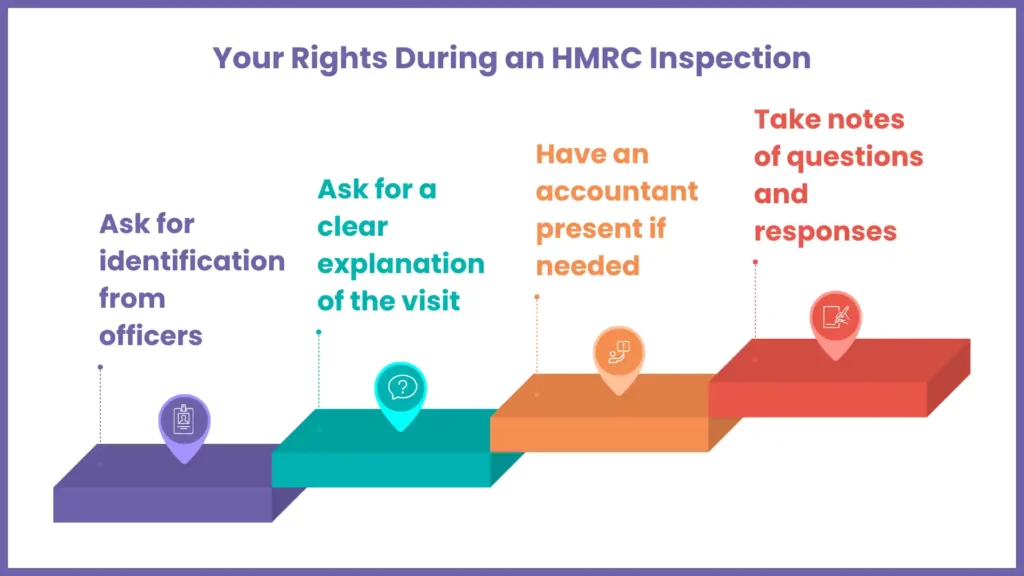
You do have rights. Use them calmly and professionally.
- You can ask for identification from every officer present before the inspection begins.
- You can ask for a clear explanation of what the visit is about and what records are being requested.
- You can have your accountant or business adviser present during the inspection. Ask for this immediately if they are not already on site.
- You can keep a written record of every question asked, every document shown, and every answer given.
- You can ask for a reasonable amount of time to locate documents.
What you cannot do is refuse access. Obstructing HMRC significantly increases your penalties and can turn a routine check into a full compliance audit.
Common Payroll Mistakes That Put You at Risk
Most businesses that fail HMRC checks are not deliberately cheating their workers. They make administrative mistakes, some of which carry the same penalties as intentional fraud.
The most common errors include:
Misclassifying employees as contractors:
If someone works regular hours under your direction, they are very likely an employee regardless of what their contract says.
Incorrect minimum wage calculations:
Deductions for uniforms, tools, or meals can push effective pay below the legal minimum.
Missing prep and travel time:
Time spent preparing for work or travelling between job sites often counts as working time for minimum wage purposes.
Using the wrong tax codes:
Emergency codes left in place for months create both compliance issues and cash flow problems.
Manual payroll errors:
Rounding mistakes, data entry errors, and missed rate updates stack up quickly in manual systems.
How to Reduce Your Risk Before HMRC Arrives
You cannot stop HMRC from visiting. But you can make sure there is nothing worth finding when they do.
Keep accurate, accessible records:
HMRC can examine up to six years of payroll history. Every payslip, contract, and timesheet needs to be stored securely and easy to retrieve at short notice. From 6 April 2026, this same six-year standard now also applies to holiday pay and annual leave records, following the Fair Work Agency’s expanded remit.
Run regular internal audits:
Review your payroll every quarter. Catching a mistake yourself and correcting it before HMRC finds it consistently results in a lower penalty than when HMRC discovers the same mistake first. When you audit, sample the lowest-paid workers first rather than the average, since that is where NMW exposure concentrates, and specifically test deductions and any salary sacrifice arrangements against the hourly floor, since these push otherwise-compliant pay below the legal minimum more often than the headline rate does.
Update your pay rates without delay:
The April 2026 National Living Wage is now £12.71 per hour for workers aged 21 and over, £10.85 for workers aged 18 to 20, and £8.00 for workers aged 16 to 17 and apprentices. If your payroll has not been updated to reflect these figures, you are already non-compliant. Build a process that applies new rates on the day they come into effect rather than getting around to it at some point later.
Use reliable payroll software:
Modern payroll systems apply rate changes automatically, flag errors before submission, and produce compliant payslips. Manual spreadsheets carry far greater risk.
Train anyone who touches payroll:
HR managers, line managers, and anyone responsible for timesheets needs to understand minimum wage rules, deduction limits, and what needs to be recorded.
Get professional help when you are unsure:
The cost of professional payroll support is a fraction of what a single HMRC penalty can cost you.
HMRC Payroll Compliance Checklist
Use this monthly to stay inspection-ready:
- RTI submissions filed on or before payday
- Pay rates updated to April 2026 NMW/NLW rates (£12.71, £10.85, £8.00)
- All employees issued correct, itemised payslips
- Timesheets capturing all working hours, including prep and travel time
- Employment contracts reviewed and up to date
- Pension auto-enrolment processed for all eligible workers
- Tax codes reviewed and corrected where needed
- No cash payments made outside the payroll system
- Payroll records retained and accessible for the last six years
- Holiday pay and annual leave records retained for six years (new from 6 April 2026)
- Deductions and salary sacrifice arrangements tested against the statutory minimum wage floor
- Workers who turned 18, 20 or 21 moved to the correct pay band from their next pay reference period
- Internal audit completed within the last quarter
What to Do If Your Business Is Selected for a Check
Notify your accountant or payroll advisor straight away. They should be with you during the inspection wherever possible. Ask officers to show identification and explain the scope of the visit. Hand over all requested documents without unnecessary delay. Write down everything that happens during the visit.
After the inspection, deal with any issues identified as quickly as you can. Responding quickly and voluntarily is the single most effective way to bring your penalties down.

Not sure if your payroll would pass an HMRC inspection?
Book a payroll compliance review with MyIVA today and make sure your business is fully protected before an inspection happens.
Frequently Asked Questions
Does HMRC warn you before a payroll check?
Not always. HMRC can arrive unannounced if they consider it urgent. For routine checks, you may get some notice beforehand, but enforcement visits often happen without any warning at all.
Can HMRC visit without permission?
Yes. HMRC has the legal right to enter your business and check payroll records. Refusing access makes things significantly worse and leads to heavier penalties.
How far back can HMRC check payroll?
For standard checks, HMRC can look back six years. If they suspect carelessness, the same six-year window applies. In cases of serious fraud, they can go back up to 20 years.
Do small limited companies get targeted?
Yes. Small limited companies, particularly those without payroll software, are very much on HMRC’s radar. They use data to identify businesses with problems, big and small alike.
Can HMRC question employees during an inspection?
Yes. HMRC officers can speak to your employees about their hours and pay. You are not permitted to prevent or interfere with those conversations.
What is the Fair Work Agency, and has it replaced HMRC for payroll checks?
Not yet in full. The Fair Work Agency launched on 7 April 2026 and holds strategic responsibility for National Minimum Wage enforcement, but HMRC officers are carrying out the actual day to day checks on the FWA’s behalf through the 2026/27 tax year. A full handover to the FWA directly is expected from April 2027. The FWA has also extended enforcement into holiday pay and Statutory Sick Pay, areas HMRC did not previously police as closely.
Conclusion
HMRC wage raid payroll checks are not going away. In fact, they are happening more often, relying more on data, and having greater consequences, and since April 2026 they increasingly sit alongside the Fair Work Agency’s wider remit over holiday pay and sick pay, not just wages. The businesses that face the largest penalties are seldom the ones that intend to cheat their workers. More frequently, they are the ones with flawed administrative processes, those that overlooked a rate update, or those that clung to a manual payroll system for too long.
The good news is that compliance is genuinely achievable. Accurate records, regular internal audits, and solid payroll support take away the risk almost entirely. A surprise HMRC visit stops being something to dread the moment your payroll is exactly where it should be.
Need help getting your payroll HMRC-ready?
Get in touch with MyIVA today and take payroll compliance off your worry list for good.