If you have ever spent your July frantically chasing receipts, calculating mileage, and double-checking health insurance premiums, you know the “P11D season” dread all too well. For decades, the P11D form has been the standard way for you to report benefits in kind (BiK) to HMRC. But the tide is turning. HMRC has announced a seismic shift in how benefits will be taxed, and for many business owners, the news that the P11D Abolished era is coming is a reason to both celebrate and prepare.
The way you handle employee benefits is going to change forever, starting from April 2027 when mandatory payrolling begins in two phases, running through to April 2028. This isn’t just a minor tweak to a form; it is a fundamental shift toward “payrolling benefits in kind”. In this guide, we will walk you through exactly what this means for you, your business, and your employees.
Introduction
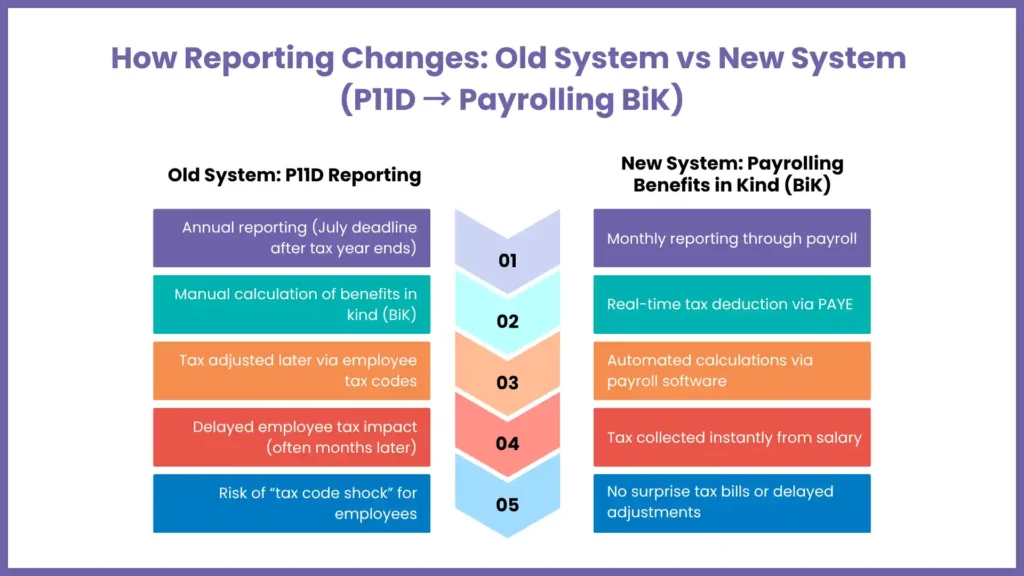
As an employer, you provide perks to attract and retain talent—company cars, private medical insurance, or even gym memberships. Currently, most of you report these at the end of the tax year using a P11D form. HMRC then adjusts the employee’s tax code to collect the tax due in the following year. It is a slow, retrospective system that often leads to “tax code shock” for your team.
The government’s plan to make payrolling mandatory is part of a wider drive to digitise the UK tax system. By integrating benefit taxation directly into your monthly payroll, HMRC aims to simplify the process, reduce administrative burdens, and ensure tax is paid in real-time. But while the goal is simplification, the transition requires your immediate attention.
Is the P11D being abolished?
The short answer is yes—but with a few caveats, and it’s happening in stages rather than all at once. HMRC has confirmed that the P11D Abolished timeline is set to begin in earnest from the 2026/27 tax year, running in two phases: phase 1 from 6 April 2027 (company cars, car fuel, vans, van fuel, and medical benefits), and phase 2 from 6 April 2028 (most remaining benefits). For the vast majority of benefits, the annual P11D form will be scrapped in favour of a digital-first, real-time reporting system through your payroll software, though the full transition won’t be complete until 2028. According to HMRC, this change means 3.5 million employees will stop having their Income Tax collected in arrears and will instead pay the right amount at the right time.
This change is designed to remove the need for you to file thousands of individual forms every July. Instead, the “cash equivalent” value of the benefit will be treated like salary, with Income Tax deducted at source every payday. While the form itself is going away for most, the obligation to calculate the value of those benefits remains firmly on your shoulders.
What’s changing, and when? (The Timeline)
Understanding the timeline is crucial so you aren’t caught off guard. Here is the roadmap for the transition:
- Current State (Voluntary Payrolling): Right now, you can already choose to payroll most benefits. If you register before the start of a tax year, you don’t have to file P11Ds for those specific benefits.
- The Announcement (January 2024): The government officially announced that the reporting and paying of Income Tax and Class 1A National Insurance Contributions (NICs) on benefits in kind will become mandatory via payroll software.
- April 2025 (Delay Confirmed): HMRC pushed the original April 2026 start date back to April 2027 to give employers, payroll providers, and software developers more time to prepare.
- 15 June 2026 (Phasing Announced): HMRC confirmed mandatory payrolling will now roll out in two phases rather than a single cutover.
- April 2027: Phase 1. Mandatory payrolling becomes the standard for company cars, car fuel, vans, van fuel, and employer-provided medical benefits. P11Ds are still required for 2026/27 (filed by 6 July 2027) for any benefits not yet payrolled.
- April 2028 — Phase 2. Most remaining benefits (gym memberships, non-cash vouchers, mobile phones outside the exemption, employer-provided childcare outside statutory exemptions, and similar) move to mandatory payrolling.
- Loans and accommodation: These stay outside mandatory payrolling for the time being. Voluntary registration to payroll them opens in November 2026, with a registration deadline of 5 April 2027. P11D and P11D(b) remain available for these two categories.
By April 2028, once both phases are complete, the traditional P11D cycle — reporting benefits months after the tax year has ended — will be a thing of the past for most UK businesses. Loans and accommodation will continue to follow the P11D process unless an employer voluntarily registers to payroll them.
What is “payrolling benefits in kind”?
If you aren’t already using it, payrolling benefits in kind is the process of calculating the tax due on a benefit and deducting it from your employee’s pay throughout the year.
Instead of an employee receiving a company car in June 2024 and not paying the tax on it until their tax code changes in 2025, you calculate the value of that car benefit monthly. You then add that “notional value” to their gross pay in your payroll software. The software calculates the tax on the total, deducts it from their actual cash pay, and sends it to HMRC via your Full Payment Submission (FPS).
The employee never “sees” the benefit money in their bank account, but they pay the tax on it instantly. This ensures their tax affairs are always up to date.
What stays the same (and what’s excluded)
While the headlines say the P11D Abolished era is here, some things are staying behind—at least for now. HMRC has historically found certain benefits difficult to pay via payroll due to their complexity.
The two benefits excluded from mandatory payrolling altogether are:
- Beneficial Loans: Loans provided to employees at low or no interest.
- Living Accommodation: Housing provided by the employer.
These two benefits involve values that fluctuate (loan balances, rental values) and don’t fit cleanly into a per-payroll calculation, so HMRC has kept them on the P11D process. Employers can choose to voluntarily payroll them instead — registration opens in November 2026, with a deadline of 5 April 2027 — but there’s no mandatory deadline for these two categories yet. However, for most businesses providing health insurance, cars, and fuel, the P11D is definitely on its way out, starting with phase 1 in April 2027. Additionally, you will still need to handle Class 1A NICs, though the method of payment is shifting toward the payroll system as well, in step with each phase.
What does this mean for employers?
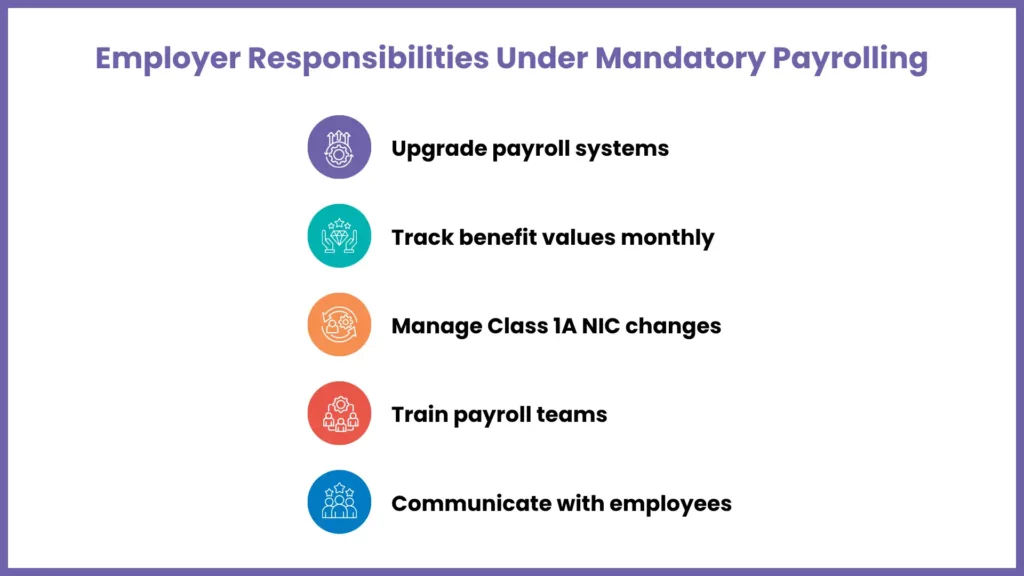
For you, the employer, this change is a double-edged sword. In the long run, it eliminates the “July rush” of P11D filings and the risk of late-filing penalties. However, it places a higher demand on your payroll accuracy.
You will need to:
- Upgrade Your Software: Ensure your payroll provider is ready for mandatory reporting.
- Review Benefit Data: You can no longer wait until the end of the year to calculate benefit values; you need that data ready every single month for whichever benefits fall into your phase.
- Manage Class 1A NICs: Currently, Class 1A NICs are paid annually. Under the new system, these will eventually be integrated into your regular payroll reporting, changing your monthly cash flow requirements.
- Track Which Phase Applies to Which Benefit: Because phase 1 and phase 2 cover different benefits, you may be running payrolled reporting for some benefits (like cars) while still filing P11Ds for others (like gym memberships) during 2027/28. Keeping this split straight will matter for compliance.
What this means for employees
Your employees will likely appreciate the change once they understand it. The biggest benefit for them is the end of “unexpected tax bills”.
Under the old P11D system, if an employee received a new benefit mid-year, they might end up underpaying tax for months before HMRC caught up. This often resulted in a “Week 1/Month 1” tax code or a significant deduction from their take-home pay the following year to make up the deficit. With mandatory payrolling, they pay the right amount of tax, at the right time, every time — though employees should be warned that during the transition, they may see tax deducted both in real time for the current year’s benefits and as a correction for underpayments from a previous year, which can look like double taxation on a payslip even though it isn’t.
How to prepare now (employer checklist)
Don’t wait until March 2028 to start thinking about this. Here is your proactive checklist:
- Audit Your Benefits: List every benefit you provided, and map each one to phase 1 (2027) or phase 2 (2028). Identify which ones are currently excluded (like loans) and which will move to payroll.
- Speak to Your Provider: Ask your payroll software provider or accountant about their roadmap for mandatory payroll.
- Clean Your Data: Ensure you have accurate, up-to-date information on car CO2 emissions, insurance premiums, and other BiK values.
- Communicate: Start telling your employees now. They need to know why their “Taxable Pay” on their payslip might look higher than their actual salary.
- Consider Early Adoption: You don’t have to wait. You can register for payroll benefits voluntarily for the next tax year to get ahead of the curve.
Will there be penalties during the switch?
HMRC has confirmed a degree of leniency for the first year of mandatory payrolling. According to BDO’s analysis of HMRC’s position, HMRC will not charge penalties for inaccuracies in payrolling benefits during 2027/28, provided non-compliance isn’t deliberate. That leniency covers mistakes, not failure to comply altogether, so employers who make no effort to pay the relevant benefits by their phase deadline shouldn’t assume they’re protected. Outside that grace period, the usual penalties for inaccurate or late Full Payment Submissions apply, along with interest on unpaid tax.
Do you still need to file a P11D before April 2027?
Yes! Until your benefits move into mandatory payrolling, you must continue with your current reporting obligations. If you are not yet registered for voluntary payrolling, you must file your P11Ds and your P11D(b) by July 6th following the end of each tax year — and even after phase 1 begins in April 2027, you’ll still need to file P11Ds for any benefits that fall into phase 2 (2028) or that remain excluded altogether (loans and accommodation). Skipping this because you “heard the P11D was abolished” will lead to immediate fines.
How MyIVA Can Help
Mandatory payrolling touches payroll, HR, and finance all at once, and it’s easy for the details to slip through the cracks of a busy year. If you’re not sure which of your benefits fall into phase 1 or phase 2, or how to get your payroll software and data ready in time, it’s worth talking it through with an accountant before the deadlines arrive.
MyIVA’s payroll services can help you map your current benefits against the new phases, check your software is reporting correctly, and keep your wider accounting and filing obligations on track at the same time. Speak to MyIVA today for straightforward, practical advice on getting your business ready for mandatory payrolling — and on keeping the rest of your accounting and filing obligations on track at the same time.

Don’t Get Caught Out When the P11D Disappears
Miss your phase deadline, and you could face HMRC penalties, interest on unpaid tax, and a payroll system that’s reporting the wrong figures every month. Talk to an accountant at MyIVA about your payroll services now, before mandatory payroll catches your business off guard.
FAQs: Frequently Asked Questions
Is the P11D being scrapped completely?
For most benefits, yes, though on a phased timeline. It’s being replaced by mandatory payrolling of benefits in kind, rolled out in two phases (2027 and 2028). Loans and accommodation will keep using the P11D process for the foreseeable future.
When exactly does payrolling become mandatory?
Phase 1 begins 6 April 2027, covering company cars, car fuel, vans, van fuel, and medical benefits. Phase 2 begins on 6 April 2028, covering most remaining benefits. Loans and accommodation are excluded from mandatory payrolling for now.
Do I need to register for payroll benefits?
For benefits covered by mandatory payrolling, no registration is required once your phase begins. If you want to voluntarily take out payroll loans or accommodation, you’ll need to register— registration for this opens in November 2026, with a deadline of 5 April 2027.
What happens to the P11D(b) and Class 1A NIC?
The P11D(b) is the form used to report the total Class 1A NICs you owe. HMRC’s goal is to move the reporting and payment of Class 1A NICs into the payroll system itself, in step with each phase, removing the need for the annual P11D(b) form for benefits that have moved to mandatory payrolling.
Will employees pay more tax under the new system?
No, the amount of tax doesn’t change. What changes is the timing. They will pay the tax as they receive the benefit rather than in a lump sum or via a tax code change later on.
Do loans and accommodation still go on a P11D?
Yes. These two benefits are excluded from mandatory payroll and will continue to follow the P11D and P11D(b) process unless an employer chooses to voluntarily payroll them instead.
Conclusion
The era of the P11D is reaching its sunset. While the transition to mandatory payrolling of benefits in kind might seem daunting, it is ultimately a step toward a more efficient, transparent, and real-time tax system. By preparing your software, your data, and your staff now, you can turn a looming deadline into a seamless transition — even though that transition now happens in two stages rather than one.
Ready to get your finances in order before the big changes hit? Contact MyIVA UK today for a free consultation on managing your financial future and staying ahead of the curve. Don’t let tax changes catch you off balance—take control now!