Managing corporate financial obligations in the UK requires meticulous forecasting and strict adherence to HM Revenue & Customs (HMRC) deadlines. For small and medium-sized enterprises (SMEs), Corporation Tax is traditionally due in a single lump sum nine months and one day after the end of the accounting period. However, as businesses grow, their tax payment schedules accelerate significantly.
Enter Quarterly Instalment Payments (QIPs). Designed for large and very large companies, the QIP system requires corporate taxpayers to pay their Corporation Tax in four estimated instalments throughout the year rather than after the year-end. Navigating this regime can be daunting—especially following recent updates to associated company rules and shifting interest rate penalties from HMRC.
At MyIVA UK, we work with business owners and corporate leaders to ensure tax compliance, safeguard cash flow, and navigate corporate debt liabilities effectively. In this guide, we provide a complete breakdown of quarterly instalment payments for Corporation Tax, explaining who is affected, how to calculate your payments, exact instalment dates, and practical strategies to avoid costly HMRC penalties.
What are Quarterly Instalment Payments (QIPs)?
Quarterly Instalment Payments (QIPs) are the mechanism through which HM Revenue & Customs collects quarterly instalment payments for corporation tax from larger UK businesses. Instead of enjoying a nine-month settlement buffer after the financial year ends, qualifying companies must make payments on account during the current accounting period based on estimated profits.
The fundamental purpose of QIPs is to bring tax collection closer to the point at which corporate profits are earned. Under Corporation Tax Self Assessment (CTSA), affected companies must forecast their annual taxable profits before the year has even closed.
Key features of the QIP regime include:
- Estimated Liabilities: Payments are calculated on projected taxable profits (net of allowable deductions, losses, and reliefs).
- In-Year Settlement: The first two quarterly payments for large companies are due before the accounting period actually finishes.
- Tiered Framework: UK tax law separates businesses into two main instalment regimes—”Large” and “Very Large”—each with its own distinct payment schedule.
- Strict Adjustment Rules: If projected profits change during the year, companies must adjust subsequent payments to keep their total paid in line with updated estimates.
Do QIPs apply to your company?
Whether your company falls into the QIP regime depends primarily on your annual taxable profits, the length of your accounting period, and the number of associated companies connected to your business.
1. The Large Company Threshold (£1.5 Million)
A company is classified as “Large” if its annual taxable profits exceed £1.5 million for a 12-month accounting period.
- Large companies pay Corporation Tax in four equal instalments, starting mid-way through their accounting period.
2. The Very Large Company Threshold (£20 Million)
Introduced to accelerate tax collections from major corporations, a company is classified as “Very Large” if its annual taxable profits exceed £20 million.
- Very Large companies face an accelerated payment timeline, with their first instalment due just two months and 14 days into the accounting period.
The Grace Period (“First-Year Exception”)
To prevent growing businesses from being caught off guard by sudden cash flow demands, HMRC provides a relief rule known as the grace period. A company that crosses the £1.5 million profit threshold will not be required to pay by quarterly instalments in that first year, provided:
- Its taxable profits for the current accounting period do not exceed £10 million.
- It was not classified as a large company in the preceding accounting period.
If your company’s profits exceed £10 million in a single year, the grace period is bypassed immediately, and QIPs apply for that year. Note that all threshold limits (£1.5m, £20m, and £10m) are proportionately reduced if your accounting period is shorter than 12 months or if you have associated companies.
Quarterly Instalment Payment Dates for Large and Very Large Companies
Understanding quarterly instalment payments dates is essential to avoiding late payment interest and non-compliance penalties. Payment schedules differ depending on whether your business is classified as Large or Very Large.
Payment Schedule for Large Companies
For a standard 12-month accounting period, a large company must make four equal payments on the following dates:
- Instalment 1: 6 months and 13 days after the start of the accounting period.
- Instalment 2: 3 months after the first payment (9 months and 13 days after the start).
- Instalment 3: 3 months after the second payment (14 days after the end of the accounting period).
- Instalment 4: 3 months after the third payment (3 months and 14 days after the end of the accounting period).
Payment Schedule for Very Large Companies
Very Large companies follow a significantly faster timeline, requiring all four payments to be settled before or immediately at the conclusion of the accounting period:
- Instalment 1: 2 months and 13 days after the start of the accounting period.
- Instalment 2: 3 months after the first payment (5 months and 13 days after the start).
- Instalment 3: 3 months after the second payment (8 months and 13 days after the start).
- Instalment 4: 3 months after the third payment (11 months and 13 days after the start).
Comparison Table: 12-Month Accounting Period (1 January – 31 December)
| Instalment | Large Company (£1.5m – £20m) | Very Large Company (> £20m) |
| 1st Payment | 14 July (Month 7) | 14 March (Month 3) |
| 2nd Payment | 14 October (Month 10) | 14 June (Month 6) |
| 3rd Payment | 14 January (Month 13 / Day 14 post-year) | 14 September (Month 9) |
| 4th Payment | 14 April (Month 16 / Month 3.5 post-year) | 14 December (Month 12) |
Worked example: how the threshold divides between associated companies
A critical area where finance teams make errors is failing to account for associated companies. Effective from 1 April 2023, HMRC re-introduced the associated company rules (replacing the previous 51% related group company rules).
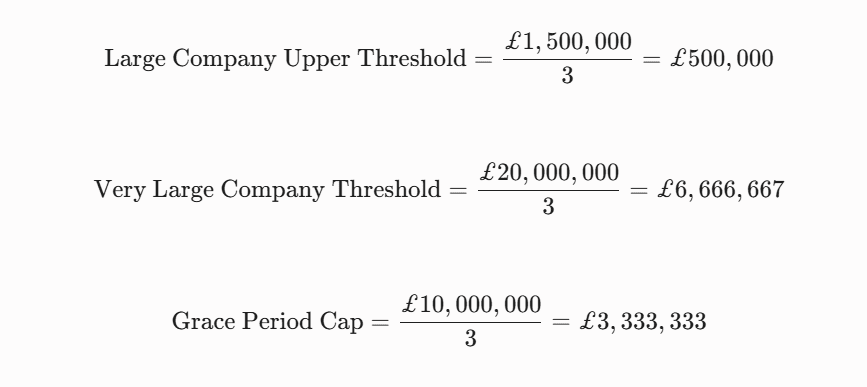
Under these rules, the profit thresholds (£1.5 million, £10 million, and £20 million) are divided equally by 1 + the total number of associated companies worldwide.
Example Scenario
Consider Apex Holdings Ltd, a UK trading company operating a standard 12-month accounting period ending 31 December. Apex Holdings is owned by an individual who also controls two other active trading companies in the UK and overseas.
- Total associated companies = 2
- Total divisor (Apex Holdings + 2 associated companies) = 3
Let’s look at how the thresholds adjust for Apex Holdings:
Impact on Tax Obligations
If Apex Holdings achieves taxable profits of £750,000 for the financial year:
- In isolation, £750,000 is below the £1.5 million limit.
- However, because the threshold is divided by 3, the adjusted limit is £500,000.
- Because £750,000 exceeds £500,000, Apex Holdings is classified as a Large Company and must pay corporation tax quarterly payments. If Apex Holdings was also large in the prior year, it cannot claim the grace period and must make QIP payments on account.
What happens if you miss a payment or get the estimate wrong?
Because quarterly instalment payments rely on forward-looking estimates, HMRC recognizes that actual corporate profits fluctuate due to market shifts, unexpected expenses, or seasonal variations. However, failing to pay or underestimating payments carries distinct financial costs.
1. Interest Accumulation
HMRC automatically calculates interest on underpaid quarterly instalments. If your estimated instalments fall short of your actual final tax liability, interest charges accrue on the underpaid portion from the date the instalment was due until the balance is cleared.
2. Penalty Charges
HMRC retains statutory powers to impose penalties if a company:
- Deliberately underpays its quarterly instalments.
- Submits intentionally low profit estimates to defer cash outflows.
- Fails to make instalment payments altogether despite knowing it falls within the QIP regime.
Penalties are levied in addition to standard late payment interest and can mount rapidly if HMRC determines that non-compliance was deliberate or careless.
Correcting Mid-Year Estimations
If you discover during Q3 or Q4 that your company’s annual profit will be higher than originally predicted, you should make an immediate “top-up” payment. You do not need to wait for the next scheduled instalment date to pay excess tax; submitting top-up payments as soon as projections change halts the accrual of debit interest.
HMRC Interest Rates on Quarterly Instalment Payments
Understanding hmrc interest rates quarterly instalments payments is crucial for maintaining corporate cost controls. Interest rates charged by HMRC are directly linked to the Bank of England base rate, making underpayment significantly more expensive during tight economic periods.
Late Payment Interest Structure
HMRC applies two distinct interest tiers for Corporation Tax underpayment:
- Instalment Interest Rate (Within the Accounting Year):
Charged on underpaid QIPs from the instalment due date up until the normal Corporation Tax due date (9 months and 1 day post year-end). This rate is set at the Bank of England base rate plus a statutory margin. - Main Late Payment Interest Rate (Post Normal Due Date):
If tax remains unpaid after 9 months and 1 day following the end of the accounting period, the interest rate escalates sharply. Following legislative updates, main late payment interest is charged at the base rate plus 4%.
Repayment Interest (Overpayments)
If your estimated QIPs exceed your final calculated tax liability, HMRC pays repayment interest on the excess funds returned to you. However, the repayment interest rate is set significantly lower than the late payment rate (typically base rate minus 1%).
Because HMRC penalises underpayment far more heavily than it rewards overpayment, maintaining precise, quarterly management accounts is essential for tax efficiency.
Managing cash flow with Group Payment Arrangements (GPA)
For business structures operating multiple companies within the UK, managing individual quarterly instalment payments for each entity creates major administrative overhead and cash flow friction. To streamline this, HMRC allows eligible corporate groups to enter into a Group Payment Arrangement (GPA).
How a Group Payment Arrangement Works
A GPA allows a nominated group company to make a single, consolidated QIP payment on behalf of all participating group members each quarter.
Key operational benefits include:
- Simplified Administration: One consolidated payment replaces multiple individual corporate tax transfers.
- Interest Offsetting: When actual liabilities are finalized after year-end, overpayments made by one group company can automatically offset underpayments made by another. This eliminates unnecessary HMRC interest charges across the group structure.
- Flexible Allocation: The group can allocate the paid tax pool among participating entities in the most tax-efficient manner before final submissions.
Eligibility Criteria for GPAs
To establish a Group Payment Arrangement, companies must meet specific HMRC requirements:
- Participating entities must be parent/subsidiary companies or under common corporate control.
- All participating group companies must share the exact same accounting period end date.
- Companies must be up-to-date with historical Corporation Tax filings and payments.
- The GPA contract must be formally executed with HMRC at least one month prior to the first QIP instalment due date for the accounting period.
FAQs: Frequently Asked Questions
What counts as an associated company for QIP purposes?
A company is considered an associated company if one company has direct or indirect control of the other, or if both companies are under the common control of the same person or group of persons (such as business partners or close family members). Associated companies worldwide are counted, regardless of where they are incorporated or tax-resident. Non-trading or dormant companies that carry on no business activity during the period are excluded from the calculation.
What is the £1.5 million threshold based on, exactly?
The £1.5 million threshold is based on your company’s taxable total profits plus any exempt distributions received from non-group companies (ABGH distributions). Taxable total profits include net trading profits, commercial investment income, capital gains, and dividend income from non-group sources.
Do QIPs apply if my company only just crossed the threshold?
Generally, no—thanks to the “grace period”. If your company was not classified as large in the preceding accounting period, you are exempt from QIPs in the first year your profits exceed £1.5 million, provided your profits do not exceed £10 million (or the adjusted threshold based on associated companies). If profits exceed £10 million, QIPs apply immediately.
Is there a minimum tax liability below which QIPs do not apply?
Yes. If a large company’s total Corporation Tax liability for a 12-month accounting period is less than £10,000, it is exempt from making quarterly instalment payments. In this scenario, the tax liability is paid under standard rules (nine months and one day post year-end). The £10,000 limit is proportionately reduced for short accounting periods.
What happens if I overpay an instalment?
If you realize during the year that earlier QIP instalments were higher than necessary, you can reduce subsequent instalment payments to balance your total contributions. Alternatively, you can apply to HMRC for an immediate repayment of the overpaid tax before the year ends, provided you present detailed management accounts proving the overpayment.
Can associated companies pay their instalments together?
Yes. Associated companies that form a qualifying corporate group can apply for an HMRC Group Payment Arrangement (GPA). A GPA enables the group to make single, combined quarterly payments and offset overpayments against underpayments across entities.
How to Calculate Your Quarterly Instalment Payments
Learning how to calculate quarterly instalment payments involves a straightforward four-step process:
Estimate Total Tax Liability (CT): Forecast your total taxable profits for the 12-month period and apply the applicable UK Corporation Tax rate (e.g., 25% main rate), taking into account capital allowances, reliefs, and deductions.
Determine Payment Portions: Divide the projected total liability by 4. Each instalment equals 25% (CT / 4) of the total estimated annual tax bill.
Re-evaluate Every Quarter: At each instalment deadline, recalculate your expected total annual liability based on up-to-date year-to-date management figures.
Adjust Subsequent Payments: Apply the standard formula for instalment i= (1, 2, 3, or 4):
Example: If your estimated annual tax is £400,000, instalment 1 is £100,000. If at Q2 your annual estimate increases to £480,000, your required cumulative total at Q2 is £240,000 (50% of £480,000). Having already paid £100,000, your second instalment will be £140,000.
Conclusion
The Quarterly Instalment Payments regime represents a significant operational transition for expanding businesses. Crossing the £1.5 million threshold requires moving from retroactive tax settlement to proactive financial forecasting. Failing to monitor associated companies, missing key instalment dates, or incorrectly calculating projected liabilities can quickly lead to substantial HMRC interest costs and penalties.
To safeguard corporate liquidity and maintain compliance:
- Review your associated company network annually to establish correct profit thresholds.
- Implement robust quarterly management reporting to adjust profit forecasts dynamically.
- Explore administrative tools like Group Payment Arrangements if managing multiple entities.
At MyIVA UK, we understand how rapidly shifting tax liabilities and cash flow constraints can impact commercial stability. Whether you need assistance structuring corporate debt, resolving HMRC arrears, or managing working capital pressures, our financial restructuring experts are here to help. Contact MyIVA UK today to discuss your business options and secure your financial peace of mind.