



A P800 is a tax calculation issued by HMRC that shows whether you’ve overpaid or underpaid income tax in the UK. The form is sent annually to millions of UK employees, pensioners, and others who pay tax through the PAYE system, usually between June and November following the end of the tax year.
Understanding your P800 is key to knowing how much tax you actually owe or are owed. The UK tax system can feel complex, with its codes, forms, and acronyms, and the P800 sits at the centre of HMRC’s annual reconciliation for many taxpayers. Whether it arrives as a paper letter or a notification in your Personal Tax Account, it can bring either a welcome refund or a bill for underpaid tax.
At MyIVA, we understand that financial clarity is the first step toward stability. Whether you are due a P800 tax refund or have been notified about underpaid tax, understanding this document is essential. In this comprehensive 2026 guide, we will break down everything you need to know about the P800 form explained for UK taxpayers.
What Is a P800 Tax Calculation?
A P800 is a formal tax calculation that is submitted by HM Revenue and Customs (HMRC). Neither is it a bill, nor is it a mere receipt. Rather, it is a result of HMRC’s annual reconciliation process.
Each year, HMRC reviews the records of your earnings in the form of employment, pensions, and state benefits and compares them with the amount of tax you actually paid using the Pay As You Earn (PAYE) system. In case if the numbers do not match with their records, i.e., you either overpaid or underpaid, a P800 is issued by HMRC.
With an increasing number of automated systems in 2026, the P800 tax calculation will still be the most common method used by HMRC to inform taxpayers of discrepancies not covered by the Self Assessment framework. It serves as the “final word” for the previous tax year for millions of UK employees.
Why You Might Receive a P800 from HMRC
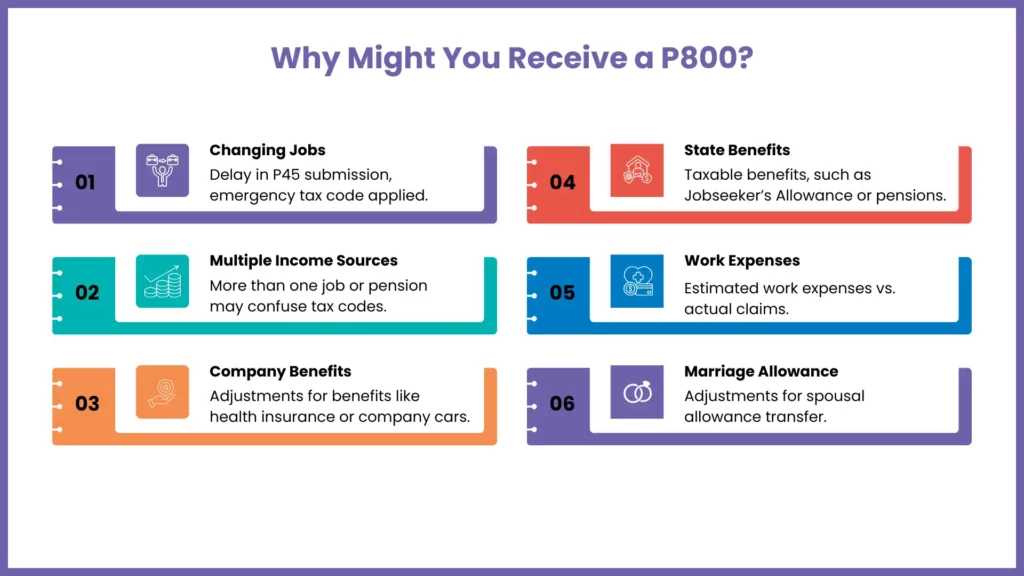
The PAYE system is set in such a way that it collects the right amount of tax throughout the year and distributes this tax among your paychecks. But that is not always the case in the real world. Some of the subtle causes of your tax account being out of balance are:
Changing Jobs Frequently: Provided you started a new job, and your former employer was slow to provide you with a P45, your new employer may have applied an emergency tax code. This often results in an overpayment of tax.
Multiple Income Sources: Having more than one job or receiving a private pension alongside a salary can confuse the tax code allocation. HMRC may inadvertently apply your full Personal Allowance to both jobs, leading to underpaid tax.
Variable Company Benefits: When you were given taxable benefits (such as a company car, personal medical insurance, or fuel card) and the value of those benefits increased or decreased during the year, your tax code may not have kept pace in time.
State Benefits: It is a fact that not all people are aware of the state benefits, including the Jobseeker Allowance or the taxable component of the state pension, which is taxed. Unless you include these in your PAYE code, a P800 will be invoked.
Work Expenses: In case you have claimed tax relief on work expenses (such as uniform laundry, professional subscriptions, or travel) but you have estimated them instead of actuals, a reconciliation will be required.
Marriage Allowance: The transfer of the personal allowance of £1,260 between spouses may lead to an imbalance in the year in which the marriage allowance was claimed or cancelled.
When Do HMRC Send Out P800 Forms?
In the UK, the tax year runs from April 6th to April 5th the following year. HMRC begins its “reconciliation” process once it receives all the necessary data from employers and pension providers (usually via P14 and P60 submissions).
Typically, the HMRC P800 letter is sent out between June and the end of November.
In 2026, the process is heavily digitized. If you have a Personal Tax Account, you might receive a notification as early as June. If you still rely on paper records, the letter may arrive closer to autumn. If you haven’t received one by December but believe your tax is wrong, it is usually time to take proactive steps.
What Information Is Included on a P800?
A P800 is a detailed breakdown of your financial year. It is divided into clear sections to help you verify the data:
- Total Income: Your total income lists every penny you earned from all employers, pension providers, and taxable state benefits.
- Tax-Free Allowance: The tax-free allowance is a section that shows your Personal Allowance (the amount you can earn before paying tax, which is £12,570 for the 2025/26 and 2026/27 tax years) plus any additional allowances or reliefs.
- Tax Paid: The tax paid section is the most important figure for your reconciliation. It is the total amount of tax deducted from your paychecks throughout the year.
- The Calculation: This is the “math” section. It subtracts your allowance from your income to find your “taxable income,” applies the relevant tax bands (20%, 40%, or 45%), and compares that result to what you actually paid.
- The Result: The form will conclude with a clear summary:
- Overpaid: You are due a P800 tax refund.
- Underpaid: You have underpaid tax that HMRC needs to collect.
- Correct: No further action is needed.
What To Do If You Receive a P800
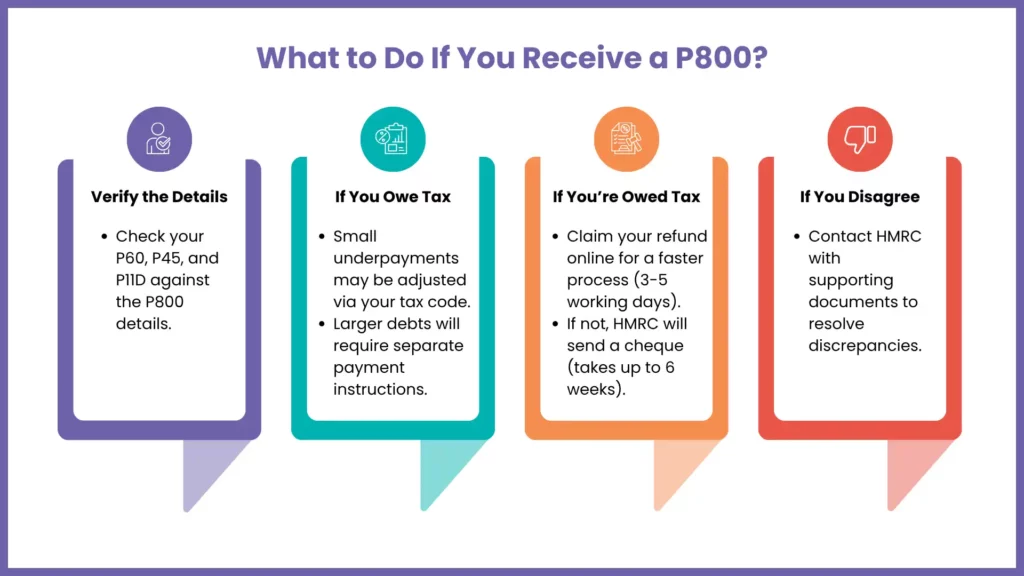
When an HMRC P800 letter arrives, it is vital to act quickly. The steps you take depend entirely on the outcome of the calculation.
1. Verification is Key
Before accepting the result, cross-reference the P800 with your own documents.
- Check the “Total Income” against your P60 (issued by your employer in May).
- Check any P45s if you left a job during the year.
- Check your P11D if you receive company benefits.
2. If You Owe Tax (Underpayment)
HMRC usually collects small underpayments (typically under £3,000) by adjusting your tax code for the following year. This is known as “coding out” the debt. You won’t have to pay a lump sum; instead, a small extra amount will be deducted from your salary each month starting next April.
However, if the amount is large or you no longer work under PAYE, HMRC will send a letter explaining how to pay the bill online or via a payment plan.
3. If You Owe Tax (Refund)
If you are lucky enough to be due a P800 tax rebate, the letter will specify if you can claim it online or if it is on its way via cheque.
4. If You Disagree
If you find a P800 incorrect calculation, do not pay it and do not claim the refund. Contact HMRC via their helpline or digital assistant to provide the corrected figures.
P800 Refund – How to Claim Your Tax Rebate
In 2026, claiming an overpaid tax refund nationwide in the UK has become more streamlined. There are two primary routes to getting your money back:
The Digital Route (Fastest)
If your P800 says you can claim online:
- Log onto your Personal Tax Account on GOV.UK or use the official HMRC app.
- Navigate to the “Check your taxes” section.
- Follow the prompts to claim your refund.
- Enter your bank’s sort code and account number.
- Timing: The money usually reaches your bank account within 3 to 5 working days.
The Automated Route (Cheque)
If you do not claim online within 21 days of the P800 issue date, HMRC will default to sending a paper check (payable order).
- The cheque is sent to the address HMRC has on file for you.
- Timing: This can take up to 6 weeks to arrive.
- Important: Ensure your address is updated in your tax account, or the cheque may be lost in the post.
Can You Claim a Tax Refund Without a P800?
Many taxpayers wait for the P800 to arrive like a letter from a long-lost relative, but you don’t have to. You can trigger a P800 refund early if you are certain you’ve overpaid. Common scenarios for proactive claims include:
- Professional Fees: If you pay for your own professional body memberships or trade union fees that are necessary for your job.
- Working from Home: While the rules have become stringent since the pandemic, some employees can still claim relief for additional household costs if they are required to work from home.
- Uniform Maintenance: If you wear uniform or protective clothing and have to wash it yourself at home, you can claim a flat-rate deduction.
- Mileage: If you use your personal vehicle for business travel (excluding your commute) and your employer pays less than 45p per mile.
By submitting a P87 form online, you can claim these expenses, which will either result in an immediate refund or a change in your tax code to give you more take-home pay.
What If Your P800 Is Wrong?
P800 incorrect calculation is not a rare occurrence. It usually stems from “dirty data”—information that is either missing, duplicated, or outdated.
Common Scenarios for Errors:
- Dual-Employment Confusion: If you switched jobs in the middle of a month, HMRC might accidentally count your monthly salary from both jobs as your “regular” monthly income, pushing you into a higher tax bracket incorrectly.
- The “Zombie” Benefit: This happens when a benefit (like health insurance) ended in a previous tax year, but the employer failed to notify HMRC, so it continues to be deducted from your allowance.
- Incorrect Personal Allowance: If you are entitled to the Blind Person’s Allowance or have a complex Marriage Allowance transfer, these are often missed in automated calculations.
How to Fix It:
Do not simply call and say, “it’s wrong.” You need evidence. Have your P60 and bank statements ready. You can use the HMRC digital assistant to upload documents, or you can call the PAYE helpline. In many cases, providing the correct “Total Taxable Pay” figure is enough for the advisor to trigger a revised P800.
P800 vs P60 vs P45 – What’s the Difference?
To manage your taxes effectively, you need to understand the “Big Three” of tax paperwork. At MyIVA, we find that many clients get overwhelmed by these forms, but they each serve a distinct purpose:
| Form | What is it? | When do you get it? | Why does it matter? |
| P45 | Your “leaving” document. | When you quit or are let go from a job. | It tells your next employer how much you’ve earned so far this year, so they can tax you correctly. |
| P60 | Your “End of Year” certificate. | Every May (if you are still employed on April 5th). | It is your legal proof of how much tax you paid. You need this to verify your P800. |
| P800 | Your “Reconciliation” | Between June and November. | It is the final verdict from HMRC on whether your P60 figures match their expectations. |
Should You Hire a Tax Accountant for a P800?
For the vast majority of UK taxpayers, a P800 is a DIY task. The HRMC online portal is designed to be user-friendly; also, claiming a tax refund is as simple as a few clicks. However, there are specific circumstances where professional advice is invaluable:
- High Earners: If you earn over £100,000, your Personal Allowance starts to taper away. This calculation is notoriously complex and often leads to P800 errors.
- Complex Benefits: If you have a sophisticated “Salary Sacrifice” scheme for pensions or electric vehicles, the P800 may not reflect the nuances of these agreements.
- Debt Concerns: If you receive a P800 stating you owe thousands of pounds in underpaid tax and you are already struggling with credit cards or loans, this can be the breaking point.
At MyIVA, we specialise in helping people manage their total financial health. An unexpected tax bill can be a significant stressor. If a P800 reveals a debt you cannot pay, a professional can help you negotiate a “Time to Pay” arrangement with HMRC or look at how this tax debt fits into a wider debt management plan like an MyIVA.
FAQs: Frequently Asked Questions
Can I view my P800 online?
Yes! In fact, HMRC prefers it. You can check P800 online by logging into your Government Gateway account. This is the safest way to ensure you are dealing with official documents and not a scam.
What if I didn’t receive a P800 but think I’m owed tax?
HMRC processes millions of records, and yours might be at the end of the queue. If you haven’t heard anything by December, use the “Claim a tax refund” tool on GOV.UK. You will need your P60 figures to complete the check.
I’ve received more than one P800 — what does this mean?
This is usually because HMRC received “supplementary” information. Perhaps your pension provider sent their data after your employer did. The most recent P800—the one with the latest date—is the one that matters.
Can I get a P800 if I’m self-employed?
No. If you are self-employed, you are responsible for your own “reconciliation” via your annual Self Assessment tax return. You will only get a P800 if you have a separate job where you are an employee.
Is a P800 always correct?
Unfortunately, no. HMRC is only as good as the data it receives. Always verify the “Income” and “Tax Paid” lines against your P60.
Is a P800 the same as a tax return?
No. Think of a tax return as a report you give to HMRC, and a P800 as a report HMRC gives to you.
How do I read my P800 tax calculation?
A P800 shows your total income, tax‑free allowance, tax paid, and the final result.
Total income: all PAYE‑based earnings and taxable benefits.
Tax‑free allowance: your Personal Allowance plus any extras.
Tax paid: total tax deducted during the year.
Result: overpaid (refund due), underpaid (tax to collect), or correct (no action).
Can pensioners get a P800 tax calculation?
Yes. Many UK pensioners receive a P800 if their state or private pension is taxed through PAYE and HMRC spots an overpayment or underpayment of tax.
Conclusion
The P800 form is more than just a piece of mail; it is a vital check-and-balance in the UK’s financial system. Whether it brings the welcome news of an overpaid tax refund UK or the challenge of underpaid tax HMRC requires back, staying informed is your best defense.
By understanding the difference between a P800 vs P60, knowing how to check a P800 online, and being aware of the common reasons for a P800’s incorrect calculation, you put yourself in the driver’s seat of your financial life.
If you find that tax discrepancies are contributing to a larger cycle of debt, don’t face it alone. At MyIVA, we are dedicated to helping UK residents find the right path to financial freedom. Whether it’s tax advice or debt restructuring, we are here to help you manage the complexities of 2026’s financial landscape.
Do you have a tax bill to pay or a debt that is building up? Contact MyIVA now and get a discreet consultation and make the first step to peace of mind.


