


Hiring an external professional to manage a company’s financial records, including transaction processing, reconciliations, and reporting, is known as outsourced bookkeeping. Time-consuming bookkeeping duties, growing expenses, mistakes, and meeting compliance standards are problems that many small businesses face.
Let’s understand more with a short story,
Take James, a small business owner who started with minimal resources. Doing his own bookkeeping was manageable at first, but managing invoices, expenses, reports, and reconciliations began eating into his week. To preserve accurate records, improve his financial visibility, and focus on growing the business, he outsourced bookkeeping, and got both cleaner books and his time back.
This guide covers what outsourced bookkeeping is, how it works, and the advantages it offers small businesses.
What Is Outsourced Bookkeeping?
Outsourced bookkeeping is when you hire an external firm or remote bookkeeper to manage your financial records instead of employing someone in-house. They record transactions, reconcile your accounts, run reports, and keep your books tax-ready, working inside your accounting software, on a fixed monthly fee.
Cloud accounting changed what’s possible here. Your bank feeds sync automatically, receipts get captured by phone, and your bookkeeper works in the same QuickBooks Online or Xero file you can open at 11pm from your kitchen. Nobody is mailing shoeboxes anymore.
That’s why virtual bookkeeping services now serve everyone from solo consultants to $10M e-commerce brands. The work is the same. The delivery model is just cheaper and faster.
Outsourced Bookkeeping vs. In-House Bookkeeping
Most owners aren’t choosing between outsourcing and nothing, they’re choosing between outsourcing, hiring someone, and doing it themselves at 10pm.
| Factor | DIY (You Do It) | In-House Bookkeeper | Outsourced Bookkeeping |
| Monthly cost | “Free” — but 8–20 hours of your time | Salary + payroll taxes + benefits + software + PTO | Fixed monthly fee, no employment costs |
| Hiring time | None | 4–8 weeks to recruit and onboard | Typically live within 1–2 weeks |
| Coverage during vacation/sick leave | None | None — work stops | Team-based, so coverage continues |
| Expertise level | Whatever you’ve taught yourself | One person’s skill set | Team with multi-industry and multi-software experience |
| Scales with growth | No — breaks first | Requires a second hire | Adjust the service tier |
| Software cost | You pay | You pay | Often bundled or discounted |
| Risk of error | High during busy seasons | Depends entirely on the hire | Review processes and second-set-of-eyes checks |
| Best for | Pre-revenue or under ~50 transactions/month | 200+ employees, complex in-house finance needs | Most small businesses under $10M revenue |
The math most owners miss
full-time bookkeeper in the US doesn’t cost you their salary. It costs you their salary plus roughly 20–30% in payroll taxes, health insurance, paid time off, workers’ comp, and software seats. Then add recruiting time and the risk that they leave in eight months and take your process knowledge with them.
Outsourced bookkeeping services convert that fixed cost into a predictable monthly line item. No W-2, no benefits administration, no coverage gap when someone’s out.
When in-house actually wins
Be fair about this: in-house makes sense if you need someone physically handling cash daily, if you’re running a finance department with multiple functions, or if your transaction volume genuinely justifies a full-time salary. Below that threshold, you’re paying for capacity you aren’t using.
Not sure which model fits? Compare your current costs in a 15-minute call
Benefits of Outsourced Bookkeeping for Small Businesses
Small businesses can improve their financial control by outsourcing bookkeeping without having to deal with the expense and difficulty of having an internal finance team. Your saved time can be utilized for some new activities and business growth too.
Reduces Operational Costs:
Salary, training, software expenses, and employee perks are all part of hiring a full-time bookkeeper. Small firms can access qualified experts through outsourced bookkeeping without having to pay for an internal workforce.
Saves Valuable Time:
It can take hours each month to complete routine procedures like processing invoices, tracking transactions, balancing accounts, and creating financial reports. Business owners can dedicate more time to everyday operations, strategy, and customers by outsourcing these tasks.
Improves Financial Accuracy:
To keep accurate records and minimize errors, professional bookkeepers adhere to organized procedures. This guarantees that companies have trustworthy financial data for tax preparation, decision-making, and compliance needs.
Provides Better Cash Flow Visibility:
Small firms can see income, expenses, unpaid invoices, and impending payments more clearly when their books are kept up to date. This facilitates future investment planning and cash flow management.
Access to Accounting Expertise:
Experience in many industries and accounting software, including Xero, QuickBooks, and Sage, is brought by outsourced bookkeeping services. Expert knowledge can be advantageous to businesses without requiring internal hiring of specialists.
Supports Business Growth:
The complexity of bookkeeping tasks increases as a business expands. Bookkeeping services that are outsourced can grow with the company, offering extra assistance during busy times, expansion, or times of higher financial activity.
Which Small Businesses Benefit Most From Outsourced Bookkeeping?
Outsourced bookkeeping fits best when you need accurate books but not a full-time finance hire. That describes most businesses under roughly $10M in revenue. A few segments where it’s especial Startups, clean books and investor-ready reporting from day one, no salary on the books.
- Growing small businesses (10–50 employees) — added capacity exactly when transaction volume spikes.
- E-commerce sellers — sales reconciliation, COGS/inventory tracking, marketplace fees, and multi-state sales tax across Shopify, Amazon, and Stripe. See our guide to Amazon bookkeeping for US sellers for platform-specific detail.
- Professional service firms — client billing and time-to-invoice tracking without enough volume to justify a hire.
- Restaurants and multi-location retail — daily sales reconciliation, tip reporting, and food cost tracking.
- Any business with no finance staff — the fastest fix when bookkeeping has nowhere to live.
What Services Are Included in Outsourced Bookkeeping?
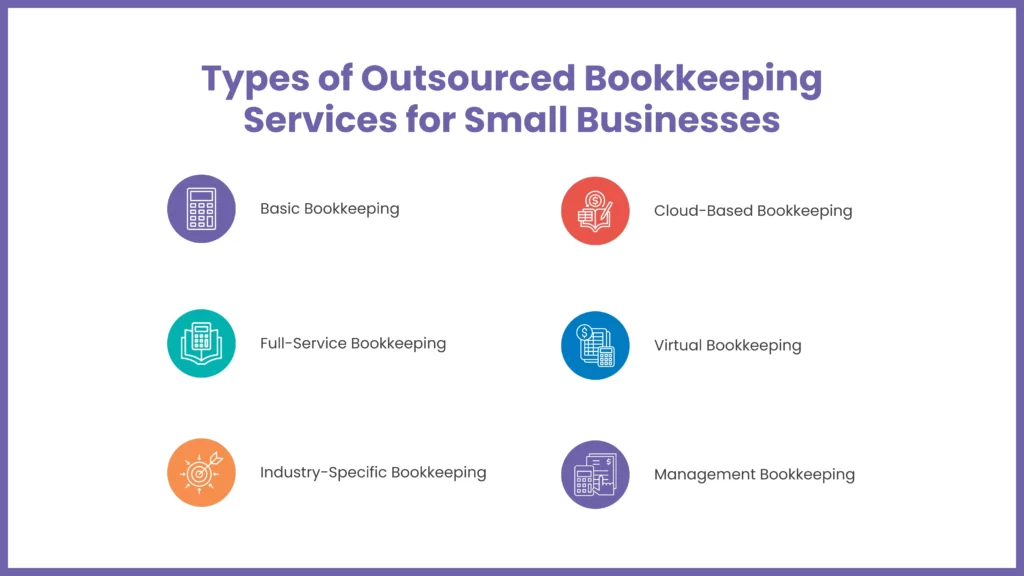
A variety of financial services that assist US small businesses in keeping correct records and managing their finances are covered by specialised outsourced bookkeeping. Depending on the demands of the business, the specific services may change, however they usually consist of:
- Recording transactions — sales, purchases, expenses, and payments logged daily.
- Bank reconciliation — comparing statements to records to catch discrepancies early.
- AP/AR management — supplier invoices, customer payments, and outstanding balances.
- Payroll bookkeeping — wages, deductions, and payroll activity kept current.
- Financial reporting — P&L, balance sheet, and cash flow summaries.
- Software management — Xero, QuickBooks, or Sage kept accurate and automated.
- Expense tracking and categorization — for clean reporting and tax prep.
How Much Does Outsourced Bookkeeping Cost?
There’s no single price for outsourced bookkeeping, because there’s no single business. A solo consultant with one bank account and 30 transactions a month is a completely different engagement from a three-location retailer with inventory and payroll.
Most providers quote after reviewing your actual books. Here’s what they’re looking at.
Factors that affect your bookkeeping cost
- Transaction volume — the biggest driver of cost.
- Number of accounts and platforms — each connected account is another reconciliation.
- Business complexity — inventory, multi-entity, multi-location, multi-state sales tax.
- Payroll — headcount, contractors, and number of states.
- Accounting software — a clean existing file costs less to take over than a neglected one.
- Reporting requirements — standard monthly reports cost less than weekly or investor-ready packages.
- Catch-up work — a separate one-time fee if you’re behind.
What to ask before you sign
- What exactly is in scope, and what triggers an extra charge?
- Is software included, or billed separately?
- What’s the turnaround for the monthly close?
- Is there a catch-up fee, and how is it calculated?
- Who is my actual point of contact?
- What happens if my volume grows mid-contract?
The cheapest quote is rarely the cheapest outcome. A provider who under-scopes will either miss things or come back with change orders, and you’ll pay your CPA to fix the difference.
Get a scoped quote based on your actual transaction volume.
How Does Outsourced Bookkeeping Work
The process of outsourcing accounting involves assigning an outside bookkeeping company to handle a company’s regular financial record-keeping duties. The procedure gives small firms access to competent bookkeeping services without sacrificing control over their financial data.
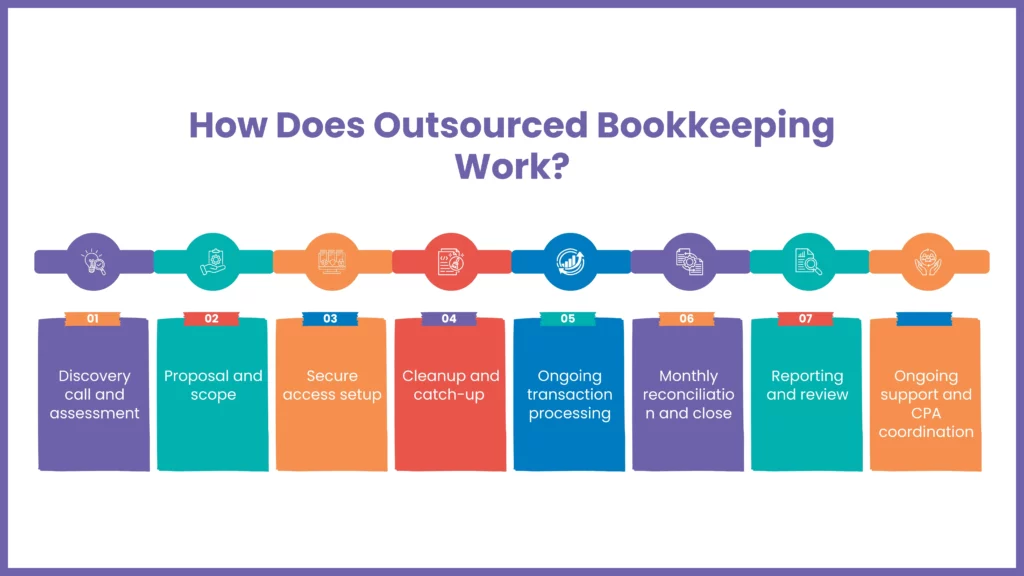
- Discovery call and assessment: You walk through your business, current software, transaction volume, pain points, and reporting needs. The provider reviews your existing books to see what shape they’re in.
- Proposal and scope: You get a written scope, pricing, deliverables, and timeline. Read what’s excluded as carefully as what’s included.
- Secure access setup: You grant read-only or accountant-level access to your accounting software, bank feeds, payroll system, and payment processors. A legitimate provider will never ask for your online banking password — they use accountant access and read-only bank feeds.
- Cleanup and catch-up (if needed): Prior periods reconciled, miscategorized transactions fixed, chart of accounts rebuilt. This is a one-time project before ongoing work starts.
- Ongoing transaction processing: Income, expenses, vendor payments, and customer transactions recorded and categorized on a set cadence daily, weekly, or monthly depending on your plan.
- Monthly reconciliation and close: Every account reconciled, discrepancies flagged, adjusting entries posted, and the month locked.
- Reporting and review: P&L, balance sheet, cash flow, and AR/AP aging delivered on schedule — ideally with a short call or written summary on what the numbers mean.
- Ongoing support and CPA coordination: Your bookkeeper answers questions, coordinates with your tax preparer, and flags issues before they become problems.
When Should a Small Business Outsource Bookkeeping?
Small businesses can reduce financial stress, increase productivity, and keep accurate records as they expand by knowing when to outsource bookkeeping in the US. While every organization is different, there are several general signals that indicate it may be the ideal moment to consider outsourcing.
- Bookkeeping is consuming time you need for operations and customers.
- Records are falling behind, unreconciled transactions, missing receipts, late updates.
- The business is growing and transaction volume is climbing.
- Tax and compliance requirements are getting harder to manage alone, the IRS’s recordkeeping guidelines outline what you’re on the hook for.
- A full-time in-house hire isn’t cost-effective yet.
- You want to focus on strategy and growth instead of admin.
How to Choose the Right Outsourced Bookkeeping Provider?
Choosing the right bookkeeping partner is about more than price, you need someone who understands your business, protects your financial data, and gives you insights you can act on. Here’s what to look for:
- Industry experience — familiarity with your sector’s compliance and reporting needs.
- Expertise and qualifications — proficiency with Xero, QuickBooks, and Sage.
- Technology capabilities — automation and secure, modern systems.
- Communication and turnaround — reliable delivery schedules and clear updates.
- Pricing and flexibility — transparent structure without sacrificing quality.
- Client reviews — testimonials and case studies as proof of reliability.
In order to offer you accurate financial records and free up time to concentrate on expanding your business, a reliable outsourced accounting service should function as an extension of your team.
Common Mistakes to Avoid When Outsourcing Bookkeeping
Outsourcing can boost productivity and cut admin work, but the wrong approach brings its own risks. Here are the mistakes to avoid:
- Choosing based only on price: The least expensive provider might not necessarily provide trustworthy service, timely reporting, or accurate records. Prioritize value, experience, and long-term advantages over price alone.
- Not checking industry experience: A bookkeeping service provider who is unfamiliar with your business may find it difficult to comprehend particular regulations, compliance guidelines, or reporting standards.
- Poor communication with the provider: Errors, delays, and missed deadlines can result from irregular updates and imprecise communication routes.
- Not reviewing work regularly: Businesses should analyze reports and retain oversight even with an outsourced team to guarantee accuracy and spot problems early.
- Overlooking software compatibility: Make sure the supplier can interact with software you already use, like Xero, QuickBooks, or Sage, and is knowledgeable about your accounting software.
- Ignoring data security practices: Sensitive financial data is involved in bookkeeping. Always make sure the supplier complies with compliance requirements and secure data management procedures.
How MyIVA Helps Small Businesses With Outsourced Bookkeeping
MyIVA’s small business bookkeeping services handle transaction recording, bank reconciliations, expense tracking, and accurate accounts, so daily operations, client needs, and growth don’t get crowded out by admin. We work in Xero, QuickBooks, and Sage to keep your financial data current and organized.
What you get:
- A dedicated bookkeeper, a named point of contact, not a rotating queue
- Expertise in QuickBooks Online, Xero, and the integrations that connect to them
- A defined monthly close with every account reconciled and statements delivered on schedule
- Complete AP and AR management, including aging reports you can act on
- Payroll bookkeeping and 1099 tracking
- Catch-up and cleanup bookkeeping if you’re behind by months or years
- CPA-ready year-end packages that can mean a smaller tax prep bill
- Transparent, fixed monthly pricing scoped to your actual volume
- Bank-level data security, we never ask for your banking passwords
Industries we work with: e-commerce and retail, construction and trades, professional services and agencies, healthcare practices, hospitality, and real estate.
Ready to hand off your books?
Book a free, no-obligation assessment. We’ll review your current setup, tell you honestly what shape your books are in, and give you a scoped quote based on your real transaction volume.
People Also Ask:
Why do companies need to outsource bookkeeping?
Businesses outsource bookkeeping in order to save money, save time, preserve accurate financial records, and get professional bookkeeping assistance without having to hire staff members. Businesses can concentrate on expansion and enhance compliance with its assistance.
How frequently should a company contract out its bookkeeping services?
The frequency is determined by the needs of the business. While some businesses may require weekly or monthly services, others may demand daily bookkeeping support.
Does financial decision-making improve when bookkeeping is outsourced?
Indeed, precise and current financial records give companies a better understanding of their cash flow, expenses, and overall performance.
Which sectors typically utilize bookkeeping that is outsourced?
Outsourced bookkeeping solutions are frequently used by industries like retail, eCommerce, construction, healthcare, hospitality, real estate, and professional services.
Can I customize my company’s outsourced bookkeeping services?
Yes, companies can select services like basic bookkeeping, payroll processing, or management reporting according to their needs.
Can outsourced bookkeepers work with my existing QuickBooks or Xero file?
Yes. Most outsourced bookkeeping services work directly inside your existing accounting software. If your file needs cleanup first, that’s usually handled as a one-time catch-up project before ongoing monthly work begins.
How far behind can my books be before it’s too late?
It’s not too late. Catch-up bookkeeping for several months, or several years, is routine. Providers reconstruct prior periods from bank statements, receipts, and payment processor records, then bring you current and move you onto a monthly plan.
Conclusion
Bookkeeping is the one back-office task that gets harder as your business gets better. More revenue means more transactions, more vendors, more compliance, and less of your time to handle any of it.
Outsourced bookkeeping solves that without the cost or commitment of a full-time hire. You get accurate books, financial visibility you can actually use, and expertise across the software and regulations that apply to your business.
The question isn’t whether your books need to be right. It’s whether you should be the one making them right at 10pm on a Sunday.
Ready to simplify your bookkeeping?
Get expert outsourced bookkeeping support to keep your financial records accurate, improve cash flow visibility, and focus on growing your business. Schedule your free consultation today.
