


The foundation of a successful construction company is construction accounting. Contractors must manage project-based expenses, monitor job profitability, accurately recognize income, and maintain a healthy cash flow across several projects, in contrast to normal accounting. Accurate financial management is more crucial than ever in 2026 as labor expenses, material prices, and compliance needs continue to change.
Understanding construction accounting can help you make more informed business decisions and cut down on expensive mistakes, whether you are a general contractor, subcontractor, or owner of a construction company. This Construction Accounting Guide 2026 discusses the main accounting processes, crucial financial reports, typical issues, and the best construction accounting software for US contractors, so you can keep every project financially on track.
Construction accounting: what is it?
A specific area of accounting created for construction companies, contractors, and subcontractors is called construction accounting. It focuses on monitoring project-specific expenses, controlling cash flow, assigning costs to specific activities, and identifying income from long-term contracts.
Construction accounting views each project as a distinct profit center, in contrast to traditional accounting. Throughout a project’s lifecycle, this enables contractors to keep an eye on task expenses, check project profitability, manage budgets, and make wise financial decisions.
Difference between Construction Accounting vs Traditional Accounting
| Construction Accounting | Traditional Accounting |
| Focuses on individual projects or jobs as separate profit centers. | Focuses on the company’s total financial results. |
| Monitors labor, supplies, equipment, and subcontractors, among other job-specific expenses. | Keeps track of revenue and costs at the corporate level without using project-based tracking. |
| Uses revenue recognition based on projects, frequently over the course of a contract. | Revenue is typically recognized when goods or services are delivered. |
| Manages long-term agreements that could last for months or years. | Ideal for companies with frequent transactions and shorter sales cycles. |
| Requires job costing to measure the profitability of each project. | Does not normally require extensive expense tracking by project. |
The Importance of Construction Accounting for Your Company
Construction accounting helps contractors manage expenses, enhance cash flow, and make well-informed business decisions by providing them with a clear picture of each project’s financial performance. Since construction projects generally include extensive deadlines, changing budgets, and various stakeholders, precise accounting is vital for preserving profitability.
Key benefits include:
- Tracks job profitability: To discover profitable and failing jobs, keep an eye on each project’s revenue and expenses.
- Improves cash flow management: To prevent cash shortages, keep track of overdue bills, retainage, and progress payments.
- Ensures tax and regulatory compliance: Keep correct financial records and fulfill all tax, state, and federal reporting obligations.
- Provides better financial insights: Create project-specific reports to aid in forecasting, pricing, and strategic planning.
- Supports accurate budgeting: To improve project estimates in the future, compare projected and actual costs.
- Controls project costs: To cut down on cost overruns, monitor labor, material, equipment, and subcontractor charges in real time.
- Enables business growth: You can expand your construction company, increase profit margins, and start with confidence on new projects when you have accurate financial data.
Choosing the Right Construction Accounting Method for Your Business
Contractors can correctly track project expenses, recognize revenue, manage cash flow, and analyze profitability with the help of construction accounting, which employs a number of techniques. The length of the project, the value of the contract, the size of the company, and the requirements for financial reporting all influence the appropriate strategy. To get a full view of their financial performance, many construction businesses use these techniques.
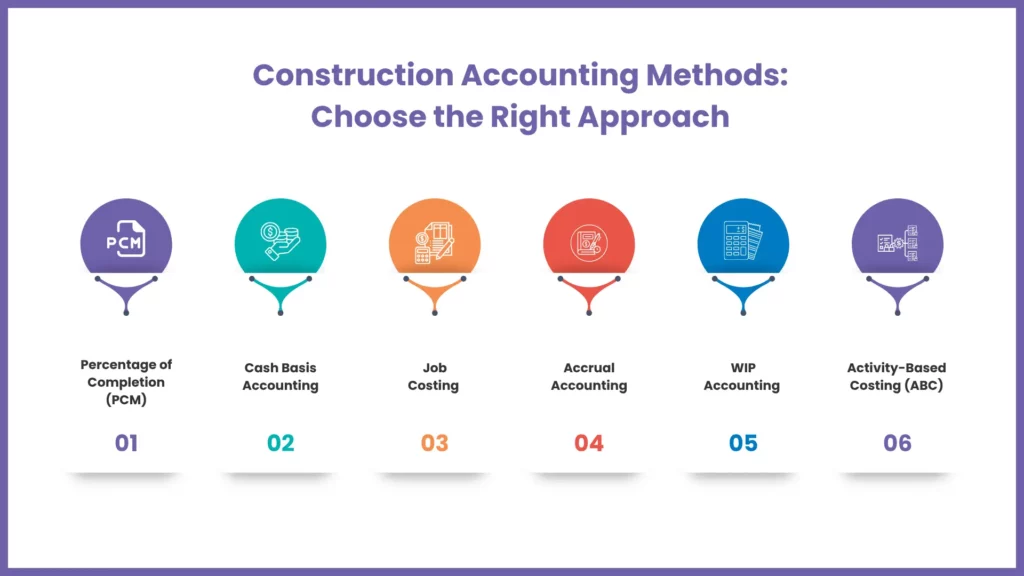
Percentage of Completion Method (PCM):
Instead of waiting until a project is finished, this method records income and expenses as it moves forward. Revenue is usually computed as a percentage of completed work, such as project milestones reached or expenses incurred relative to total projected costs. It is frequently utilized for long-term building contracts and offers a more accurate picture of continuous profitability.
Cash Basis Accounting:
Revenue is only recorded under cash basis accounting when payments are received, and expenses are only recorded when bills are settled. It functions effectively for small contractors with simple activities and is easy to manage. However, because income and expenses are reported based on cash movement rather than when the work is completed, it might not give a true picture of project profitability.
Job Costing:
Every expense associated with a single construction project is tracked by job costing, including labor, supplies, machinery, subcontractor fees, permits, and overhead. Contractors can monitor project profitability, manage budgets, spot cost overruns, and enhance pricing for subsequent projects by allocating expenses to certain jobs.
Accrual Basis Accounting:
Regardless of when payment is received or paid, the accrual method, compared to cash accounting, records income as it is earned and expenses as they are spent. Medium-sized and big construction companies that oversee several projects frequently employ this method, which provides a more realistic picture of a company’s financial health.
Work-in-Progress (WIP) Accounting:
After comparing the contract value, expenses incurred, percentage of completion, revenue recognized, and amounts billed to customers, work-in-progress (WIP) accounting focuses on ongoing projects. It assists contractors in spotting possible cash flow difficulties, budget discrepancies, overbilling, and underbilling before they become worse.
Activity-Based Costing (ABC):
Indirect costs like administration, equipment maintenance, site supervision, and quality checks are distributed according to the activities that produce them using activity-based costing. This approach improves pricing and profitability by more accurately allocating overheads and assisting contractors in comprehending the actual cost of each project.
Must-Have Financial Reports for Construction Accounting
To keep an eye on project performance, manage cash flow, keep expenses under control, and make sure the company is profitable, a construction accountant needs reliable financial data. These reports offer insightful information on every phase of a building project, assisting contractors in making wise choices and spotting possible financial hazards before they have an adverse effect on the company.
Profit and Loss (P&L) Statement:
The Profit and Loss Statement provides an overview of your business’s income, operating costs, project costs, and net profit for a given time frame. This report is used by construction accountants to assess overall business performance, find profitable projects, and keep an eye on costs that might be impacting margins.
Balance Sheet:
A balance sheet lists the assets, liabilities, and owner’s equity of your business, giving you a quick overview of its financial situation. It assists a construction accountant in monitoring debt levels, evaluating financial health, and figuring out whether the company has the resources to sustain current and upcoming construction projects.
Work-in-Progress (WIP) Report:
The financial standing of ongoing projects is tracked by a Work-in-Progress (WIP) Report. It contrasts the percentage of work finished with incurred expenses, recognized revenue, and customer invoices. In order to improve project forecasts and detect overbilling, underbilling, and possible profit erosion, a construction accountant employs WIP reports.
Accounts Receivable Ageing Report:
The length of time that unpaid customer invoices have been overdue is displayed in this report. By following up with clients before outstanding balances become an issue, a construction accountant uses it to track past-due payments, enhance collections, and maintain a healthy cash flow.
Cash Flow Statement:
In the construction sector, where project payments are sometimes paid in stages, cash flow is crucial. A construction accountant can make sure there is sufficient working capital to pay workers, suppliers, subcontractors, and other project-related costs by using a cash flow statement, which keeps track of the money coming into and going out of the company.
Job Cost Report:
A job cost report keeps account of every expense related to a specific construction project, including labor, supplies, machinery, overhead, and subcontractor fees. A construction accountant can use this report to assess each project’s profitability, find cost overruns, and compare actual costs to budgets.
Accounts Payable Ageing Report:
Outstanding supplier and subcontractor invoices are listed in the Accounts Payable Ageing Report, along with the dates when they must be paid. It protects cash flow while assisting a construction accountant in managing payment schedules, avoiding late fees, and keeping good connections with suppliers.
Accounts Receivable Ageing Report:
The length of time that unpaid customer invoices have been overdue is displayed in this report. By following up with clients before outstanding balances become an issue, a construction accountant uses it to track past-due payments, enhance collections, and maintain a healthy cash flow.
Budget vs Actual Report:
A report titled “Budget vs. Actual” contrasts projected costs with actual expenditures made during the building process. This report is routinely reviewed by a construction accountant to spot budget deviations, look into unforeseen expenses, and maintain projects’ financial stability.
Top-Rated Construction Accounting Software Every US Contractor Should Consider
Selecting the best construction accounting software can have a big impact on how well your company records expenses, organizes projects, and stays profitable. Construction-specific solutions, in contrast to typical accounting software, are made to manage subcontractor administration, equipment tracking, payroll, job costing, progress billing, and work-in-progress (WIP) reporting.
These are a few of the best construction accounting software programs that US contractors rely on.
Procore Financial Management:
One of the top cloud-based construction management systems, Procore offers both project management and strong financial management solutions. Contractors can work with project teams in real time while managing commitments, budgets, invoicing, change orders, forecasts, and financial reporting from a single platform.
Best for: Commercial contractors and large construction firms
Sage 300 Construction and Real Estate:
Larger contractors frequently utilize Sage 300, which was created especially for the construction sector. Project cost monitoring, budgeting, contract administration, payroll, equipment management, and financial reporting are just a few of the sophisticated accounting features it offers. It is perfect for businesses handling several intricate projects because of its extensive features.
Best for: Medium to large construction companies
Foundation Software:
Foundation Software is created specifically for the building sector. Job costing, certified payroll, accounts payable, accounts receivable, equipment tracking, union payroll, and comprehensive financial reporting are some of its features. Both general contractors and specialty contractors can benefit from the software’s great degree of customization.
Best for: Construction businesses requiring industry-specific accounting
CMiC:
Accounting, project management, document management, procurement, and business intelligence are all combined in CMiC’s enterprise-level solution. Construction organizations may centralize financial data and enhance visibility at every step of a project thanks to its integrated platform.
Best for: Large construction enterprises
Acumatica Construction Edition:
Construction accounting, project management, Customer Relationship Management (CRM), payroll, and financial reporting are all integrated with Acumatica, a cloud-based ERP application. Because of its mobile accessibility, contractors may keep an eye on project finances from almost anywhere.
Best for: Growing construction businesses seeking cloud-based solutions
Construction Tax Compliance: What US Contractors Need to Know
A key component of managing a profitable construction company is tax planning. In contrast to many other companies, construction contractors confront particular tax issues due to long-term contracts, varying project prices, equipment investments, and shifting federal tax regulations.
Choose the Right Accounting Method:
When revenue and expenses are recorded for tax reasons it is directly impacted by the accounting system you use. You may be able to employ the cash method, accrual approach, Completed Contract Method (CCM), or Percentage of Completion approach (PCM), depending on the size of your company and the type of contracts you have. By choosing the best approach, cash flow may be optimized and taxable income can be more closely aligned with project completion. Certain residential building contracts now have more flexibility thanks to recent revisions to the tax code.
Maximize Equipment Deductions:
Construction companies often make investments in cars, specialized equipment, and heavy machinery. Expanded Section 179 expensing and 100% bonus depreciation may be available for qualifying purchases in 2026, enabling contractors to deduct a sizable amount or possibly the entire cost of qualified assets in the year they are put into service. It is crucial to properly record the dates of purchase, delivery, and in-service.
Monitor Long-Term Contract Tax Rules:
One of the most crucial tax factors for contractors is still revenue recognition. Long-term construction contract income must be recognized in accordance with federal tax regulations, which directly affects taxable income. To guarantee compliance with IRS regulations, contractors should routinely examine project schedules, projected expenses, and contract classifications.
Manage Payroll Tax Compliance:
Subcontractors, seasonal workers, and full-time employees are frequently employed by construction companies. To prevent IRS penalties and guarantee compliance with federal and state payroll requirements, proper worker classification, payroll tax withholding, overtime computations, and employment tax reporting are crucial.
Review State and Multi-State Tax Obligations:
Due to the fact that many contractors operate in several states, they have additional tax obligations. Depending on where projects are carried out, there may be differences in state income tax, sales and use tax, payroll tax, and business registration requirements. Contractors should keep an eye on the nexus regulations and filing requirements for each state where they do business.
Take Advantage of Available Tax Credits:
You might be eligible for important federal tax advantages, such as energy-efficiency deductions, research and development (R&D) tax credits for creative building techniques, and other industry-specific benefits, depending on the nature of your projects. You can lower your overall tax burden by reviewing your potential credits every year.
Plan Year-End Tax Strategies Early:
If you wait until tax season, you may have fewer options to plan. Well before the end of the year, contractors should check their financial records, expected taxable income, equipment purchases, retirement contributions, and deductible costs. Businesses can make well-informed decisions that enhance cash flow and reduce tax obligations by preparing ahead for taxes.
Construction Accounting Pain Points for US Contractors
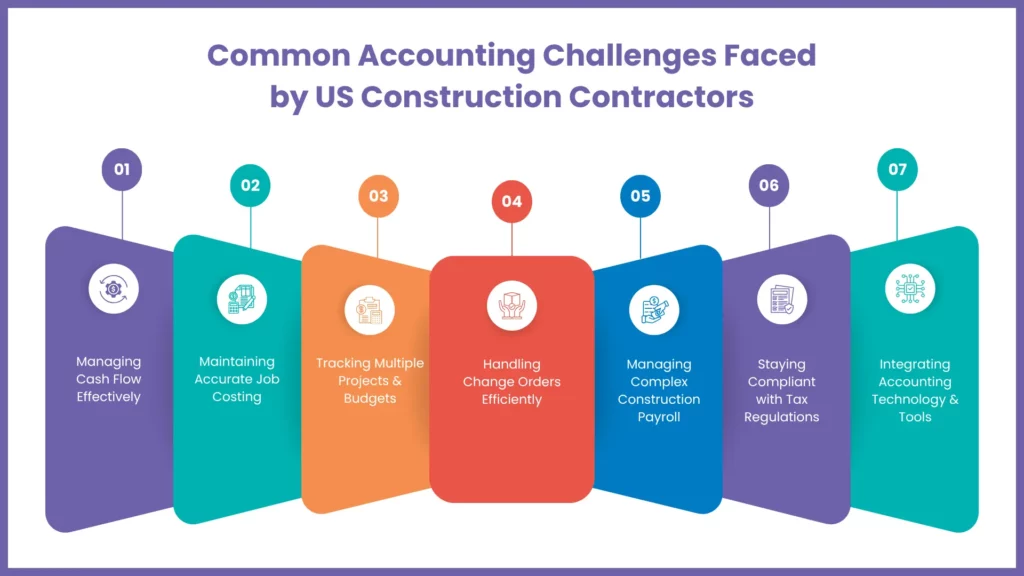
- Cash Flow Management: Delays in customer payments, retainage, and the requirement to pay labor, materials, and subcontractors up front make managing cash flow difficult.
- Accurate Job Costing: It is crucial but frequently challenging to keep track of labor, materials, equipment, overhead, and subcontractor costs for every project, which results in erroneous project profitability.
- Managing Multiple Projects: Maintaining separate budgets, expenses, invoices, and financial records is necessary when managing many projects concurrently without sacrificing overall business performance visibility.
- Change Order Management: Maintaining accurate project budgets and preventing revenue leakage require timely tracking and billing of scope modifications.
- Payroll Complexity: Accurate record-keeping and adherence to labor laws are necessary for managing payroll for employees, subcontractors, union workers, overtime, and different project locations.
- Tax Compliance: Payroll taxes, sales taxes, depreciation rules, and contractor-specific tax requirements are just a few of the federal, state, and local tax laws that construction companies must abide by.
- Technology Integration: Accessing real-time financial data is challenging for many contractors due to disjointed accounting and project management systems.
Construction Accounting Best Practices for US Contractors
For construction companies that deal with complicated projects, variable costs, and lengthy payment cycles, efficient money management is crucial. Contractors can enhance cash flow, manage costs, and sustain profitability by adhering to appropriate procedures and utilizing expert construction accounting services.
- Implement Accurate Job Costing: To monitor profitability and spot cost overruns early, keep track of personnel, materials, equipment, subcontractor charges, and overhead expenses for every project.
- Use Construction Accounting Software: To handle task costing, payroll, invoicing, budgeting, and financial reporting more effectively, implement industry-specific software.
- Review Financial Reports Regularly: To make wise company decisions, examine cash flow statistics, project profitability reports, and profit and loss statements.
- Plan for Taxes Throughout the Year: To enhance tax compliance and planning, maintain precise records of all spending, equipment purchases, payroll, and deductions.
Need Help With Construction Accounting? Get Expert Support to Improve Job Costing, Cash Flow, and Financial Accuracy.
People Also Ask:
What are construction accounting services?
Bookkeeping, job costing, payroll processing, tax planning, financial reporting, Work-in-Progress (WIP) reporting, cash flow management, and compliance support designed especially for construction companies are all included in construction accounting services.
What does construction accounting job costing mean?
The practice of keeping track of all project-related costs, such as labor, supplies, machinery, subcontractors, and overheads, in order to assess each construction project’s profitability is known as job costing.
What financial reports are important for construction businesses?
Profit and Loss Statements, Balance Sheets, Cash Flow Statements, Job Cost Reports, Work-in-Progress (WIP) Reports, Budget vs. Actual Reports, and Project Profitability Reports are important reports.
How might cash flow be enhanced by construction accounting services?
Expert construction accounting services lower the risk of cash shortages by assisting contractors with invoice management, accounts receivable monitoring, cash flow forecasting, project cost tracking, and timely payments.
Conclusion
Construction accounting is much more than just keeping track of earnings and expenditures; it also involves controlling project expenses, preserving a positive cash flow, monitoring job profitability, and adhering to US tax and financial reporting regulations. Contractors can enhance long-term business performance and make better financial decisions by using the appropriate accounting techniques, keeping an eye on important financial reports, installing construction-specific software, and adhering to industry best practices.
Working with seasoned experts can be extremely beneficial if you want to streamline your financial operations. We at MyIVA Accounting offer thorough construction accounting services that are specifically designed to meet the demands of US contractors. Our staff assists you in gaining more financial insight while lowering administrative duties, from bookkeeping and job costing to payroll, financial reporting, and tax support.
Get in touch with MyIVA Accounting right now to learn how our professionals in construction accounting can help you optimize profitability, simplify your finances, and maintain the expansion of your construction company.
