


In-house vs. outsourced accounting for dental practices depends on size, cost, and control. Small and mid-size practices usually save by outsourcing instead of hiring full-time. Large multi-location groups often keep an in-house team, supervised by an outside CPA.
Dr. James owns a dental practice. The maximum time of his day is filled with patient appointments, treating patients and then managing accounting tasks with the help of the office manager. Monthly reports were created late, tax filing deadlines were missed. Dr. James was frustrated because of the poor accounting system and no financial clarity about the practice.
James thought about hiring an internal accountant, but the quantity of staff needed, the salary and personnel expenses seemed expensive. So, he decided to outsource dental accounting, which may provide him with expert assistance without hiring a full-time employee.
Most of the dental practice owners face a similar confusion regarding: should they hire in-house accounting team or outsource?
This guide will tell you about the costs, pros and cons of both options. Based on that you can decide which option will be best for your dental practice.
Quick Answer: Should a Dental Practice Outsource Accounting?
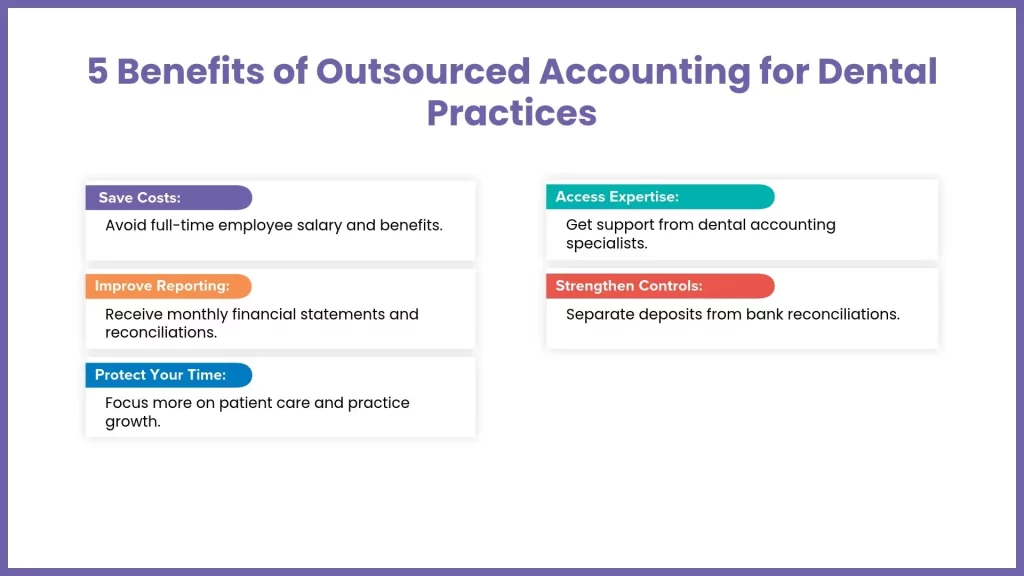
Most solo and small to mid-size dental practices can choose outsourced accounting. It costs less than a full-time hire, gives you access to specialists who understand dental finances, and frees your time to focus on patients.
Choose Outsource if:
- You run a small dental practice, hiring a full time accountant can be expensive.
- Your office manager spends too much time on bookkeeping.
- You need expert help with monthly reports, payroll and tax planning.
Choose in-house staff if:
- You manage multiple locations or a large team.
- Your budget covers a full-time accountant and backup support.
- You prefer to manage daily transactions and approvals within your practice.
Many owners start like Dr. James, a solo dentist whose monthly reports ran weeks late and who missed tax deadlines. Outsourcing gave him expert help without a full-time salary. (Illustrative example.)
What Is the Difference Between In-House and Outsourced Accounting for a Dental Practice?
In-house accounting means hiring an accountant to manage daily dental accounting tasks. On the other hand, outsourced accounting means assigning your accounting tasks to an external service provider. Bookkeeping records transactions; accounting turns them into reports, tax returns and advice; a dental CPA is a licensed accountant who specializes in dental practices.
Key differences at a glance
| Factor | In-house | Outsourced |
|---|---|---|
| Cost structure | Payroll taxes, salary, benefits, software, training and workspace. | Predictable monthly or hourly fee, no employee overhead |
| Expertise | Depends on one person’s skills | Access to dental accountants, including CPA and dental specific specialists. |
| Control and access | Immediate, on-site, face to face | Need to schedule a meeting with a service provider. |
| Tax strategy | Mostly limited, unless a dental CPA is involved. | Often integrated with year-round tax planning |
| Internal control | Can be risky if one person handles all tasks. | Built-in separation of duties when an outside party reviews the books |
| Scalability | More staff can be needed as the practice grows. | Services scale up or down by contract |
How Much Does Outsourced Accounting Cost vs. an In-House Hire?
In-house
The median US bookkeeper salary was $50,670 as of May 2025 (BLS). Adding employer taxes, benefits, software and training, the total is typically $70,000–$75,000 a year, before separate CPA tax fees.
Outsourced
Dental-specific bookkeeping and payroll typically cost $400–$1,200 a month ($5,000–$14,000 a year), often set by monthly collections. Tax returns and extra advisory work are usually billed separately.
CTA – Want a quote based on your collections? Request a free cost comparison from MyIVA Accounting.
What Are the Pros and Cons of In-House vs. Outsourced Accounting?
In-house accounting gives more control and quick access, but it costs more and depends on one person. Outsourced dental accounting services are less expensive and give access to more expertise. Responses may not be immediate.
Pros and Cons of In-House Accounting
Pros:
- Quick Access: You can directly speak to the accountant when a patient payment or payroll figure needs checking.
- Practice familiarity: Dental accountants can learn about your software, work pattern and patient payment habits.
- Direct control: You can review transactions and assign work based on priorities.
Cons:
- High costs: Salary is the only part of expense. You may also need to pay employer taxes, benefits, software and training.
- Limited expertise: One employee may not have expertise in tax planning, worker classification, or S corporation compensation rules.
- Absenteeism: At the crucial period in-house accountant may take unplanned leave due to sickness or unforeseen emergency.
Pros and Cons of Outsourced Accounting
Pros:
- Lower cost for small practices: Cost range is about $5,000-$12,000 a year for bookkeeping, with no benefits or payroll taxes on your side.
- Broader expertise: You get a team, which frequently consists of CPAs with expertise in dental-specific matters like insurance adjustments and production vs collections.
- Built-in oversight: An outside reviewer adds a second set of eyes and helps separate duties.
Cons:
- Insufficient communications: If you don’t stay in regular contact, the outsourced team may miss important details.
- Safety of information: As a rule, when the patient data is involved in the accounting information the institution should sign a Business Associate Agreement (BAA) with the contractor.
- Extra expenses: Services such as tax return or payroll assistance are usually charged additionally.
Is Outsourced Accounting Secure and HIPAA-Compliant for Dental Practices?
It can be, with the right contract and careful data handling. Your practice is always a HIPAA covered entity, but a BAA is required only when a vendor can access patient information.
When a BAA is needed
- Bank reconciliations, P&L statements and payroll usually contain no patient data.
- Billing reports and insurance files often do.
- If your accountant can see patient information, even accidentally, they are a business associate.
What a BAA must include
- Signed before any patient data is shared.
- States how the data may be used.
- Requires protection of the data and breach reporting.
- Covers subcontractors.
- Lets you terminate if rules are broken.
- Requires data return or deletion when you leave.
See the HHS sample BAA provisions.
Example: How dental practice protected patient data while outsourcing.
A practice hired a firm for payroll, reconciliations and monthly reports. The accountant asked for practice management software access to match payments to billing records, which exposed names, treatments and insurance data. The owner limited access to financial data only, signed a BAA, and set breach-reporting and access-control protocols. The firm finished its work with only the data it needed.
Which Option Is Right for Your Dental Practice Stage?
The right decision whether to choose in-house vs outsourced accounting for dental practices on the type of dental practice stage.
- New or solo practice: Transaction volumes are low at the initial stage and full-time in-house accountant can be costly. You can start with the monthly outsource plan ranging (about $5,000-$12,000 a year).
- Established small practice (1-2 dentists): Outsource or use a hybrid. An office manager handles daily deposits, while an outside firm handles reconciliations, payroll, and taxes.
- Growing practice: Choose hybrid options. Add monthly financial reviews, tax planning, and checks on associate and hygienist classification.
- Multi-location group: In-house team plus an outside CPA for tax returns and oversight.
Can You Outsource Only Part of Your Dental Accounting? (Hybrid Model)
Yes. In a hybrid model, your office team handles daily tasks and an outside dental CPA or bookkeeper handles the technical work.
- Keep in-house: Your office manager handles deposits, patient payments, bill approvals and daily records.
- Outsource: Financial statements, business tax returns, payroll and tax filings (Form 941 and W-2s), and monthly reconciliations.
- Benefits: Lower costs and access to professional support.
- Check: Verify payroll tax payments, sign a BAA if patient data is shared, set reporting deadlines, monitor bank accounts, and define roles clearly.
Which Software Should Your Dental Accountant Use?
Most dental accountants work in QuickBooks Online alongside practice management systems such as Dentrix, Eaglesoft or Open Dental. Ask for secure, read-only data feeds so reports stay accurate without sharing unnecessary patient data.
What Reports and Insights Should a Dental Accountant Provide?
You should get more from a dental accountant than just tax returns. Reports on the practice’s performance should be sent to you on a frequent basis.
Monthly reports:
- Profit and Loss (P&L) Statement: A look at how your business is doing by comparing revenue and expenses to the previous month and year.
- Balance Sheet: Where you can find a snapshot of your business’s financial position – showing assets, debts, and how much value you’ve got in the business.
- Cash Flow Statement: A report that lays out the full picture of where your cash is coming from, and where it’s going – including loan payments and any drawings you make as the owner.
- Bank Reconciliations & Credit Card Statements: Just makes sure that what’s in your books matches up with the actual numbers in your bank and credit card accounts.
- Accounts Receivable (A/R) Aging Report: A breakdown of any unpaid patient or insurance bills by how long they’ve been outstanding.
- Production vs. Collections Analysis: Gives you a good idea of how much you’re billing versus how much you actually end up collecting.
Key numbers to Keep an Eye on
- Overhead Costs as a Percentage of Collections: Your total expenses as a share of the money you’ve actually brought in.
- Collection Rate: Your collections divided by your net production – an important gauge on how well you’re actually getting paid.
- Payroll as a Share of Collections: How much your staff costs are eating into your income.
- Lab, Supply, and Rent Expenses: Each of these as a percentage of your collections – good to keep track of so you can see where you can cut back.
- Hygiene Production: Revenue from dental hygiene appointments.
- Insurance Write-Offs and Adjustments: Indicates you may have issues with billing or contracts – something that needs to be looked into.
Tax and compliance reports
- Payroll tax filings: Form 941 each quarter, and W-2s and W-3 by January 31.
- 1099-NEC forms: For contractors paid $2,000 or more for 2026 payments, due February 1, 2027 (January 31 falls on a Sunday).
- Estimated tax payments: Quarterly reminders so you avoid penalties.
- Entity returns: Form 1120-S, Form 1065, 1120, or Schedule C Form 1040.
Planning and advice
- Budget and forecast: Expected income, expenses, and cash needs.
- Owner pay review: Reasonable compensation for S corporation owners.
- Equipment purchase planning: Tax treatment of major purchases, such as Section 179 expensing, based on current law.
- Section 199A review: Dentistry is a specified service business, so the deduction phases out at higher income.
- Benchmarking: How your numbers compare with similar dental practices.
- 2026 tax changes: Recent federal legislation expanded Section 179 limits and made the 199A deduction permanent. Confirm details with your CPA before year-end purchases.
How Do You Switch From In-House to Outsourced Accounting?
- Keep clear goals: Be clear about your requirements and goals you expect from an outsourcing service provider. What type of reports you need, how much dental staff you have and what will be your tax planning responsibilities. All information should be conveyed clearly to outsourced dental practice accounting.
- Provide lists of tasks: Write down what your bookkeeper does: deposits, bill pay, payroll, reconciliations, reports, tax filings. Inform the service provider which software and logins are used.
- Choose Experienced Provider: Make sure the outsource service provider has experience of dental practice accounting. They have a specialized CPA, clear pricing, and strong security.
- Sign the paperwork: Get an engagement letter covering services, fees, and deadlines. Sign a Business Associate Agreement (BAA) if the vendor can see patient information.
- Transfer Access Securely: Make sure to share software, bank feeds, payroll, and read-only practice management data through a secure portal. Never send the passwords by email or text message.
- Confirm Payroll Tax Responsibility: Choose who makes federal deposits and submits Form 941. Check your own deposits. Owners who fail to pay payroll taxes can be held personally liable under the IRS Trust Fund Recovery Penalty.
Real-World Example: Before and After Outsourcing
Practice: Solo dentist with about $80,000 in monthly collections.
| Before (in-house) | After (outsourced) | After (outsourced) |
|---|---|---|
| Bookkeeping and payroll | About $72,000 all-in | About $14,000 |
| CPA tax work | About $3,000 | About $3,500 |
| Total | About $75,000 | About $17,500 |
| Monthly reports | 30–45 days late | Within 10–15 days |
| Tax planning | Once, after year end | Mid-year and year end |
| Deposits and reconciliations | One person | Split between office manager and firm |
- Estimated savings are up to about $57,000 a year, less the office manager’s added time and any software costs. The owner now sees overhead, collection rate and A/R aging monthly, and separating duties lowers fraud risk.
Why Does Segregation of Duties Matter in a Dental Practice?
Dental offices handle cash, checks, insurance payments and write-offs, so embezzlement is a real risk when one person controls deposits and reconciliations. Outsourced reconciliation creates a built-in check.
What Mistakes Do Dental Practices Make When Choosing an Accounting Model?
- Focusing on price: The least expensive solution frequently lacks tax preparation or dental expertise.
Check if reconciliations, payroll, reporting, and tax processing are all covered.
- Hiring a Generalist With No Dental Experience: Dental books contain unique items such as finance, insurance write-offs, patient credits, and production versus collections.
Errors here cause the collection rate and overhead to be distorted.
- Giving One Person Control Over All Finances: Fraud will be hard to spot when one person handles deposits, bank reconciliations and adjustments. Divide these tasks between staff and ask the practice owner to review write-offs and bank statements regularly.
- Skipping the Business Associate Agreement (BAA): Before work starts, a BAA is required for every outside vendor who has access to patient data. Missing one creates HIPAA exposure for the practice.
- Skipping Tax Planning: Your alternatives are limited if you wait until after the end of the year. Plan owner compensation, equipment purchases (Section 179), and the annual Section 199A deduction.
How Do You Choose a Dental Accounting Provider?
When choosing a dental bookkeeping service, look for a provider who understands dental practices, offers clear pricing, and keeps your financial and patient information secure.
- Accounting experience: Check whether they understand production vs. collections, insurance write-offs, and patient credits.
- CPA involvement: In comparison to bookkeepers, dental CPAs provide more services than just record-keeping. They offer evaluation of the accounts and tax planning advisory.
- Sufficient Software: Check the right type of software being utilized by the accounting service.
- Competitive Pricing: Make sure pricing is clear with the service providing firm and get the agreement in writing. Ask whether pricing is flat, hourly or a percentage of collections.
Questions to Ask Before Signing
- How many dental practice accounting have they managed?
- Will you sign a Business Associate Agreement (BAA) before seeing patient data?
- Do they have a CPA to review the work?
- What reports will I get, and how soon after month end?
- What process do you follow to protect data (encryption, multi-factor login, limited access)? Is any work done offshore?
- How is my data returned or deleted if I leave?
Red Flags to Avoid
- The service provider refuses to sign BAA.
- No experience of dental practice bookkeeping.
- No clear promise about pricing.
- They push long lock-in contracts with hard exit terms.
- Service providers do not guarantee data security.
- There are negative reviews about the accounting service provider.
Quick Decision Checklist: In-House or Outsourced?
Choose Outsourced if:
- Accounting work is about 15-20 hours a week.
- You are a new, solo, or small practice.
- You need CPA advice for tax preparation, not just data entry.
- You don’t want to hire or manage finance staff.
Choose Hybrid If:
- You have a reliable office manager for daily tasks.
- You need an outside expert for payroll, reconciliations, and taxes.
For Any Model:
- Split deposits from reconciliations.
- Review bank statements yourself.
- Verify payroll tax deposits.
- Sign a BAA with any vendor who sees patient data.
Conclusion:
Maintaining current records is only one aspect of good accounting. You should be able to identify areas where practice spending is increasing, identify cash flow problems, and make smarter decisions regarding staffing, equipment, and future expansion. You may make more confident plans for the future when your financial information is trustworthy.
MyIVA Accounting can assist you to get a clearer picture of your dental practice without adding more work. Visit MyIVA website to know more about our accounting services and make your dental practice grow more.
This article is general information, not tax or legal advice. Consult a licensed CPA or attorney.
