
Business owners in the UK encounter one of the most challenging times during the financial year-end, where tax requirements undergo thorough scrutiny. Whether you run a small limited company, a sole trader business, or a growing company, you must prepare year-end filing, and send it to HMRC as per the strict requirements of business tax filing.
Losing proper control of this process may result in high fines, time loss and compliance problems that may be detrimental to your operations. Professional assistance also makes business accounting and tax filing easier, more accurate, and more beneficial such as tax deductions for businesses in the UK.
This guide is an all-encompassing document that gives clear guidelines of HMRC submission to ease the process of preparing a tax return on behalf of a business. Keeping a well-organised record is one way to turn a painful task into a chance to enhance your financial status, as well as to meet the goals of the deadlines, adhere to the steps that allow to complete the year-end tax filing.
What Is HMRC End of Year Filing?
The year-end filing system under HMRC submission guidelines asks UK businesses to declare their full financial performance to the HM Revenue & Customs at the end of their accounting period. This will include filing of corporate tax returns through CT600 form, annual statutory accounts with Companies House and various other requirements including business VAT filing returns and PAYE returns where necessary. The accounting period of a limited company is usually based on its chosen financial year-end whereas the sole traders and partnerships use the standard tax year of 6 April to 5 April of the next year.
The common factor among all business structures is the uncompromising responsibility of preparing year-end accounts in the proper manner and by the competent date to meet the requirements of compliance with the UK tax laws. This knowledge of these business tax filing requirements is the key to an effective preparation.
Key Deadlines for HMRC Year-End Filing
On time submission is paramount according to the HMRC submission guidelines regulations. Penalties are automatic in case of late filings.
| Obligation | Deadline |
| Annual accounts to Companies House | 9 months after financial year-end |
| Corporation tax payment to HMRC | 9 months + 1 day after period end |
| Corporate tax returns (CT600) to HMRC | 12 months after period end |
| First accounts (new companies) | 21 months after registration |
| Self Assessment tax return (online) | 31 January following tax year |
| Self Assessment tax payment | 31 January following tax year |
| Business VAT filing process returns | month + 7 days after VAT period |
Companies House Late Filing Penalties : The most recent late penalty increases for limited companies came into effect on 1 February 2009. The following fines being applied
- £150 – if less than one month late
- £375 – if more than one month but less than three months late
- £750 – if more than three months but less than six months late
- £1,500 – if more than six months late
What Information Do You Need for HMRC Year-End Filing?
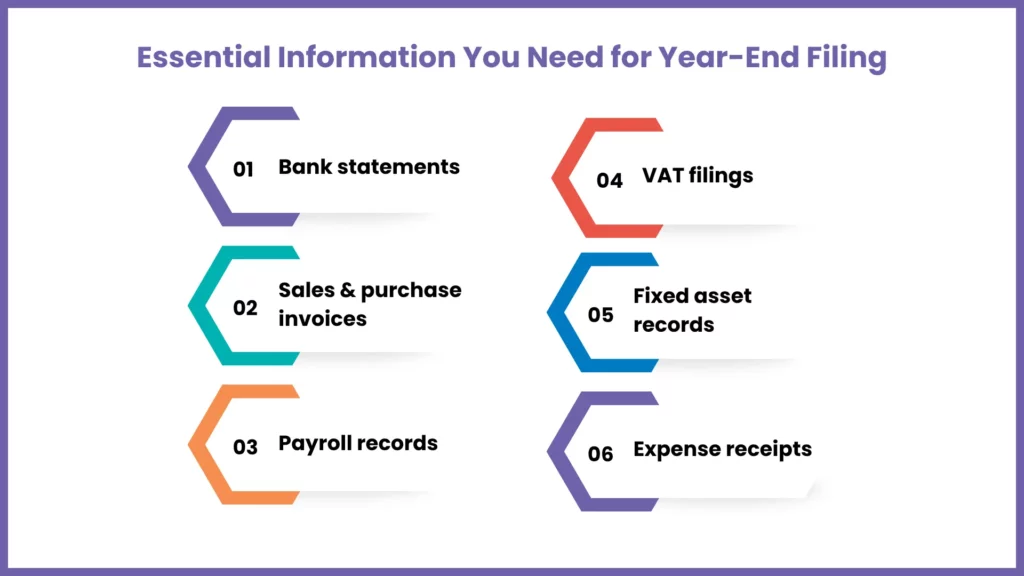
To prepare year-end accounts, gather detailed records early: Bank statements covering the entire year and reconciled to books, Sales invoices that prove income, purchase invoices and expense receipts that businesses in the UK can claim tax deductions, payroll records (PAYE, salaries, P11Ds).
VAT records to show VAT returns and payments, fixed assets including depreciation; debts/liabilities; stock adjustments. Cloud accounting software keeps your business records in an audit-ready format throughout the year to prepare the tax filings.
Steps to Prepare Your Business for HMRC Year-End Filing
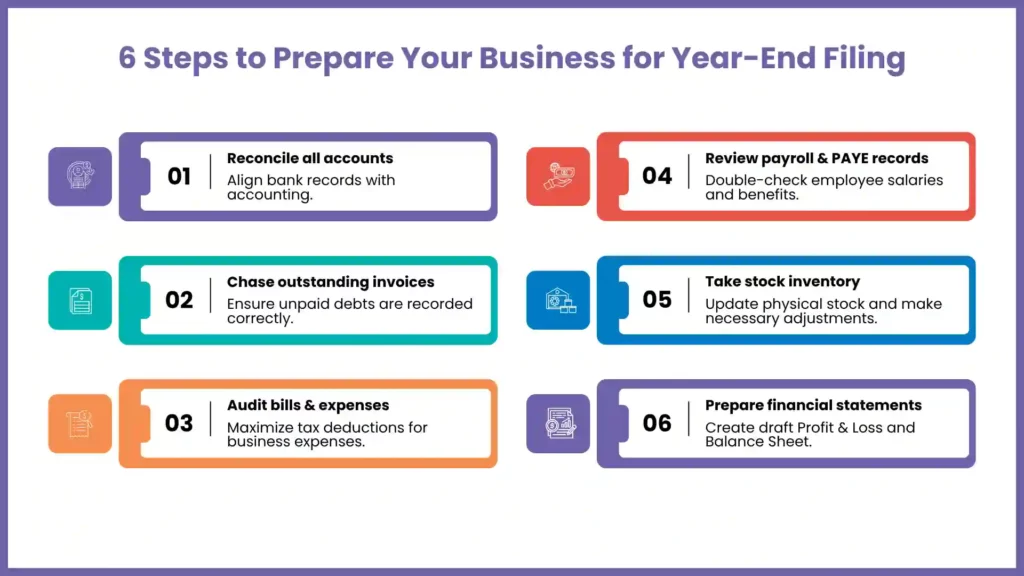
To ensure success in filing year-end taxes and preparing tax returns for businesses, follow the following steps in detail:
Complete the Reconciling of All Accounts: Compare the bank accounts with accounting records, code all transactions with documentation and correct the difference immediately. Cloud accounting software would combine transactions matching and they would not be left unmatched, which would provide a clean basis on which to prepare year end accounts.
Chase Outstanding Invoices and Work Bad Debts: Contact customers who have outstanding invoices and ensure that no further payments are expected within the current accounting period. Only include cash that has actually been received as part of your taxable income. For legitimate bad debts, you can claim bad debt relief, which will directly reduce your taxable profits and corporation tax liability.
Review your bills and take advantage of tax reliefs: Make sure that all the business expenses that can be incurred are entered and classified accordingly- office costs, travel, subscriptions, software licenses, employee expenses should all be under tax deductions for businesses in the UK. Every £100 of qualifying expenses saves £25 in Corporation Tax at the 25% rate. Annual Investment Allowance (AIA) and R&D tax credits can significantly reduce the cost of qualifying capital projects
Check Payroll and PAYE Records: Assure final month salaries, bonuses, employer pension contributions and P11D data are correct regarding employee benefits in kind (by 6 July after the end of the tax year). Make sure that you submit all the PAYE returns in order to evade penalties.
Carry out Full Stock Inventory: Conduct physical inventory, reconcile inventory and revalue damaged, obsolete or slow-moving inventory. The correct amount of stocks directly relates to your profit calculation as well as the tax payable.
Preparation and Reviewing Financial Statements: Prepare Profit and Loss Account and Balance Sheet out of reconciled data. Check to detect abnormalities, stand up against accounting standards, and proofread before submitting to your accountant to be completed.
Common Mistakes to Avoid During HMRC Year-End Filing
Many established businesses still make mistakes when filing annual taxes. Late submission of deadlines attract automatic penalties despite the tax due. Unreconciled banks or expenses that are not categorised as such makes your tax bill larger and not approved quickly. Asserting non-qualifying expenses is a breach of the wholly and exclusively rule of business purpose.
Failure to register for VAT once you exceed the £90,000 threshold demands an immediate process of making business VAT filing MTD compliant. Loans to directors above 9 months without any pay are subject to 33.75% S455 tax. It is a waste of money to ignore tax deductions for businesses in the UK such as AIA or R&D credits. Mistakes in the payroll cause penalties and hassles. Stay organised throughout the year to remain compliant with UK tax rules.
Preparing for an HMRC Audit
HMRC can open compliance checks going back several years, depending on the circumstances. Keep a minimum of 6 years: bank statements, invoices/receipts, VAT/PAYE filings, payroll information, contracts and claim tax deductions for businesses in the UK.
The MTD software makes the accounting of the business on tax filing automatically available and arranged in real time. Act swiftly and gather all records, and contact your accountant as soon as possible to handle paperwork and reduce potential penalties.
How Professional Advice Can Help with HMRC Year-End Filing
Although self-filing of corporate tax returns is allowed, qualified accountants provide better services in preparing tax returns for businesses. They provide error-free statutory accounts and CT600 submissions, identify tax deductions that businesses may have overlooked in the UK, ensure MTD compliance (VAT compulsory, ITSA from April 2026 if income > £50k), handle HMRC inquiries and audits, and arrange optimal spending, profit extraction, and pension contributions. Their charges are tax-deductible, which may result in a net benefit, making professional advice a necessity for complex operations and robust UK tax compliance.
HMRC Year-End Filing Checklist for Your Business
For year-end tax filing, use this annual UK tax filing checklist to guarantee UK tax compliance:
- Balancing of all bank accounts and settling of differences.
- Raise and pursue outstanding sales invoices.
- Get full purchase receipts and expense records.
- Record bad debts that are confirmed.
- Finalise payroll, pensions and file P11Ds(6 July deadline)
- Full physical inventory and valuation
- Fix fixed asset register with depreciation.
- Develop Profit and Loss Account and Balance Sheet drafts.
- File annual reports to Companies House (9 months)
- Send file corporate tax returns CT600 to HMRC (12 months)
- Pay corporation tax (9 months and 1 day)
- Complete your VAT returns using MTD-compliant software
- Companies House File Confirmation Statement.
- Claim viable reliefs (AIA, R&D Tax Credits)
- Store all electronic financial documents in a safe place.
- Set up budgets and financial objectives for the next period.
This yearly tax filing checklist simplifies the process of filing in the tax returns of companies.

Need Help with Your Year-End Tax Filing?
Let MyIVA handle your HMRC submissions while you focus on growing your business. Book a free consultation now and ensure your filings are accurate, compliant, and stress-free.
FAQs: Frequently Asked Questions
What are year-end accounts?
Statutory accounts showing your company’s financial position, including the Profit & Loss (P&L), Balance Sheet, and Notes. Filed with Companies House. Different from the CT600 corporation tax return to HMRC.
When are Corporation Tax deadlines?
Corporation tax must be paid 9 months and 1 day after the accounting period ends. The CT600 return must be filed 12 months after the accounting period ends.
What is the VAT registration threshold?
£90,000 taxable turnover (for tax years 2024/25–2026). Businesses above this must register for VAT. Making Tax Digital is mandatory for VAT-registered companies.
What is a Confirmation Statement?
Annual statement confirming your company’s details (registered office, directors, shareholders). Must be filed within 14 days of the review period
Can I use accounting software for HMRC filings?
Yes, you can use MTD-compliant accounting software like Xero, QuickBooks, or FreeAgent to handle VAT filings and prepare CT600 data. The software must connect directly to HMRC via API for submissions, ensuring
Conclusion
To learn how to prepare a year-end accounts, one must be a proactive UK tax-compliant, follow the guidelines of submission to HMRC correctly and use an annual tax filing checklist in a disciplined manner. The UK strategic tax deductions of business, professional skills of corporate tax returns and structured systems make end of year tax filing a burden to an opportunity.
Continued business accounting to file taxes guarantees confidence in compliance, financial transparency and growth. The software in tools such as Myvia offers MTD-compliant software utilised by businesses in the UK to ensure the smooth business VAT filing process, annual records organisation, efficient tax management, and expert advice.