

Since April 2023, the UK’s Corporation Tax system has changed significantly. Rather than applying one standard rate to all companies, tax is now charged using a tiered structure. Businesses with profits of up to £50,000 generally pay 19%, while those earning £250,000 or more pay the main rate of 25%. Companies whose profits fall between these two limits sit in the marginal relief band, where the effective tax rate increases gradually between the lower and upper rates.
For many small businesses, this shift has not always been easy to understand. Directors may see their profits rise slightly and assume that the entire amount will suddenly be taxed at 25%. In reality, that is not how the system works.
This is where marginal relief for corporation tax comes into play. When a company’s profits fall between £50,000 and £250,000, the tax calculation includes a reduction known as marginal relief. The purpose of this relief is to ensure that businesses moving through the middle profit range do not face an immediate jump from the small profits rate to the main rate.
Because of this structure, the effective tax rate increases gradually as profits grow, rather than changing suddenly at a single threshold. However, many business owners are unaware of how this calculation works or whether it has been applied correctly in their Corporation Tax return.
In this article, we explain what marginal relief for corporation tax is, how it works in practice, who qualifies for it, how it is calculated, and why it matters for companies whose profits fall near the tax thresholds.
What Is Marginal Relief for Corporation Tax?
Marginal relief for corporation tax is designed to smooth the transition between the 19% small profits rate and the 25% main Corporation Tax rate. It applies to companies whose taxable profits fall between £50,000 and £250,000.
Instead of moving directly from one tax rate to another, companies within this range pay an effective rate somewhere between 19% and 25%. The exact rate depends on how close the company’s profits are to the upper threshold.
For example, a business earning just above £50,000 will still pay a rate close to 19%. As profits increase, the benefit of marginal relief gradually reduces. Once profits reach £250,000, the relief no longer applies and the company pays the full 25% main rate.
This approach was introduced to make the tax system more balanced for growing businesses. Without marginal relief, even a small increase in profit above the lower threshold could lead to a significant increase in tax.
It is also worth noting that the thresholds can change if a company has associated companies. In such cases, the £50,000 and £250,000 limits are divided between the associated companies, which may reduce the range where marginal relief applies.
How Does Marginal Relief Work?
Marginal Relief works by gradually increasing the amount of Corporation Tax a company pays when its profits fall between the lower and upper profit limits of £50,000 and £250,000. Instead of jumping directly from the Small Profits Rate to the Main Rate, Marginal Relief provides a smooth transition.
The Profit Thresholds
According to HM Revenue & Customs, Marginal Relief applies when a company’s profits fall between:
• £50,000 Lower Limit. Companies at or below this level usually pay the Small Profits Rate of 19 %.
• £250,000 Upper Limit. Companies at or above this level pay the Main Corporation Tax Rate of 25 %.
If a small firm’s profits fall between £50,000 and £250,000, marginal relief for corporation tax reduces the tax payable so the effective rate gradually increases from 19 % to 25 %.
If there are associated companies, these limits are divided by the number of associated companies. This is often overlooked and can change the position significantly.For accounting periods shorter than 12 months, HMRC adjusts thresholds proportionately (e.g., 6-month period: lower limit £25,000, upper £125,000). This ensures fairness for partial-year returns.
How the Relief Is Calculated
- Compute main tax: Taxable Profits × 25%.
- Marginal Relief = Fraction × (Upper Limit − Taxable Profits) × 3/200.
- Fraction = Taxable Profits ÷ Total Profits (usually 1.0 if no franked dividends).
- Final tax = Main tax − Relief.
Relief applies only if profits > lower limit; enter in CT600 box 555. No separate claim needed.
Example
Suppose a small business makes £100,000 in taxable profits. On the surface, you might assume tax is charged at 25 %. However, because profits are within the band, marginal relief for corporation tax applies. The company receives a reduction, meaning the effective rate sits somewhere between 19 % and 25 %.
It is not a separate payment or claim. It forms part of the Corporation Tax calculation.
Who Can Claim Marginal Relief for Corporation Tax?
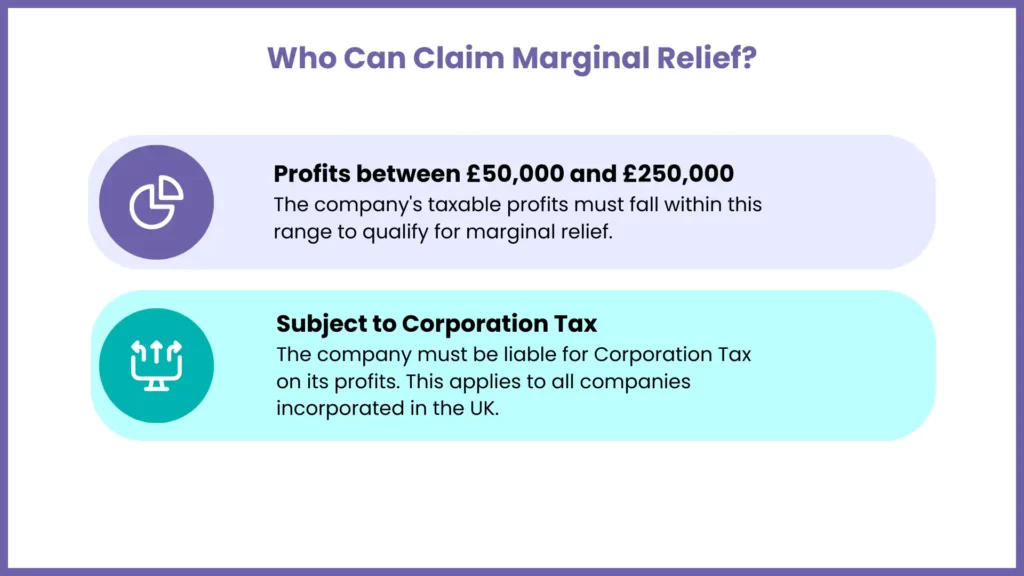
Marginal Relief can be claimed by companies that pay Corporation Tax and whose profits fall between the lower and upper limits. It does not apply to sole traders or partnerships, as they are taxed under Income Tax rules.
Companies Eligible for Marginal Relief
A small firm may qualify for marginal relief for corporation tax if it meets the following conditions:
Profits Between the Threshold Limits
Taxable profits must fall between £50,000 and £250,000.
Subject to Corporation Tax
The company must be liable for Corporation Tax on its profits.
Not Eligible for the Small Profits Rate Alone
Profits above £50,000 move beyond the pure 19 % rate. Instead of switching straight to 25 %, marginal relief for corporation tax adjusts the rate gradually.
Adjusted Limits for Associated Companies
If the small business has associated companies, the thresholds are divided. This can reduce the band available for relief.
Example
If a small firm earns £120,000 in taxable profits and has no associated companies, it falls clearly within the marginal relief for corporation tax range. It will not pay the full main rate. Instead, relief reduces the final bill.
Key Exclusion
- Non-UK resident companies (unless trading in UK).
- Close investment holding companies.
These are ineligible for marginal relief despite meeting profit thresholds—check CT600 guidance.
How to Calculate Marginal Relief for Corporation Tax?
Although software often handles the calculation, it is helpful to understand the steps behind it.
Step 1: Identify Taxable Profits
Confirm that profits fall between £50,000 and £250,000. If they do, marginal relief for corporation tax may apply.
Step 2: Apply the Formula
Marginal Relief = (250,000 − Taxable Profits) × 3 / 200
This provides the amount of relief.
Step 3: Calculate Corporation Tax at 25 %
Corporation Tax = Taxable Profits × 25 %
Step 4: Deduct the Relief
Final Corporation Tax Payable = Main Rate Tax − Marginal Relief
Example Calculation
£120,000 Profits (No Associates)
- Taxable Profits (P): £120,000; Upper Limit (U): £250,000; Fraction: 1.
- Main tax: £120,000 × 0.25 = £30,000.
- Relief: 1 × (£250,000 − £120,000) × 3/200 = 130,000 × 0.015 = £1,950.
- Final tax: £28,050 (effective rate ~23.4%).
With 1 associate: Limits halve (£125,000 upper); relief: 1 × (£125,000 − £120,000) × 3/200 = £75; final tax £29,925.
Why Is Marginal Relief Important for Medium Sized Businesses?
Medium sized small businesses often find themselves in the £50,000 to £250,000 profit range. This is exactly where marginal relief for corporation tax operates.
Without it, growth could feel punishing. A small increase in profit would lead to a full jump in tax rate. The relief softens that effect and allows directors to plan with more certainty.
Cash flow planning also improves. When you understand how marginal relief for corporation tax affects your liability, you can set aside the correct amount for tax rather than guessing. For a growing small firm, that clarity matters.
Optimising Corporation Tax with Marginal Relief
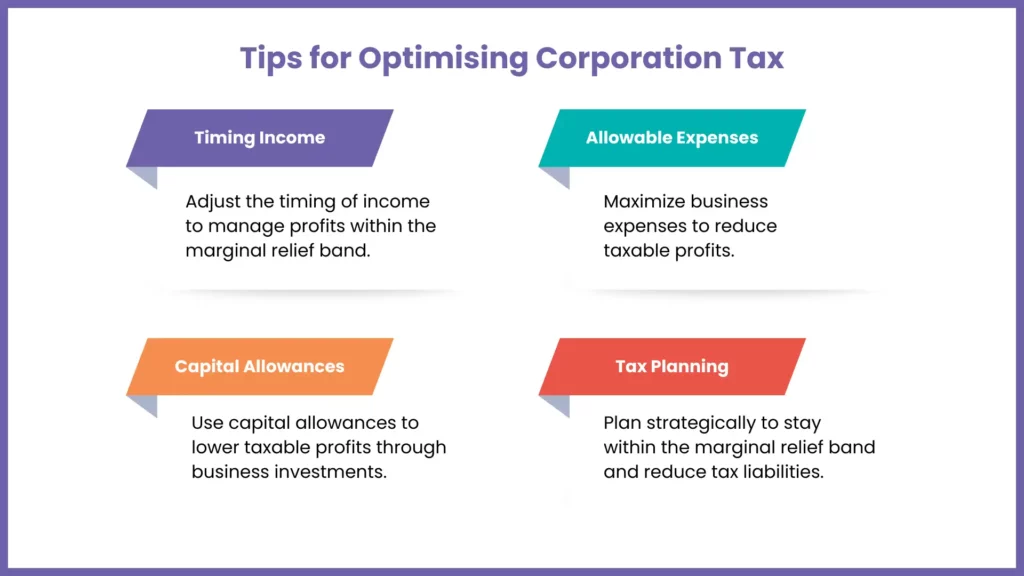
A small business does not control tax rates, but it can manage timing and structure.
Manage Profit Levels Strategically
Directors may consider:
• Timing income within the accounting period
• Bringing forward allowable expenditure
• Investing in deductible assets
Careful planning can help a small firm remain within the marginal relief for corporation tax band where appropriate.
Utilise Allowable Business Expenses
Claiming legitimate expenses reduces taxable profits. Office rent, staff wages, software subscriptions, and professional fees all count. Lower profits can increase the benefit of marginal relief for corporation tax.
Take Advantage of Capital Allowances
Capital allowances on equipment and machinery reduce taxable profits further. This supports growth while managing tax exposure.
Consider the Impact of Associated Companies
Where multiple companies exist under common control, thresholds are divided. Reviewing structure is important to understand how marginal relief for corporation tax applies.
Seek Professional Tax Planning
While the formula is fixed, planning around profit levels and structure requires judgement. An experienced adviser can ensure the small business applies the rules correctly and avoids miscalculation.
Note: If you’re looking for more strategies, check out our 10 Ways to Reduce Corporation Tax guide to explore additional tips on minimising your tax burden.
Corporation Tax Rates and Their Relationship to Marginal Relief
The current structure creates three broad positions for companies. Understanding how they link to marginal relief for corporation tax makes forecasting easier.
| Corporation Tax Rate | Rate %age | Relationship to Marginal Relief |
| Small Profits Rate | 19 % | Applies to profits up to £50,000. No Marginal Relief needed. |
| Marginal Relief Band | Effective rate between 19 % and 25 % | Applies to profits between £50,000 and £250,000. Relief reduces main rate tax. |
| Main Rate | 25 % | Applies to profits of £250,000 and above. No Marginal Relief available. |
The system is tiered, but the transition is gradual rather than abrupt.
FAQs: Frequently Asked Questions
What are the current corporation tax rates and thresholds?
The small profits rate is 19 % up to £50,000. The main rate is 25 % from £250,000. Marginal relief for corporation tax applies between these limits.
Who cannot claim marginal relief?
Companies below £50,000 or above £250,000 in profits cannot claim marginal relief for corporation tax. Sole traders are also excluded.
Is marginal relief available to all companies?
It applies only to companies within the qualifying band and subject to Corporation Tax. Associated companies may reduce the available thresholds.
What happens if I miss the deadline for claiming marginal relief?
Marginal relief for corporation tax is calculated within the Corporation Tax return. Late filing can result in penalties.
Does the relief apply automatically?
It is part of the tax computation, but figures must be accurate. Incorrect profit calculations will affect the result.
Can tax planning increase the benefit of marginal relief?
Yes. Managing expenses and capital allowances can influence taxable profits and therefore the amount of marginal relief for corporation tax.
Conclusion
Marginal relief for corporation tax plays a quiet but important role in how a small business pays Corporation Tax. It prevents a sudden shift from 19 % to 25 % and ensures that companies with moderate profits are taxed gradually.
MyIVA works closely with small firms to calculate Corporation Tax accurately and apply marginal relief for corporation tax correctly. If your small business profits are near the threshold, speak with MyIVA today and make sure you are not paying more tax than necessary.