
Filing a Self-Assessment for the first time can feel a bit daunting. Every year, plenty of people leave it until the last minute, and that’s when mistakes and penalties usually happen. If you’re a sole trader, contractor or managing a small firm for the first time, it’s perfectly normal to feel unsure about what to include or how to begin.
A lot of first-time filers simply don’t know what HMRC expects. It’s easy to worry about missing documents, entering the wrong figures or forgetting to record certain expenses. All of this creates pressure and makes the process seem far more complicated than it actually is.
When you understand how to file a Self-Assessment tax return correctly, the pressure eases. You know what HMRC needs, you avoid penalties, and you get a clear picture of what personal tax you owe. Once the steps make sense, the whole process becomes much easier to manage.
This guide will walk you through your first Self-Assessment. It explains how the process works, what documents you need, how to complete each part of the return and when it might be sensible to ask for help.
In this blog we will explore who needs to file a Self-Assessment tax return, registration steps, key deadlines, documents you need, how to file your return step by step, how payments work, and how MyIVA can help you file accurately and on time.
What Is a Self-Assessment Tax Return?
A Self-Assessment tax return is a system used by HMRC to collect personal tax from individuals who don’t have their full income taxed at source. Instead of your employer automatically handling everything through PAYE, you report your own income and expenses directly to HMRC.
You must tell HMRC how much you earned in the tax year that runs from 6 April to 5 April. You also report expenses, tax reliefs, and any additional income such as rental profits, dividends, or partnership income. HMRC then calculates how much tax you owe or whether you are due a refund.
Self-Assessment is for people who need to tell HMRC about income that isn’t already taxed. This includes sole traders, landlords and anyone earning money outside a normal job. Filing your return on time keeps you compliant and helps you avoid penalties.
Who Needs to File a Self-Assessment Tax Return?
If you earn money that isn’t automatically taxed through PAYE, you may need to file a Self -Assessment tax return. This applies to many sole traders, landlords and small firm owners. The rules are clear once you know them, and this section explains exactly who must file.
Do I Need to File a Self-Assessment?
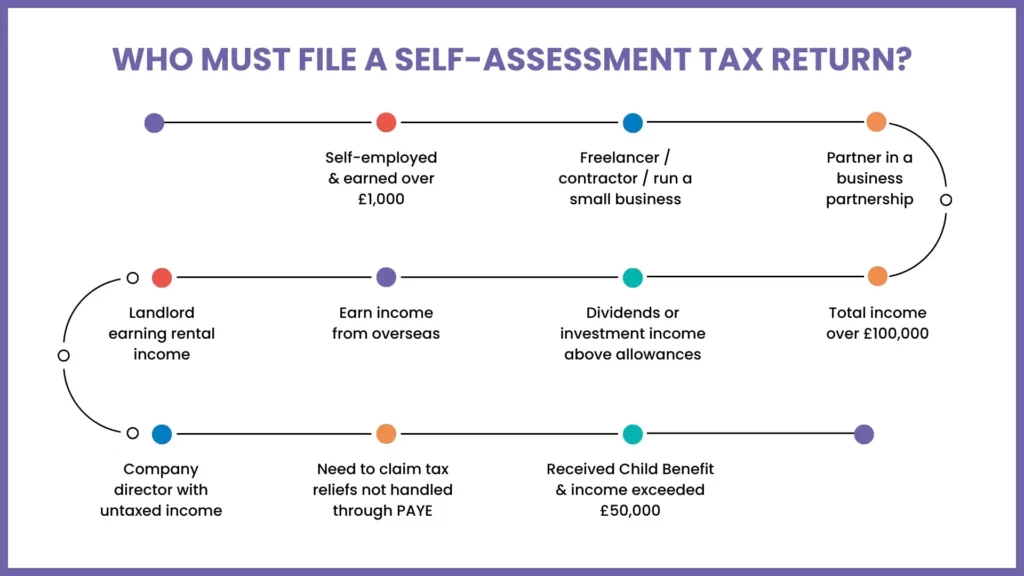
You’ll need to file a Self-Assessment tax return if any of these apply to you:
- You’re self-employed and your earnings for the year were above £1,000.
- You run a small business or work independently as a freelancer or contractor.
- You’re part of a partnership and share profits.
- You have income from renting out a property.
- You’re a company director and pay tax on some income outside PAYE.
- You earn over £100,000 a year.
- You receive dividends or investment income above your tax-free allowances.
- You have foreign income.
- You need to claim certain tax reliefs.
- You received Child Benefit and your income exceeded £50,000.
- HMRC specifically asks you to file.
If you’re unsure, do it sooner rather than later. Many first-timers only check at the end of the year and make life harder than it needs to be.
Can I avoid filing when my income is low?
If your self-employed income is under £1,000 for the year, the trading allowance normally covers you, so you won’t need to submit a return. The property allowance works the same way if your rental income stays below £1,000.
But you may still need to file if:
- You want to claim allowable expenses instead of the allowance.
- You made a loss and want to carry it forward.
- HMRC sends you a notice to file.
- You received dividends or savings income above allowances
- You need to declare foreign income.
- You run a small firm and your accounts need reporting.
If you are unsure, getting support from an accountant such as MyIVA can help you decide whether a tax return is required.
Self-Assessment Tax Return Filing Deadline
HMRC sets specific dates for Self-Assessment each year:
- The deadline for paper tax returns is 31 October
- The deadline for online tax returns is 31 January
- Your tax bill must also be paid by 31 January.
- If you make payments on account, these are due on 31 January and 31 July.
Filing earlier in the year is always easier. It gives you time to find your documents, correct any mistakes and plan for your tax bill instead of rushing at the last minute.
What Happens If I Miss the Deadline?
If you miss the filing date, HMRC charges a £100 penalty straight away, even if you don’t owe any tax. The fine increases the longer your return is overdue, and interest is added if your payment is late as well.
Delays can cause real problems for sole traders and small firms who depend on accurate budgeting. Filing on time keeps everything under control and avoids unnecessary costs.
How Do I Register for Self-Assessment Tax Return with HMRC?
If you are filing for the first time, you must register before you can submit your return. Here is how to do it:
- Create a Government Gateway account on the HMRC website.
- Register for Self-Assessment as a sole trader, partner, landlord, or individual with untaxed income.
- Once registered, HMRC sends you a Unique Taxpayer Reference (UTR) by post. This usually arrives within ten working days.
- You also receive an activation code for your Government Gateway account.
- Log in and activate the account using the code.
- Once activated, you can complete your return online.
Registering early ensures you receive your UTR and codes in time. Many first-time filers register too late and run out of time to file.
What Documents Do I Need to Prepare for My First Self- Assessment?
Gathering the right documents early will save you a lot of stress. You should prepare:
- Records of all self-employed income.
- Invoices and receipts.
- Bank statements.
- Expense records.
- Mileage logs.
- Home office calculations if applicable.
- Bookkeeping summaries if you run a small firm.
- Rental income and expense records if you are a landlord.
- PAYE records if you had employment alongside self-employment.
- P60 or P45 forms.
- Pension contributions.
- Dividend vouchers.
- Interest statements.
- Overseas income records.
- Any information relevant to corporate tax if you run a company and file personal tax alongside it.
Having clear records helps you file accurately and reduces the risk of an HMRC enquiry.
How to File a Self-Assessment Tax Return Step by Step
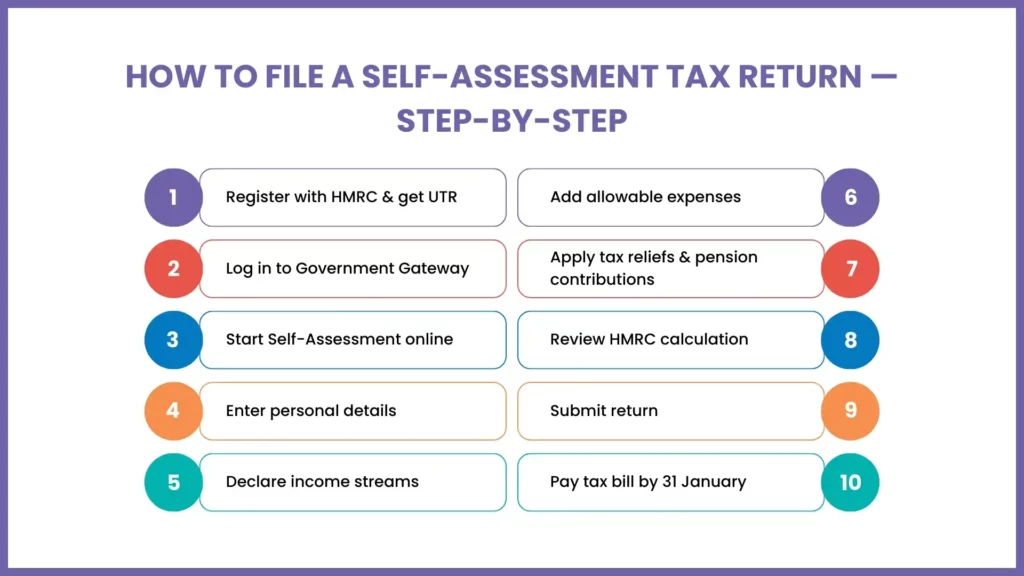
Follow these steps carefully to file your return:
- Log in to your HMRC Government Gateway account.
- Select Self-Assessment and begin your online return.
- Answer the initial questions which decide which sections apply to you.
- Enter your personal details and check that your National Insurance number is correct.
- Declare your income whether you are a sole trader, landlord, partner or company director.
- Include any extra income such as dividends, interest from savings or money earned from overseas.
- Enter your allowable expenses including tools, travel, home working, and professional services.
- If you run a small firm, submit your trading summary or accounts figures.
- Add pension contributions or other tax reliefs if applicable.
- Review the calculation shown by HMRC which tells you your tax bill.
- Check every section carefully.
- Submit your return.
- Pay your tax bill by 31 January.
- If chosen by HMRC, set up payments on account for next year.
Filing slowly and checking each section helps avoid mistakes. If you are unsure at any stage, MyIVA can step in to help you complete your return accurately.
Can I Pay My Self-Assessment Tax Bill in Advance?
Yes. Many people choose to pay early to spread the cost. You can:
- Make voluntary payments throughout the year.
- Set up budgeting reminders.
- Make payments on account if required by HMRC.
- Pay your full bill early once your return is complete.
Early payment helps with cash flow and ensures you never miss deadlines.
How Can MyIVA Help with My Self-Assessment Tax Return?
Filing your first return can feel overwhelming, especially if you are self-employed or running a small firm. MyIVA is an online accounting and tax partner designed to make the entire process smooth and stress free.
Here is how MyIVA helps:
- Fast and accurate personal tax return filing.
- Support for corporate tax and accounting if you run a small firm.
- Clear guidance on what documents you need.
- Full online process with secure document handling.
- Quick turnaround in three to five working days.
- 24-hour express option available.
- Expert accountants ready to answer questions.
- Help with expenses, reliefs, and avoiding mistakes.
- HMRC compliant filing.
- Ongoing support for bookkeeping, VAT returns, payroll, and company accounts.
Whether you are a first-time filer, a landlord, or someone running a small firm, MyIVA makes the process simple and stress free.
FAQs: Frequently Asked Questions
How long does it take to file a Self-Assessment?
If you have all your documents ready, it’s quick. Most people take less than an hour. If it’s your first time, it might take a bit longer while you get used to the HMRC system.
What are the most common mistakes people make?
People often miss some of their income, forget to include expenses, type in the wrong figures or leave everything until the last minute.
When should I contact HMRC?
Get in touch if you need to update your details, request your UTR again or check how to report income that doesn’t fit the standard categories.
Can I get a refund?
Yes. If you’ve paid too much tax through PAYE or your expenses reduce your tax bill, HMRC will send your refund once they process your return.
Can I change my tax return after submitting it?
Yes. You can correct your return for up to twelve months after the deadline.
When is it a good idea to hire an accountant?
It helps to get support if you aren’t sure how to report your income, you run a small firm or you simply want to avoid mistakes and save time.
Conclusion
Filing a Self-Assessment tax return for the first time is easier than it seems. Once you know whether you need to file, what documents to collect and how the form is laid out, the whole process starts to make sense. Register early, keep your records tidy and try not to leave everything until the deadline.
If you want support or would rather have someone handle it for you, MyIVA can take care of the return for you. We can deal with everything from personal tax returns to helping small businesses with their corporate tax needs and we make the whole process a lot less stressful. Whenever you are ready, MyIVA can guide you through every step.