



Most pensioners whose only income is the State Pension do not need to file a Self Assessment tax return, because HMRC collects any tax owed automatically. However, you will typically need to file if your total income from pensions, savings, rental property or other sources exceeds your Personal Allowance and isn’t fully taxed at source, or if you meet one of several specific HMRC triggers covered below.
The landscape of retirement in the United Kingdom is shifting, and with it, the complexities of tax compliance for those in their golden years. For many retirees, the assumption has long been that once they stop working, their relationship with HM Revenue and Customs (HMRC) becomes a simple matter of receiving a state pension. However, as we move through 2026, a significant number of pensioners are finding themselves pulled back into the world of tax filings. Understanding whether you need to file a tax return is no longer just a concern for the self-employed; it is an essential part of modern retirement planning.
At MyIVA, we understand that navigating these rules can be daunting, which is why we have compiled this definitive guide to help you understand your obligations and avoid unnecessary penalties.
Why More Pensioners Are Being Asked to File in 2026
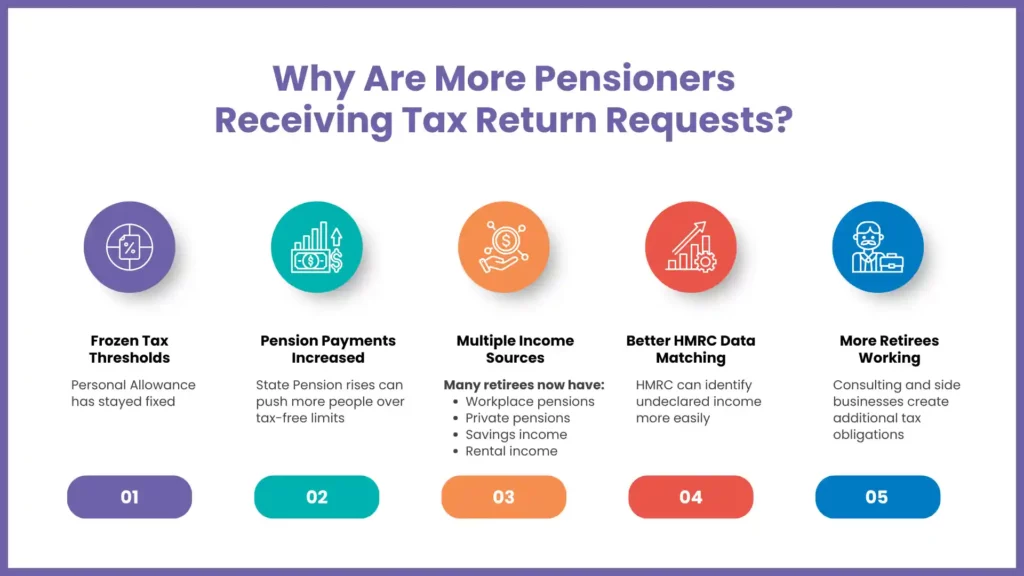
If you’ve heard more and more talk about pensioner tax returns in recent times, you’re not the only one. A significant rise in the number of people turning 65 in 2026 and being contacted by HMRC to complete a Self Assessment tax return. The main reason for this is the “fiscal drag” resulting from the tax thresholds being frozen. The Personal Allowance (how much you can earn without paying tax) has not increased in the same way as pension payments have, which tend to rise in line with inflation, such as via the ‘Triple Lock’ agreement on State Pensions.
With the Personal Allowance remaining unchanged when pension benefits increase, more and more retirees discover that the income they receive from their State Pension, private pensions and savings interest exceeds the tax-free threshold. This isn’t a distant risk: the Personal Allowance has been frozen at £12,570 since 2021 and is now confirmed by HMRC to stay frozen until 2031, while the full new State Pension continues rising under the Triple Lock. Industry analysis suggests that if State Pension increases continue at recent rates, pensioners relying solely on the State Pension could find their income exceeding the Personal Allowance from 2026/27 onwards, pulling a much larger group into the tax net for the first time. Further, HMRC’s data-matching capabilities have become more advanced, enabling it to identify taxpayers with multiple sources of income who may not have been fully taxed at source. The proactive action of the tax authorities has resulted in the formal request from many who have had no previous contact with the authorities to explain their total earnings.
When Pensioners Don’t Need to File a Tax Return
It is important to note that not every pensioner is required to file a return. For many, the tax system remains relatively automated. You generally do not need to file a tax return if:
- Your only income is the State Pension: If the only income you earn is the State Pension, then a filing is typically not required by HMRC, unless the total amount you earn in a year is less than the Personal Allowance.
- Tax is deducted at source. If you have an occupational or private pension where the correct amount of tax is deducted by the provider under the Pay As You Earn (PAYE) system, you may not need to submit a separate return.
- You have received a Simple Assessment: In some situations, HMRC will calculate the tax on your behalf and send you a “Simple Assessment” letter, which you do not need to complete a Self Assessment return on, unless the figures are wrong.
- Your savings interest is within your Personal Savings Allowance: Basic-rate taxpayers can earn up to £1,000 in savings interest tax-free, and higher-rate taxpayers up to £500, before this needs to be reported (additional-rate taxpayers receive no allowance). Interest within this allowance doesn’t, on its own, require a return.
- Allowances like Marriage Allowance or Blind Person’s Allowance have already been applied through your tax code, rather than needing to be claimed manually via Self Assessment.
However, the line between needing to file and being exempt is becoming thinner. It is always safer to verify your status rather than assume you are exempt, especially if your income is close to the threshold.
What Types of Pension Income Are Taxed?
One of the biggest myths is that pension income is all lump sum income and doesn’t count toward income tax. In fact, virtually every type of pension income is income that’s subject to income tax if you earn more than your Personal Allowance. Taxable pension streams include the following:
- The State Pension: The State Pension is paid gross (before tax is taken out), but it is included in your total taxable income.
- Occupational Pensions: Pensions paid from an employer’s pension scheme.
- Personal/Private Pensions: Income received from personal/private pensions (SIPPs) or other private schemes.
- Annuities: Regular payments purchased with a pension pot.
- Retirement Lump Sums: The first 25% of the pension pot is typically tax-free, and the remaining 75% will be considered taxable income when taken out.
In addition to their pension payments, retirees need to consider other types of income, including rental income from property, dividends from shares, and substantial interest from savings accounts, which is above the Personal Savings Allowance. (£1,000 for basic-rate taxpayers, £500 for higher-rate taxpayers) or Dividend Allowance (£500 for 2026/27).
Pensioner-Specific Situations That DO Require Filing
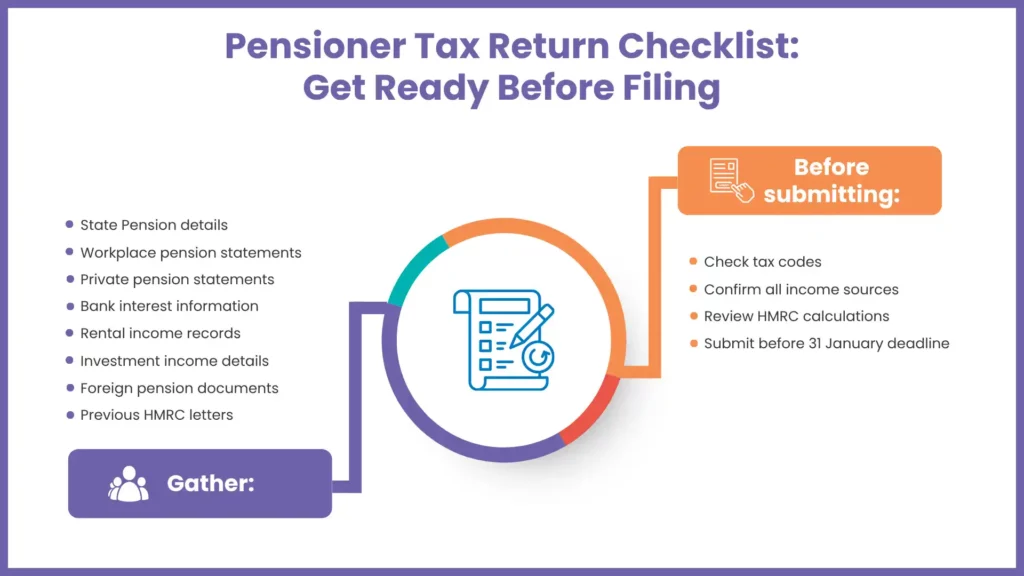
There are specific triggers that mandate a Self Assessment tax return for pensioners, even if they feel their financial life is straightforward. You must typically file if:
- Total Income Exceeds £150,000: This is the current PAYE-only Self Assessment threshold (raised from £100,000 for the 2023/24 tax year onwards). If your only income is fully taxed at source and totals less than £150,000, you generally won’t need to file for this reason alone — though other triggers on this list may still apply.
- Untaxed Income Over £2,500: This typically applies to income such as rental profits or tips that HMRC hasn’t already taxed at source.
- Savings and Investments: If your income from savings or investments is over £10,000.
- Foreign Income: If you receive a pension from overseas, this must be declared to HMRC to ensure the correct application of double-taxation treaties.
- Trust Income: If you are a beneficiary of a trust that provides a regular income.
- Self-Employed Side Hustles: Many retirees consult or run small businesses; if your gross income from these activities exceeds £1,000, you must register for Self Assessment.
- Capital Gains Tax: If you sell property, shares or other assets and your total gain exceeds the £3,000 annual tax-free allowance, you must report and pay Capital Gains Tax, usually via Self Assessment (residential property sales also require a separate 60-day CGT return in addition to the annual return).
Simple Assessment vs. Self Assessment — What Pensioners Actually Get
Understanding the document you receive from HMRC is crucial.
- Self Assessment: This is the traditional method where you are responsible for reporting your income, claiming expenses, and calculating your liability (though the online system does the math for you). You must register for this and meet the January 31st deadline.
- Simple Assessment: This was introduced to make life easier for those with straightforward affairs, particularly pensioners whose State Pension is higher than their Personal Allowance but who have no other complex income. HMRC uses data they already have to calculate your tax and sends you a P800 or a Simple Assessment letter.
If you receive a Simple Assessment, you don’t need to do anything if you agree with the numbers. However, if you have other income that HMRC isn’t aware of, you are still legally obligated to notify them, which may mean moving to the Self Assessment system.HMRC typically sends most Simple Assessment letters between July and August after the end of the tax year, and you have 60 days from the date of the letter to contact HMRC if any of the details are wrong or incomplete. After that window, it becomes harder to dispute the figures. You can read HMRC’s own guidance in the Simple Assessment guide for pensioners on GOV.UK.
If You Do Need to File: What’s Different for Pensioners?
Filing as a pensioner involves unique considerations compared to filing as an employee. One of the main differences is the Tax Code. Pensioners often have multiple tax codes spread across different pension providers. This can lead to the “Personal Allowance” being applied twice or not at all, resulting in underpayments or overpayments of tax.
Furthermore, pensioners must be careful when reporting lump sum withdrawals. If you take a large sum from your pension, your provider might apply an “emergency tax code,” taking significantly more tax than is actually owed. In these cases, filing a tax return is often the only way to claim back a substantial refund. Additionally, the way you report the State Pension is different; since it is paid without tax deducted, you must manually enter the total amount you were entitled to during the tax year, not just the amount that landed in your bank account. Note that these figures apply to England, Wales and Northern Ireland; if you’re a Scottish taxpayer, your Income Tax bands and rates differ, so it’s worth checking the Scottish-specific thresholds when working out what you owe.
Worked Example: A Realistic Retiree Scenario
To illustrate how these rules apply, consider the case of “Arthur”. Arthur receives a State Pension of £11,500 and an occupational pension of £5,000. He also rents out a small garage for £200 a month (£2,400 a year).
Arthur’s total income is £18,900. Since his Personal Allowance is £12,570, he owes tax on £6,330. While his occupational pension provider deducts some tax via PAYE, they are only aware of the £5,000 they pay him. They do not know about his rental income or the full extent of his State Pension. Arthur must file a Self Assessment tax return to declare the rental income and ensure the correct amount of tax is paid across all his income streams. Without filing, Arthur would likely face an “underpayment” notice and potential penalties later.
Common Pensioner Mistakes That Trigger Unexpected Tax Bills
HMRC frequently identifies errors in pensioner filings that lead to Stressful “brown envelopes” and financial penalties. Common pitfalls include:
- The “Forgotten” Small Pension: Many retirees have small “frozen” pensions from early in their careers. Forgetting to declare a few hundred pounds from an old scheme can trigger an investigation.
- Miscalculating the State Pension: Reporting the 13 four-weekly payments received in a year rather than the actual entitlement for the specific tax year (which runs April 6th to April 5th).
- Ignoring the P800: Assuming a P800 “tax calculation” letter is always correct. If it misses a source of income, the responsibility to correct it lies with the taxpayer.
- Missing the Deadline: Assuming that “being a pensioner” grants leniency. The £100 instant fine for missing the January 31st deadline applies regardless of age. Penalties escalate the longer a return remains outstanding — £10 per day after 3 months (up to £900), then a further £300 or 5% of the tax owed (whichever is greater) at both the 6-month and 12-month marks.
Not sure whether you need to file this year?
Get a fixed-fee Self Assessment return with MyIVA — no monthly subscription, no hidden costs, just accurate filing done for you
FAQs: Frequently Asked Questions
Do pensioners pay tax on the State Pension?
Yes, the State Pension is taxable. It is paid to you without tax deducted at the time, but is included in your income for the year. Tax will be payable on the income over and above the Personal Allowance if your total income (State Pension, other pensions and savings) is higher.
How do I know if a letter or call claiming to be from HMRC is genuine?
HMRC will never ask for bank details over the phone or send a link via text message asking for a “tax refund”. Genuine correspondence regarding tax returns will usually come via post or be visible within your official “Personal Tax Account” on the GOV.UK website. If in doubt, contact HMRC directly or speak to MyIVA.
At what age do you stop paying tax in the UK?
Income Tax is not for a certain age. You have to pay tax if your income is more than the Personal Allowance. But once you’re at State Pension age, you don’t pay National Insurance contributions anymore – even if you keep working.
Is there a special, higher Personal Allowance for pensioners?
No. The age-related Personal Allowance was phased out and pensioners now share the same £12,570 Personal Allowance as working-age taxpayers. The only exception is a small group born before 6 April 1948, who may retain a slightly different allowance.
Do I need to declare a small pension I forgot about?
Yes. All pension income must be declared. Even if it is a very small amount, it may still be picked up by HMRC’s automated systems as a discrepancy, and this could result in a broader audit of your finances.
What happens if I miss the filing deadline as a pensioner?
There will be a £100 fine for you immediately. After 3 months, the late return is subject to a daily penalty of £10, maxing out at £900. After 6 months, a further penalty of £300 or 5% of the tax owed (whichever is greater) applies, and the same again after 12 months. If you are unable to submit the work by the deadline, it is important to ask for an extension or for an exception to be granted (e.g., if you have a serious illness).
What is a P800 and do I need to act on it?
A P800 is a tax calculation sent by HMRC if they believe you have paid too much or too little tax through PAYE. If it says you are due a refund, you can usually claim it online. If it says you owe tax, you should check the figures carefully and follow the instructions to pay.
Can MyIVA help me with my tax return?
Absolutely. MyIVA specialises in assisting individuals, including pensioners, with their tax compliance. We can help you gather the necessary documentation, calculate your liabilities, and submit your return accurately and on time to ensure you never pay more tax than necessary.
Conclusion
Retirement should be a time of relaxation, not a time of tax-induced anxiety. However, the changing economic climate in 2026 means that more pensioners than ever are being brought into the Self Assessment net. By understanding which income is taxable, recognising the triggers for filing, and avoiding common mistakes, you can stay on the right side of HMRC.
Whether you are struggling with complex foreign pension income or simply need a second pair of eyes on your Simple Assessment, professional guidance can provide invaluable peace of mind. At MyIVA, we are dedicated to helping you navigate these hurdles so you can focus on enjoying your retirement. Don’t wait for a penalty notice—take control of your tax affairs today.


