



Over 4.4 million people in the UK now work for themselves, according to recent labour figures. Yet HMRC reports that a large number of penalties issued each year are linked to incorrect or late tax and National Insurance payments. For many sole traders and owners of a small business, National Insurance remains one of the least understood parts of self-employment.
The confusion often starts with National Insurance Contributions for Self-Employed workers. Unlike employees, nothing is deducted automatically. There is no payroll team and no employer checking the figures. You are expected to calculate what you owe, report it correctly, and pay it on time through Self Assessment. A small mistake can lead to interest charges or fines.
National Insurance Contributions for Self-Employed people are not just about staying on the right side of HMRC. They also affect your entitlement to the State Pension and other benefits later in life. Miss too many years and the impact can follow you into retirement.
In this blog, we break everything down in plain terms. You will learn what National Insurance is, who must pay it, how much it costs, how to pay it, and how to avoid the most common errors. If you are self-employed or run a small business, this guide will help you stay informed and prepared.
What Are National Insurance Contributions and Why Are They Important for the Self-Employed?
National Insurance Contributions are payments made to HMRC to support state benefits such as the State Pension and Maternity Allowance. While Income Tax funds public services, National Insurance focuses more on personal benefit entitlement.
For self-employed workers, National Insurance Contributions for Self-Employed operate under a different system to employees. There is no payslip deduction. Instead, your National Insurance is worked out using your annual profits and reported through your Self Assessment tax return. This extra responsibility often catches people out, especially in their first few years of trading.
National Insurance Contributions for Self-Employed people matter because they build your future entitlements. Each qualifying year adds to your State Pension record. For sole traders and owners of a small business, paying the correct amount protects both your present compliance and your long-term financial security.
Who Has to Pay National Insurance Contributions?
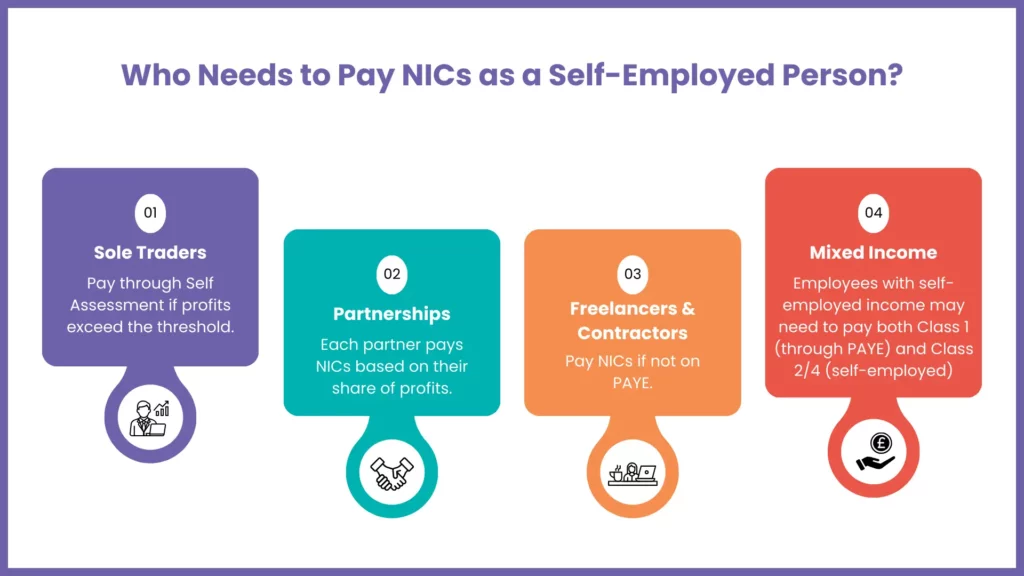
Not everyone pays National Insurance in the same way. The rules depend on how you earn your income and how much profit you make.
Sole Traders
If you are registered as a sole trader and your annual profits exceed the minimum threshold, you will normally pay National Insurance Contributions for Self-Employed people through Self Assessment.
Partners in a Partnership
Partners in a small business partnership are treated as self-employed. Each partner pays their own National Insurance based on their share of the profits.
Freelancers and Contractors
Freelancers and contractors who are not on PAYE usually fall under the self-employed rules. Even if you work with one main client, National Insurance Contributions for Self-Employed workers often apply.
People with Mixed Income
If you are employed and also earn self-employed income, you may pay two types of National Insurance. Employee contributions are taken through payroll, while self-employed contributions are calculated separately.
If you earn money outside PAYE and your profits meet HMRC limits, National Insurance Contributions for Self-Employed are likely part of your tax responsibilities.
Types of National Insurance Contributions: Class 2 vs. Class 4
The UK National Insurance system is split into classes. Each class applies to a different type of income or work status.
For self-employed people, National Insurance Contributions for Self-Employed income mainly fall under Class 2 and Class 4. Other classes apply to employees or voluntary payments.
Types of National Insurance Contributions
- Class 1: Paid by employees and employers through PAYE.
- Class 1A: Paid by employers on certain benefits, such as company cars.
- Class 1B: Paid by employers on benefits covered by PAYE Settlement Agreements.
- Class 2: Linked to self-employed work and protects your State Pension record.
- Class 3:Voluntary contributions are used to fill gaps in National Insurance records.
- Class 4A profit-based contribution paid by self-employed people
Class 2 vs. Class 4
| Feature | Class 2 | Class 4 |
| Who pays it | Self-employed people | Self-employed people |
| Based on | Flat amount or treated as paid | Percentage of profits |
| Purpose | Builds pension entitlement | Contributes based on earnings |
| How it is paid | Via Self Assessment | Via Self Assessment |
Recent changes mean many self-employed people no longer pay Class 2 as a separate charge. However, it still counts towards your pension if profits are high enough. Class 4 is calculated on profit and often forms the largest part of National Insurance Contributions for Self-Employed workers.
How Much Do You Need to Pay in NICs?
National Insurance is based on profit, not turnover. This is an important distinction for sole traders and owners of a small business.
If your profits fall below the lower threshold, you may not have to pay National Insurance, though you might still gain a qualifying year. Once profits pass the main threshold, Class 4 National Insurance is charged at a set percentage, with a reduced rate above the upper limit.
National Insurance Contributions for Self-Employed are calculated automatically when you submit your Self Assessment return. Even so, estimating your bill during the year helps with budgeting and avoids cash flow pressure near the deadline.
2025/26 Self-Employed NIC Rates and Thresholds
| Threshold/Rate | Amount (2025/26 Tax Year) | Applies To |
| Small Profits Threshold | £6,725 | Class 2 treated as paid (pension credit) |
| Lower Profits Limit | £12,570 | Class 4 starts at 6% |
| Upper Profits Limit | £50,270 | 6% Class 4; 2% above |
| Voluntary Class 2 | £3.45/week | Below small threshold |
A Complete Step-by-Step Process to Paying Your NICs as a Self-Employed Worker
Paying National Insurance becomes much easier when you follow a clear routine.
Step 1: Register as Self-Employed
Registering as self-employed with HMRC via Self Assessment is essential and should happen promptly upon starting trading, activating your tax and National Insurance record
Step 2: Track Income and Expenses
Keep simple, accurate records. This ensures your profit figure is correct.
Step 3: Review Thresholds
Check current profit limits so you know what applies to you.
Step 4: Complete Self Assessment
Enter your figures online. HMRC calculates your National Insurance.
Step 5: Check the Results
Review the calculation before submitting.
Step 6: File on Time
The usual deadline is 31 January after the tax year ends.
Step 7: Make Payment
Pay Income Tax and National Insurance together by the deadline.
Step 8: Save Proof
Keep confirmation of submission and payment.
This process helps avoid issues with National Insurance Contributions for Self-Employed people.
National Insurance and Your State Pension: What’s at Stake?
National Insurance plays a major role in your retirement income.
Qualifying Years
You need a set number of qualifying years for the full State Pension.
Class 2 Support
Class 2 National Insurance helps build pension rights at a low cost.
Missing Years
Gaps in your record can reduce pension payments.
Catch-Up Options
Voluntary contributions may fill past gaps.
Long-Term Planning
Regular National Insurance Contributions for Self-Employed workers support future stability.
Confidence
Knowing your record is complete gives peace of mind.
Overlooking National Insurance today can have lasting effects later in life.
Voluntary NICs: Should You Consider Them?
Voluntary National Insurance Contributions can help in certain situations.
- Low profits in earlier years may leave gaps
- Time away from work can affect records
- Living or working abroad may stop UK contributions
- Pension protection becomes more important with age
- Missed payments can sometimes be corrected
- Early self-employed years are often inconsistent
- UK retirement plans rely on a full record
- Voluntary payments give planning flexibility
Voluntary National Insurance Contributions for Self-Employed people are not suitable for everyone. Checking your National Insurance record before paying is always advised.
Mistakes to Avoid: Top 5 Common Errors Self-Employed People Make with NICs
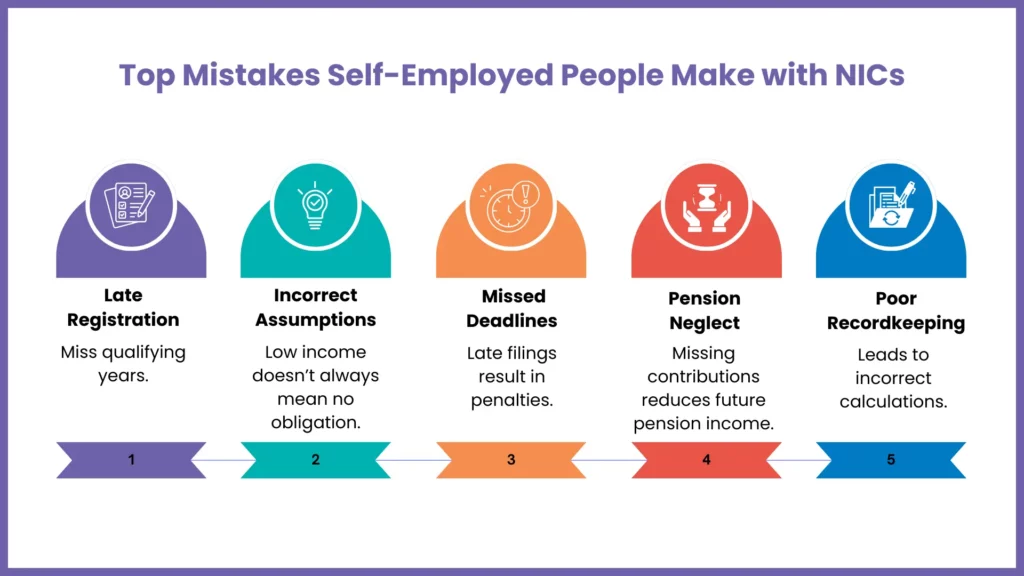
Many problems with National Insurance come from simple oversights.
Late Registration
Delays can result in missing qualifying years.
Wrong Assumptions
Low income does not always mean no obligation.
Missed Deadlines
Late payments lead to penalties.
Pension Oversight
Skipping contributions can reduce future income.
Poor Records
Inaccurate figures cause incorrect calculations.
Avoiding these mistakes keeps your small business compliant and organised.

Simplify Your Self-Employed NICs with MyIVA – Expert Self Assessment for Only £99
Let our specialists calculate your National Insurance, file your return accurately, dodge penalties, and protect your pension eligibility without the hassle.
FAQs: Frequently Asked Questions
Do I need to pay National Insurance if I make a loss?
You may not have to pay National Insurance if your profits are below the threshold, but you must still submit a Self Assessment tax return. Filing keeps your records up to date with HMRC.
Can I pay National Insurance monthly?
Most self-employed people pay National Insurance once a year after submitting their tax return. In some cases, HMRC may allow payments on account to be spread across the year.
Is National Insurance separate from Income Tax?
National Insurance and Income Tax are different charges, but they are calculated together through Self Assessment. Both are usually paid at the same time.
Do I need an accountant?
An accountant is not required by law, but professional support helps avoid mistakes and missed deadlines. Many self-employed people find it saves time and stress.
Can HMRC fine me?
Yes, HMRC can charge penalties and interest for late filing or incorrect payments. Staying organised and filing on time helps avoid extra costs
Conclusion
National Insurance Contributions for Self-Employed people affect more than just your yearly tax bill. They influence your pension, your benefits, and your long-term security. Understanding how they work makes planning easier and reduces risk.
For sole traders and owners of a small business, staying on top of National Insurance can feel like another task on an already long list. Rules change, deadlines matter, and small errors can cost money.
MyIVA supports self-employed people and small business owners with National Insurance, Self Assessment, and tax planning. We handle the details so you can focus on earning.
Contact MyIVA today for clear advice and stress free tax support.


