



If you run your own business, you’ve probably wondered which tax bracket you’re in and how much you’ll really owe. Here’s the short answer: there’s no special bracket for small businesses. Most owners pay tax on their profit at the same personal rates as everyone else, 10% to 37% in 2026. C corporations are the exception and pay a flat 21%. If you’re a sole proprietor or a partner, you’ll also pay 15.3% self-employment tax, which catches a lot of people by surprise. The rest of this guide shows what all that means in dollars, using 2026 numbers (the tax year you file in early 2027).
The short version
- You’re taxed on profit, not revenue. Rent, software, supplies and other business costs come off first.
- Brackets are marginal. Moving into a higher bracket never raises the tax on income you’ve already earned.
- Self-employment tax is separate. Sole proprietors and partners pay 15.3% on top of income tax, and for many people it’s the bigger bill.
- Set some money aside as you go. A common starting point is 25% to 30% of net profit for federal income tax and self-employment tax together. Add your state’s share on top.
Which tax brackets apply to you in 2026?
Unless your business is a C corporation, its profit lands on your personal return and gets taxed at the same seven rates as any other income. The rates didn’t change from 2025. The income thresholds went up a little to keep pace with inflation.
| Tax rate | Single | Married filing jointly | Head of household |
|---|---|---|---|
| 10% | Up to $12,400 | Up to $24,800 | Up to $17,700 |
| 12% | $12,401 to $50,400 | $24,801 to $100,800 | $17,701 to $67,450 |
| 22% | $50,401 to $105,700 | $100,801 to $211,400 | $67,451 to $105,700 |
| 24% | $105,701 to $201,775 | $211,401 to $403,550 | $105,701 to $201,750 |
| 32% | $201,776 to $256,225 | $403,551 to $512,450 | $201,751 to $256,200 |
| 35% | $256,226 to $640,600 | $512,451 to $768,700 | $256,201 to $640,600 |
| 37% | Over $640,600 | Over $768,700 | Over $640,600 |
These thresholds apply to taxable income, which is what’s left after deductions, not what you earned. Source: IRS Revenue Procedure 2025-32.
Most people take the standard deduction: $16,100 if you’re single or married filing separately, $32,200 if you’re married filing jointly, and $24,150 for head of household. If your itemized deductions add up to more, you can use those instead. Business expenses are separate and come off your profit first.
Revenue, profit and taxable income: what’s the difference?
Think of three steps. Revenue is everything customers pay you. Net profit is what’s left after business expenses. Taxable income is what’s left after your other income and personal deductions are factored in, and that’s the number the brackets look at.
Say you bring in $120,000 and spend $45,000 running the business. Your net profit is $75,000. That figure, not the $120,000, is where your tax calculation starts.
If I move into a higher bracket, is all my income taxed at that rate?
No, and it’s one of the most common worries people have. Brackets work like a staircase, not a cliff. Each rate applies only to the slice of income inside that bracket, so earning more never causes income you already earned to be taxed at a higher rate.
Here’s a single filer with $60,000 of taxable income in 2026:
| Slice of taxable income | Rate | Tax |
|---|---|---|
| First $12,400 | 10% | $1,240 |
| Next $38,000 ($12,401 to $50,400) | 12% | $4,560 |
| Last $9,600 ($50,401 to $60,000) | 22% | $2,112 |
| Total on $60,000 | $7,912 |
This person is “in the 22% bracket,” so 22% is their marginal rate, the rate on the next dollar they earn. But the share of their income that actually goes to federal income tax, their effective rate, is 13.2% ($7,912 divided by $60,000). The marginal rate tells you what an extra deduction is worth. The effective rate is better for budgeting.
How your business structure changes the tax
The rate you pay has less to do with how big your business is and more to do with how it’s set up. Your structure decides which return you file and where the profit gets taxed: at the business, at you, or both.
| Structure | Return you file | Who pays the income tax | Federal rate | On your own work income |
|---|---|---|---|---|
| Sole proprietorship | Schedule C with Form 1040 | You | 10% to 37% | 15.3% self-employment tax |
| Single-member LLC | Schedule C with Form 1040 | You | 10% to 37% | 15.3% self-employment tax |
| Partnership or multi-member LLC | Form 1065, plus a Schedule K-1 for each partner | Each partner | 10% to 37% | 15.3% self-employment tax, generally |
| S corporation | Form 1120-S, plus a Schedule K-1 for each shareholder | Each shareholder | 10% to 37% | Payroll tax on your salary, none on distributions |
| C corporation | Form 1120 | The corporation, then shareholders on dividends | 21%, then 0% to 20% on dividends | Payroll tax on your salary |
Every option except the C corporation can usually claim the 20% QBI deduction, covered further down.
If you work for yourself or have a one-person LLC
For tax purposes, you and the business are the same. You report income and expenses on Schedule C, and the profit is taxed at your personal rates. Once your net earnings hit $400, self-employment tax applies too.
An LLC has no federal tax rate of its own. It’s taxed the way its structure says: like a sole proprietorship if it has one owner, like a partnership if it has more. It can also elect to be treated as an S corporation (Form 2553) or a C corporation (Form 8832).
If you have partners
The partnership files Form 1065 to tell the IRS what it earned, but it doesn’t pay income tax itself. Each partner gets a Schedule K-1 showing their share, reports it on their own return and pays at their own rate. General partners usually owe self-employment tax on that share too.
If you’re an S corporation
Profit passes through to the shareholders, who pay at their personal rates. If you work in the business, you have to pay yourself a reasonable salary through payroll, and Social Security and Medicare tax applies to it. Anything above that can come out as distributions, which aren’t subject to self-employment tax. That’s the appeal of an S corp.
If you’re a C corporation
The corporation pays a flat 21% on its taxable income. If it then pays profit out to you as dividends, you pay tax again: 0%, 15% or 20% on qualified dividends, and high earners may owe an extra 3.8% net investment income tax. At a 15% dividend rate, money paid out ends up taxed at roughly 32.9% in total.
So which one fits?
- Sole proprietorship or single-member LLC: the simplest to file, and often enough while profit is modest.
- S corporation: worth running the numbers once your profit is steadily well above a reasonable salary for your role. The payroll tax you’d save has to be more than the extra payroll and filing costs.
- C corporation: a better match if you plan to reinvest most of the profit or bring in outside investors.
Switching structure changes how your income tax is worked out, adds payroll filings and can bring in state-level taxes. Compare both versions on paper before you make an election.
Self-employment tax, in plain words
When you work for someone else, your employer quietly covers half of your Social Security and Medicare. When you’re your own boss, that other half lands on you too. Put both halves together and you get 15.3%: 12.4% for Social Security and 2.9% for Medicare. It isn’t charged on every dollar of profit, only on 92.35% of it, and only if you net at least $400 in the year.
A few details that matter:
- Social Security tax has a ceiling. In 2026 you stop paying the 12.4% once your earnings pass $184,500.
- Medicare doesn’t have one. If you’re single and earn over $200,000 (or $250,000 if you’re married filing jointly), there’s an extra 0.9% on whatever sits above that line.
- A small consolation: half of what you pay in self-employment tax comes off your income when you work out your income tax.
It’s reported on Schedule SE and sits on top of your income tax, not inside the brackets. The IRS explains it on its self-employment tax page. If you earn under $100,000, this is often the bigger of your two bills.
So what will you actually owe? A worked example
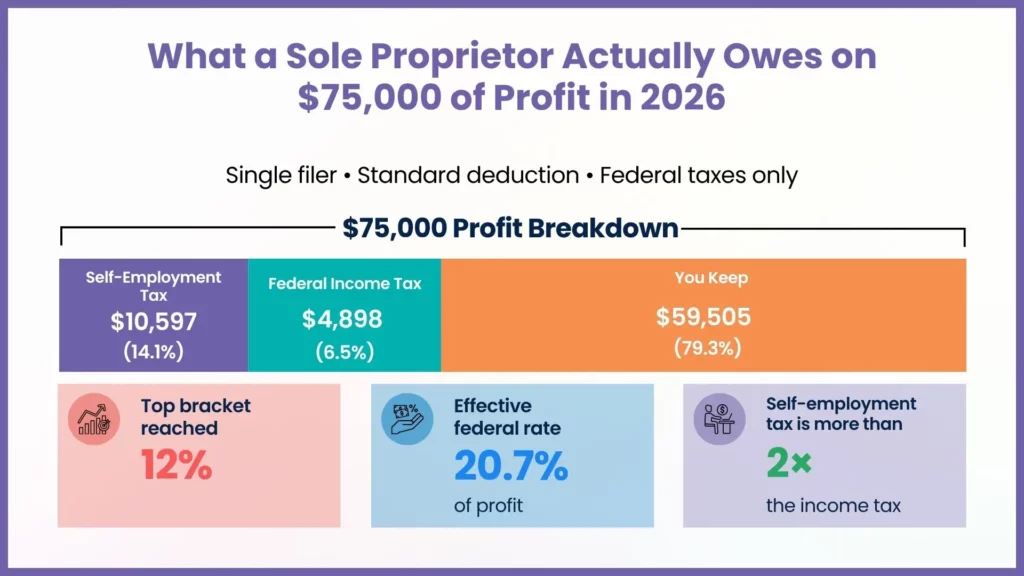
Let’s walk through a made-up example. Maya is a single freelance designer and a sole proprietor. This year she brought in $120,000 and spent $45,000 on software, equipment and other business costs. Her net profit is $75,000.
With no other income, no retirement or health insurance deductions and no credits, her federal tax for 2026 comes to about $15,500. That’s 20.7% of her profit, and self-employment tax is more than two-thirds of it.
| Step | Calculation | Amount |
|---|---|---|
| Net profit | $120,000 revenue minus $45,000 expenses | $75,000 |
| Self-employment tax | $75,000 × 92.35% × 15.3% | $10,597 |
| Less half of self-employment tax | $75,000 minus $5,299 | $69,701 |
| Less standard deduction (single) | $69,701 minus $16,100 | $53,601 |
| Less QBI deduction | 20% of $53,601 | $10,720 |
| Taxable income | $53,601 minus $10,720 | $42,881 |
| Income tax | $1,240 plus 12% of $30,481 | $4,898 |
| Total federal tax | $10,597 plus $4,898 | $15,495 |
The qualified business income (QBI) deduction took about $10,700 off her taxable income, which is why it’s worth knowing about.
If Maya earned more or less, the same method gives:
| Net profit | Self-employment tax | Taxable income | Income tax | Total federal tax | Share of profit | Top bracket reached |
|---|---|---|---|---|---|---|
| $50,000 | $7,065 | $24,294 | $2,667 | $9,732 | 19.5% | 12% |
| $75,000 | $10,597 | $42,881 | $4,898 | $15,495 | 20.7% | 12% |
| $150,000 | $21,194 | $98,642 | $16,413 | $37,608 | 25.1% | 22% |
These are federal numbers only. State tax is extra, and your own result will move with your filing status, other income and deductions.
Paying as you go: quarterly estimates
If you’ve ever had a regular job, you know the tax comes out of each paycheck before you even see the money. Nobody does that for you now, so the IRS wants its share during the year instead of all at once in April. If you expect to owe $1,000 or more, you’ll send quarterly payments using Form 1040-ES. C corporations start paying estimates once they expect to owe $500 or more.
| 2026 payment | Income earned | Due date |
|---|---|---|
| 1st quarter | January 1 to March 31 | April 15, 2026 |
| 2nd quarter | April 1 to May 31 | June 15, 2026 |
| 3rd quarter | June 1 to August 31 | September 15, 2026 |
| 4th quarter | September 1 to December 31 | January 15, 2027 |
You’ll avoid the underpayment penalty if you pay in at least 90% of this year’s tax, or 100% of what you owed last year. If last year’s adjusted gross income was over $150,000, that second number becomes 110%. That rule is the easy part. Working out each payment is harder when your income jumps around, with a great month followed by a slow one. Many owners have a tax preparation professional set each payment from profit so far this year instead of guessing. You can also read the IRS’s own estimated taxes page.
Your annual return is due in 2027:
| Return | Who files | Due date for calendar-year filers |
|---|---|---|
| Form 1065 or Form 1120-S | Partnerships and S corporations | March 15, 2027 |
| Form 1040 with Schedule C | Sole proprietors and single-member LLCs | April 15, 2027 |
| Form 1120 | C corporations | April 15, 2027 |
An extension gives you more time to file, not more time to pay. If you think you’ll owe, pay by the original deadline.
The federal rate isn’t your whole tax bill
It’s easy to focus on the federal bracket and forget everything else that can show up. If you’re newer to all of this, our guide to small business taxes covers the full list of obligations.
- Federal income tax: this is the bracket part. It depends on your taxable income and how your business is set up.
- State and local taxes: these change a lot from state to state, so check where you actually do business. Nine states have no broad personal income tax: Alaska, Florida, Nevada, New Hampshire, South Dakota, Tennessee, Texas, Washington and Wyoming. But a state with no income tax can still tax the business itself. Texas has a franchise tax, and California charges LLCs and corporations a minimum $800 franchise tax every year.
- Sales and use tax: if you sell products, you collect it from customers and pass it on to each state. It’s separate from income tax, and selling into several states can mean several filings.
- Pass-through entity tax (PTET): many states let partnerships and S corporations pay state income tax at the entity level. That payment is deductible federally and falls outside the cap on state and local tax deductions, which is $40,400 for 2026.
New York City adds city-level taxes for businesses based there, so check what applies in your area.
What’s new for small businesses in 2026
Tax rates stayed the same for 2026, but several thresholds and deduction rules changed. Most of it traces back to the One Big Beautiful Bill Act (OBBBA), signed on July 4, 2025.
- Standard deduction: $16,100 for single filers and $32,200 for joint filers, up from $15,750 and $31,500.
- QBI deduction: now permanent. It was set to expire after 2025. Limits start above $201,750 (single) or $403,500 (joint), and the phase-in range is wider at $75,000 or $150,000. There’s also a new $400 minimum deduction if you have at least $1,000 of qualified business income.
- Section 179: the limit rose to $2.56 million, and it starts phasing out at $4.09 million of purchases (it was $2.5 million and $4 million).
- Bonus depreciation: 100% bonus depreciation continues for qualifying property acquired after January 19, 2025.
- Contractor reporting: the threshold for Forms 1099-NEC and 1099-MISC went from $600 to $2,000.
- Social Security wage base: $184,500, up from $176,100.
- Business mileage rate: 72.5 cents per mile through June 30 and 76 cents after that, compared with 70 cents in 2025.
- Form 1099-K: the threshold stays at more than $20,000 and more than 200 transactions. Income is taxable whether or not you receive a form, which catches many online sellers off guard.
Sources: IRS Revenue Procedure 2025-32 and the IRS standard mileage rates page.
How can you legitimately pay less?
Every dollar you deduct saves tax at your marginal rate. A $5,000 deduction saves $1,100 of income tax if you’re in the 22% bracket, and business expenses reduce your self-employment tax too.
Deduct what the business really costs
Rent, software, advertising, insurance, supplies, professional fees, contractor payments and payment processing fees are all deductible. Most missed deductions come down to patchy records, so accurate bookkeeping is the first tax strategy.
Take the QBI deduction
Eligible pass-through owners can deduct up to 20% of their qualified business income. In 2026 the deduction starts to be limited above $201,750 of taxable income (single) or $403,500 (joint). Above those levels, wage and property tests apply, and specified service businesses such as law, health and consulting phase out.
Keep a mileage log
You can deduct business driving using either the standard mileage rate or your actual vehicle expenses. Commuting between home and your regular workplace doesn’t count, and you’ll need a log to back up the rest.
Use Section 179 and bonus depreciation
You can deduct the full cost of qualifying equipment, vehicles and off-the-shelf software in the year you put it into service, instead of spreading it over several years. Contractors and other equipment-heavy trades usually get the most out of this.
Claim the home office deduction
The space has to be used regularly and only for business. The simplified method gives you $5 per square foot, up to 300 square feet, so the most you can claim is $1,500.
Fund a retirement plan and deduct health insurance
Contributions to a SEP-IRA or Solo 401(k) lower your taxable income, and self-employed owners can usually deduct health insurance premiums as well. How much to put in depends on your cash flow, so treat it as part of your financial planning during the year instead of rushing in December.
Think about your structure
An S corporation election can cut your self-employment tax when profit is well above a reasonable salary. It also adds payroll filings and can shrink your QBI deduction, so compare both outcomes first.
Your checklist before December 31
Most of what lowers your 2026 bill has to happen before the year ends, not when you file.
- Get your books up to date. You can’t estimate a tax bill from incomplete records. If you’re months behind, catch-up bookkeeping gets you to a usable number. If the records are inaccurate rather than late, clean-up bookkeeping fixes them first.
- Project your full-year profit and compare it with the brackets and the QBI thresholds. A budget and forecast from management accounting makes this faster.
- Put planned equipment into service. It has to be delivered and ready to use by December 31 to count for 2026. Ordering it isn’t enough.
- Set up a retirement plan. A Solo 401(k) generally has to be established by December 31, while a SEP-IRA can be opened and funded up to your filing deadline.
- Confirm your S corporation salary. Reasonable compensation has to go through payroll before your last pay date of the year.
- Collect a Form W-9 from each contractor. You’ll report 2026 payments of $2,000 or more on Form 1099-NEC in January 2027.
- Check your estimated payments. The fourth-quarter payment is due January 15, 2027, so test it against the safe harbor before then.
When is it worth asking for help?
You don’t need an accountant for every tax question. But it’s usually worth a conversation if any of these sound like you:
- Your profit jumped or dropped sharply this year.
- You’re close to a bracket edge or the QBI threshold.
- You bought significant equipment or a vehicle.
- You sell into more than one state.
- You’re thinking about an S corporation election.
In each of those cases, a small business accountant can test the numbers before the year closes, while you can still change things. MyIVA Accounting works with US sole proprietors, LLCs and S corporations, and you can get in touch to book a year-end review.
People Also Ask:
What tax bracket is a small business in?
It depends on structure. Sole proprietorships, partnerships, S corporations, and most LLCs pass profit to the owner, who pays 10% to 37% in 2026 based on taxable income and filing status. A C corporation pays a flat 21%.
What is the federal tax rate for a small LLC?
An LLC has no rate of its own. A single-member LLC is taxed at the owner’s individual rates of 10% to 37%, plus 15.3% self-employment tax. An LLC that elects S corporation status keeps individual rates on profit. One that elects C corporation status pays 21%.
Do small businesses pay the 21% corporate tax rate?
Only if they are taxed as C corporations. Most small businesses are pass-through entities, so profit is taxed on the owner’s personal return at individual rates instead.
Is self-employment tax part of the tax bracket?
No. Self-employment tax is a separate 15.3% charge for Social Security and Medicare, calculated on 92.35% of net earnings. You pay it in addition to income tax, and half of it is deductible.
Do small business tax brackets change every year?
The income thresholds and standard deduction are adjusted for inflation every year. The rates themselves change only when Congress changes the law. The seven rates from 10% to 37% are now permanent under the OBBBA.
How much should a small business owner set aside for taxes?
A common starting point is 25% to 30% of net profit for federal income tax and self-employment tax combined. Add your state rate on top. In our examples, a single sole proprietor owes 19.5% to 25.1% federally on profit of $50,000 to $150,000.
What is the small business tax rate on $100,000 of profit?
Not a single rate. A single sole proprietor with $100,000 of net profit reaches the 22% bracket, but pays lower rates on most of that income. Self-employment tax of about $14,130 applies as well.
Conclusion
Your tax bill comes down to your profit, your filing status, how your business is set up and what you can legitimately deduct. A higher bracket doesn’t mean all your income gets taxed more, and self-employment tax is the part most people forget. If you plan ahead and set money aside during the year, tax time is a lot less stressful.
Note: This article is general information for the 2026 tax year, not tax advice. Rules vary by state and by individual circumstances. Speak with a qualified tax professional before acting.
