


If your business sells, hires, or stores inventory in more than one state, then you likely owe multistate taxes. may owe separate income, sales, and payroll taxes in each state where you have nexus. Nexus is the connection that gives a state the right to tax you. It can be created with an office, an employee, inventory, or enough online sales.
Following the Supreme Court’s ruling in South Dakota v. Wayfair, Inc. in 2018, states have the authority to mandate that out-of-state vendors, even those who are not physically present, collect sales tax once their sales surpass a certain threshold.Most states use $100,000 in annual sales, and a few use higher thresholds (see the table below). How to recognize your responsibilities and maintain compliance in 2026 is explained in this blog.
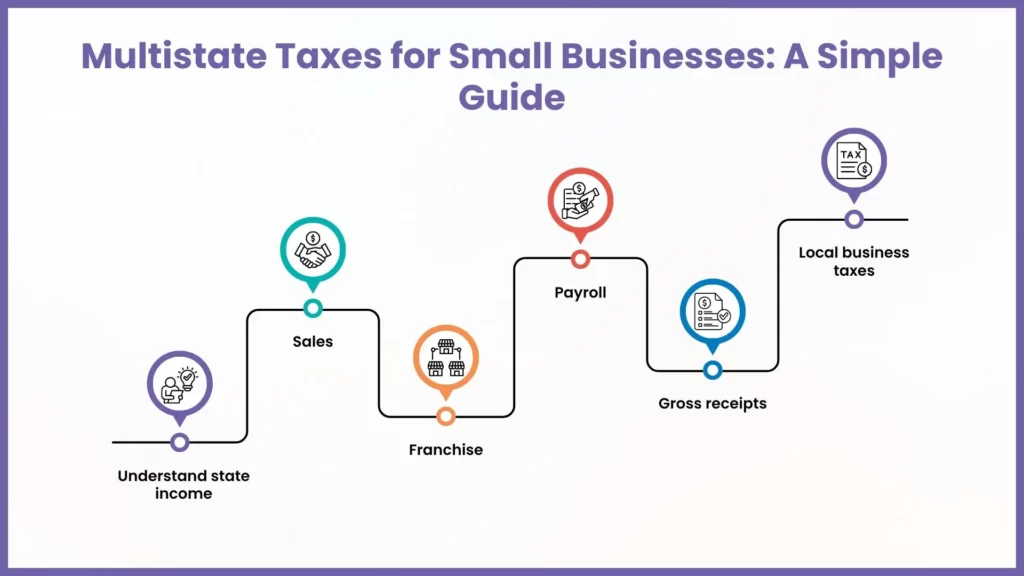
Evaluating Your Business Nexus: The 6 Primary State Tax Types
- Profits made within the state are subject to state income taxes.
- Franchise tax in states that charge businesses for operating or registering there.
- Sales and use tax on sales to clients that are subject to taxation there
- Payroll taxes for workers there, including unemployment insurance and state withholding
- Gross receipts tax in states that charge it instead of, or on top of, income tax.
- Local business taxes, such as city or county income taxes, business license taxes, and other local levies.
What Are Multistate Taxes for Small Businesses?
When a small business operates, hires people, sells goods, or generates revenue across state boundaries, it may be required to pay or report taxes in multiple U.S. states. These duties could include payroll taxes, sales and use taxes, franchise taxes, and state income taxes, depending on the business’s operations.
For example, suppose a small business is based in Texas, employs remote workers in California, and sells products to customers in New York. It may have tax obligations in multiple states, even though its headquarters are in Texas. The exact requirements depend on each state’s tax laws and the business’s activities.
Common types of multistate taxes:
- State income taxes: Some states ask businesses to pay income tax on income earned in their state.
- Sales and use taxes: When a business operations or sales result in a tax obligation in a state, they may be required to collect and remit sales tax.
- Franchise taxes: Businesses are subject to taxes in some states just for operating or registering there.
- Payroll taxes: Employers may be subject to state income tax withholding, unemployment insurance contributions, and other liabilities if they hire workers from another state.
- Gross receipts taxes: Some states tax a business’s gross receipts rather than, or in addition to, its net income.
- Local business taxes: Some cities and counties charge their own income taxes, business license taxes, or other levies.
What Creates a Tax Obligation in Another State?
A small business can have tax obligations in another U.S state when its activities create a sufficient connection known as “tax nexus”. This connection grows from having a physical location, hiring employees who reside or work there, or generating enough revenue to satisfy the state’s economic nexus threshold. Therefore, a business may need to register, collect sales tax, file state tax reports, or comply with payroll tax requirements in various states because the regulations vary depending on the state and kind of tax.
Nexus is determined separately for each tax. You might have a payroll tax nexus in a state because of a remote employee but no sales tax nexus there, or the reverse.
Physical Presence
Physical presence includes owning or renting an office, operating a warehouse, storing inventory (including at a third-party fulfillment center), or maintaining other commercial facilities in the state.
For example:
When a Florida-based small business establishes a warehouse in Georgia, it may be necessary to register for relevant Georgia taxes and adhere to multistate tax filing regulations. According to some state rules, even transient commercial activity like working at a trade fair or providing services in another state may result in tax responsibilities.
Employees and Remote Workers
Even if they are your only presence there, hiring someone who works from a different state can result in multiple obligations at once. Depending on the state, a single distant worker may indicate:
- Payroll obligations: registering as an employer, withholding state income tax from their pay, and paying state unemployment insurance (SUI) tax
- Income or franchise tax nexus: the business may have to file a return in that state
- Sales tax nexus: if you sell taxable goods or services there
Sales Into a State (Economic Nexus)
A company can establish a tax nexus even if it doesn’t have any workers or a physical site in a state. This is referred to as “economic nexus,” and it commonly occurs when a company’s sales or other economic activity in a state reaches a certain level.
For example, Customers from all throughout the nation may purchase goods from an Arizona-based internet business. The retailer may be required to register, collect sales tax, and submit the tax to the state if its sales into Colorado satisfy the applicable economic nexus requirements. Online sellers often cross thresholds without noticing, which is why ecommerce accountants who work with Amazon sellers and Shopify stores track sales by state.
Which Taxes Might You Owe?
There are five types of multistate taxes small businesses have to take into account. These taxes include state income taxes, sales and use taxes, franchise taxes, payroll taxes,gross receipts taxes and local business taxes. It is important to know about which taxes apply in each state so as to manage tax obligations properly, file returns correctly and in a timely manner, and avoid penalties.
- State income tax: Certain states impose taxes on business revenue generated within their borders. S corporations, partnerships, and sole proprietors often report business revenue through their owners’ tax returns, although C corporations may be immediately liable for corporate income tax. Each state you owe tax in means separate state business income tax filings, each with its own forms and deadlines.
- Sales and use tax: If your business has sales tax nexus in a state, then you might need to collect sales tax from customers and pay it to the state. Use tax may apply to taxable purchases when the required sales tax was not collected. Many businesses hand over sales and use tax compliance to a specialist once they register in more than a few states.
- Franchise tax: Businesses must pay franchise taxes in some states in order to operate or register there. Net worth, capital, income, or another state-specific metric may be used in the computation.
- Payroll taxes: You might have to pay state unemployment insurance contributions, withhold state income tax, and fulfill other state employment tax requirements if you employ people in another state. Hiring in another state also means multistate payroll and SUI registration before the first paycheck goes out.
- Gross receipts tax: Certain states or municipal governments tax a company’s gross receipts instead of its net profit. Even in cases where a company has little to no taxable income, these taxes may still be applicable.
How Multistate Tax Filing Works, Step by Step
Filing taxes for multiple states means identifying where you have nexus, which state you need to register, collect or withhold the right taxes and file separate returns in each state. Here are the steps mentioned for multistate tax filing:
Step 1: Confirm Where You Have Nexus
Make a list of every state in which you have employees, property, inventory, or significant sales. Then, compare each state’s sales to its economic nexus level. At least once a year, as well as anytime you open a location, hire remote employees, or introduce a new sales channel, do this. If your footprint is complex, a formal nexus examination by a CPA is worth the expense.
Step 2: Identify Which Taxes Apply in Each State
Nexus for one tax doesn’t mean nexus is applicable everywhere. For every state where your business is set up, check whether you owe tax there.
- Sales and use tax
- Income, franchise, or gross receipts tax
- Payroll taxes, including state withholding and unemployment insurance (SUI)
Step 3: Register With Each State
The state’s department of revenue often handles registration, and the state labor or workforce agency may also be involved with payroll accounts. Additionally, before conducting business in many states, an LLC or corporation must “foreign qualify” with the Secretary of State. That is not the same as registering for taxes. You can register for sales tax in eligible states from a single location using the Streamlined Sales Tax registration system.
Step 4: Apportion Your Income
Each state only charges its portion of your income if you owe income or franchise tax in multiple states. This split is called apportionment, and it’s normally based on the share of your sales, and sometimes payroll and property, that is in each state. A single sales component is used in many states, but formulae and regulations regarding the location of a service sale’s “sourcing” vary. Your overall revenue should be 100% in all states.
Step 5: Collect and Withhold Taxes
- Sales tax: charge the correct state and local rate on taxable sales in states where you are registered.
- Payroll: withhold state income tax from employees’ pay and pay SUI where required.
- Pass-through owners: if you operate as an LLC, partnership, or S corporation, income flows to your personal return, and some states require withholding or composite returns for nonresident owners.
Step 6: File and Pay on Each State’s Schedule
Each state has set its own forms and due dates, so you can’t reuse one return for all of them. The common patterns included are:
| Tax | Common frequency | Note |
|---|---|---|
| Sales tax | Monthly, quarterly or annually | The state assigns it based on your sales volume. |
| Payroll withholding and SUI | Deposits as required, plus quarterly returns. | Rules differ by state |
| Income or franchise tax | Annually, often with estimated payments | Most of the states follow federal due dates. |
If you live in one state and pay tax to another, your home state generally gives a credit for taxes paid to other states on the same income, so you aren’t taxed twice. Check each state’s rules. Because deadlines differ, many owners rely on state tax return preparation to avoid missed filings.
Step 7: Keep Records and Review Every Year
Keep sales by state, payroll by state, exemption certificates, and filed returns. If you discover you should have registered earlier, ask a tax professional about a voluntary disclosure agreement, which can limit back taxes and penalties in many states. Clean bookkeeping by state makes every earlier step easier, and if your books are behind, catch-up bookkeeping gets your records ready for that conversation.
How to Avoid Being Taxed Twice on the Same Income
When your business earns money in multiple states then each state tax will be applicable. The U.S. has several built-in protections against this, but most of them only work if you claim them.
- Claim the credit for taxes paid to other states: The primary defence is this. If you live in one state and make money in another, your home state usually reimburses you for the taxes you paid in the other state. This is provided by most states that have income taxes. You won’t pay less than the higher of the two rates because the credit is often capped at what your home state would have charged on that same income, but you shouldn’t pay both in full.
- File a nonresident return in the state where you earned the income.
- File your resident return at home and claim the credit, usually on a state-specific form or schedule.
- Apportion your income correctly: Only the portion of a multistate company’s income that is due to operations within their borders is subject to state taxation. The majority of states employ a formula based on the percentage of your sales, wages, and state-located property. Nowadays, a lot of people only use one sales factor. Accurate apportionment prevents you from paying 100% of your revenue in many states at once.
- Understand sourcing rules for sales: States differ on where revenue is “earned” from sales of services or intangibles. While some utilize the location of the client (market-based sourcing), others use the location of the job (cost-of-performance). Double taxation is frequently caused by inconsistent state regulations, so find out how each state where you have nexus handles it.
- Check for reciprocity agreements: Employees who reside in one state and work in another are required by certain neighboring states to pay taxes solely in their home state. These primarily impact wages rather than corporate income, but if you have staff that work remotely or cross borders, they can make payroll easier.
- Keep clean records: Maintain proper records of where your employees work, where your customers are, and where your property sits. If a state challenges your apportionment, documentation is your best defense.
6 Multistate Tax Mistakes Small Businesses Make
Expanding your business outside of your home state can bring in new clients, but it also includes more tax duties. You can prevent fines, back taxes, and unpleasant surprises by being aware of multistate taxes for small businesses. You just need to avoid 6 common mistakes while doing multistate tax filing.
Ignoring economic nexus: Many business owners believe they only have to pay taxes in states where they have offices or employees. Since South Dakota v. Wayfair (2018), states can require out-of-state sellers to collect sales tax once sales pass a set threshold (see the table below). Income and payroll tax nexus can also be created by workers, contractors, or property in a state. At least once a year, review your sales by state.
Economic nexus thresholds for sales tax (selected states):
| State | Economic Nexus Threshold |
|---|---|
| California | $500,000 in sales |
| Texas | $500,000 in sales |
| New York | $500,000 in sales and 100+ transactions |
| Colorado | $100,000 in sales |
| Florida | $100,000 in sales |
| Alabama | $ 250,000 in sales |
| Washington | $100,000 in sales |
- Not registering before collecting or filing: Multistate tax mistakes happen when you fail to register after exceeding the threshold or you are collecting sales tax without a permit. This can lead to penalties and interest. Therefore, first you should register with the department of revenue in each state, then proceed to collect and send.
- Treating all states’ sales tax rules the same: States differ in terms of what is taxable (some states tax software, digital commodities, and certain services, while others do not), how rates are sourced (origin vs. destination), and what exemptions are applicable. In states like Colorado, Louisiana, and Alabama, local taxes create an additional layer. Instead of thinking that one state’s laws apply to all states, use a sales tax tool or tax advisor.
- Overlooking remote employees: Payroll tax liabilities, including state withholding, unemployment insurance (SUI), and perhaps income tax nexus for the company itself, may arise from hiring one distant worker in a different state. Many owners don’t know until an audit or notification.
- Misapportioning income: You must use each state’s apportionment formula to divide your income if you owe income tax in more than one state. Not all states use simple sales or give sales a high weight. Overpaying or getting taxed twice on the same income might result from applying the incorrect calculation or utilizing inconsistent procedures between states. Double taxation can be avoided by claiming credits for taxes paid to other states.
- Poor record-keeping: If your business is operating in multiple states, keeping all records is mandatory. Without accurate records you can’t prove your filings are accurate.Track sales by state and ship-to address, employee work locations, and where inventory is stored (including third-party fulfillment centers, which can create nexus).
Note: Rules and thresholds vary by state and are subject to frequent revision. Consult a trained tax expert or the department of revenue in each state to confirm the most recent standards.
When It’s Time to Get Help?
Managing multistate taxes for small businesses yourself is realistic while you are operating in one or two states, but every new state brings its own registration rules, filing calendars, and apportionment formulas, and a single oversight can cost far more than expert advice would have. Common warning signs include a surge in out-of-state sales that may be nearing an economic nexus threshold, a new remote hire or third-party warehouse in another state, an unexpected letter from a state revenue department, a growing list of three or more filing jurisdictions, a change in entity type or a pass-through entity tax election, or a nagging suspicion that you should have registered somewhere months ago.
Myiva is prepared to intervene if any of that sounds similar. Myiva helps small business owners in the United States identify their nexus, manage state registrations, and ensure accurate and timely returns. This eliminates uncertainty from compliance so you can focus on expansion. Small business accountants who handle multistate filings every day can spot nexus problems early. If you are unsure where to start, talk to a multistate tax specialist.
Not sure where you have nexus?
Myiva helps small business owners across the United States identify their nexus, manage state registrations, and file accurate, on-time returns in every state. Talk to a multistate tax specialist to get a clear picture of where you stand.
People Also Ask:
Can two states tax the same amount of money twice?
Although it can occur, it is generally avoidable. Apportionment formulae restrict each state to taxing only its portion of your income, and the majority of states provide a credit for taxes paid to other states. Commonly, in order to receive these credits, you must file the appropriate taxes.
What are multistate taxes for small businesses?
The taxes a company must pay when it conducts business or generates revenue in many U.S. states are known as multistate taxes. These can include payroll taxes, franchise or gross receipts taxes, sales and use taxes, and state income taxes, all of which are subject to state regulations.
What is a pass-through entity (PTE) tax election?
S companies, partnerships, and LLCs may choose to pay state income tax at the entity level in a number of states. Although eligibility and regulations vary by state, it can assist owners in circumventing the federal SALT deduction cap.
For 2026, individuals can deduct up to $40,400 of state and local taxes on their federal return. That limit phases down for taxpayers whose modified adjusted gross income is above $505,000, and it bottoms out at $10,000 once income reaches $606,333.
Because a PTE tax is paid by the business, it is generally deductible at the entity level and is not limited by the individual cap. That is why the election can still reduce owners’ federal tax even under the higher cap. The higher cap is scheduled to run through 2029 and return to $10,000 in 2030. Confirm current figures with IRS guidance or a tax professional.
What is nexus, and how do I know if I have it?
The minimal link between your company and a state that permits the state to mandate that you register, collect, or pay taxes there is called Nexus. You may have a nexus for one tax in a state but not for another since it is calculated independently for each kind of tax (payroll tax, income tax, and sales tax).
Physical presence: an office, employees, inventory, or other property.
Economic presence: sales exceeding the state’s criteria. While most states use $100,000 in yearly sales for sales tax, some utilize larger amounts (see the table above). Check each state’s current regulations, as several have abandoned the previous “200 transactions” criteria.
Conclusion:
Growing outside of your home state is a sign of success, but it also requires negotiating a patchwork of inconsistent tax laws. The largest dangers, as we have discussed, are preventable: failing to recognize economic linkage, failing to register, misallocating income, failing to record credits for taxes paid to other states, and maintaining incomplete data. Penalties, back taxes, or paying tax on the same income can result from any of these.
Fortunately, multistate taxes for small businesses can be easily managed with a few regular practices. At least once a year, check the locations of your sales, workers, and property; register before collecting or filing; claim all credits and elections to which you are entitled; and maintain accurate records for each state. Regular check-ins are just as important as the original setup because thresholds and rules are always changing.
