


Delivering top-notch patient care is only one aspect of running a successful dental practice. Careful attention must be paid to managing cash flow, payroll, NHS and private income, tax requirements, and daily finances. Dental accounting becomes important in this situation, assisting practice owners in maintaining financial stability while concentrating on their patients.
We will be understanding what dental accounting is, why it’s important for your dental practice, and how hiring a specialist accountant will boost long-term growth, guarantee compliance, and increase profitability.
What Does Dental Accounting Mean for Your Practice?
Dental accounting is a procedure that lets you or your accounting team handle and arrange your dental practice’s financial transactions. Under it, you or an accountant will keep tabs on spending, earnings, and profits and produce thorough financial reports to help in decision-making.
Under dental accounting comes:
- Creating and analyzing financial statements, P&L, etc.
- Tax returns
- Daily accounts receivable
- Marketing costs
- Rent, mortgage, or utilities
What Makes Dental Accounting Crucial for Your Dental Practices?
These days, maintaining a dental business entails more than just giving your patients high-quality care; it also entails collecting insurance payments, keeping track of spending, managing finances, and making sure IRS requirements are followed. You may maintain your practice’s financial stability and audit readiness by using dental accounting. You can better concentrate on patient care when you are financially secure and fully compliant.
Here’s why dental accounting is essential:
- Accurate Revenue Tracking: Insurance reimbursements, co-pays, and out-of-pocket payments are just a few of the payment sources your business must manage. To stop revenue leaks, it is crucial to monitor these earnings.
- Management of Expenses: Payroll, medical equipment, and lab fees are just a few of the costs that a dental office must manage. Dental accounting will keep an eye on those costs and pinpoint places where they might be reduced.
- Managing Insurance and Claims: Correct handling of insurance claims will minimize errors and delays while optimizing cash flow.
- Tax Adherence: Dental accounting helps ensure that your practice complies with the particular tax regulations and deductions.
- Growth & Financial Planning: Accurate financial report preparation will be aided by dental accounting. It will assist you in making well-informed choices about employment, service expansion, and equipment purchases.
Essential Elements of Dental Accounting for US Dentists
Dental accounting helps you manage cash flow, lower risks, and make wise decisions by ensuring that every dollar is accurately tracked. You can maintain the financial stability of your practice if you concentrate on the appropriate elements.
Core components of dental accounting include:
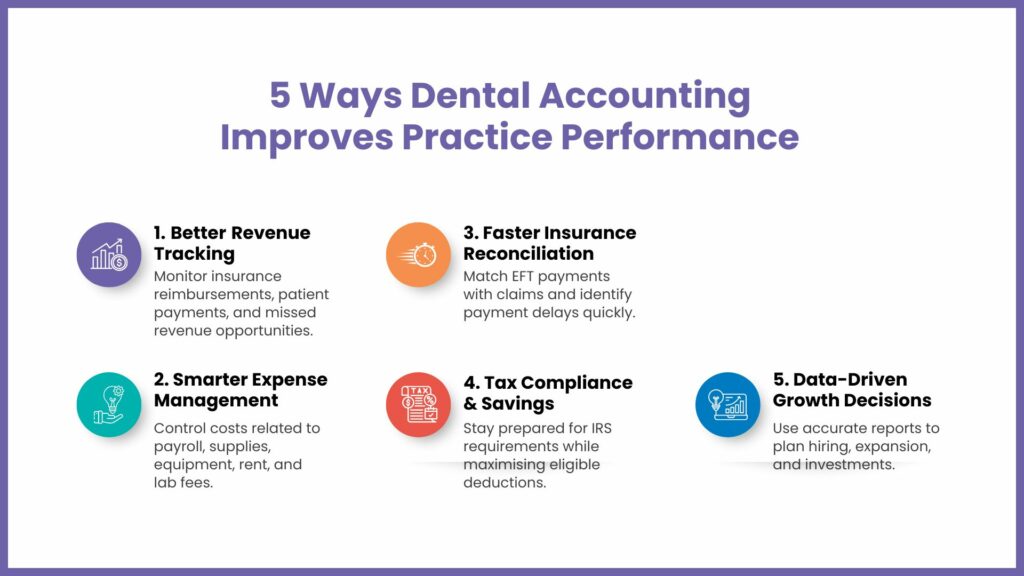
- Management of Revenue Cycles: To monitor revenue from co-pays, insurance reimbursements, and patient payments in order to prevent lost revenues.
- Monitoring Expenses: To control operating expenses in order to sustain profitability, such as payroll, lab fees, supplies, and equipment.
- Monitoring Insurance Claims: To ensure prompt reimbursements and minimize cash flow delays by documenting, confirming, and balancing claims.
- Tax Preparation and Adherence: It will optimize deductions while adhering to state and federal tax regulations.
- Payroll and Employee Remuneration: Precise and effective payment of dental teams’ salary, benefits, and retirement contributions.
- Reporting and Analysis of Finances: Creating monthly and yearly reports to monitor practice performance and make plans for future tactics.
How Dental Accounting Helps Your Practice Maintain Financial Stability
Strong financial management is just as important to the success of your dental practice as providing exceptional patient care. Dental accounting gives you the information you need to maintain the practice’s financial stability. Dental accounting will keep your finances stable while you concentrate on your patients by monitoring income, expenses, and IRS compliance.
Here’s how dental accounting supports your practice:
- Improved Cash Flow
- Cost Control
- Compliance & Tax Readiness
- Clear Financial Insights
- Strategic Decision-Making
Managing EFTs and Reconciliation: Keeping Your Dental Practice’s Finances Accurate
Nowadays, a lot of patients would want to use their insurance to pay for their care. However, this has increased your dental practice’s responsibilities because you now have to routinely reconcile deposits and claims. You will require the expertise of a skilled dental accountant to prevent being overburdened with this duty. It will guarantee:
- EFT payments match submitted claims
- Any shortfalls or denied claims are identified quickly
- Bank reconciliations are accurate and error-free
- Cash flow remains predictable and reliable
Which Accounting Software & Tools Are Best for US Dental Practices?
Getting dental accounts done with accounting tools and software is the latest approach to handling your accounts. Choose the best accounting software for your practice to get the greatest outcomes.
We have shortlisted a few:
- QuickBooks Online: This software is ideal for bookkeeping, expense tracking, and payroll.
- Xero: Ideal for cloud-based accounting with strong reporting features.
Typical Accounting Reports for Dental Practices
Obtaining financial reports is one of the most important needs for maintaining the financial stability of your dental office. A specialist dental accountant can provide these reports with accuracy.
The following are some of the essential reports you will need to maintain the financial stability of your practice:
- Profit & Loss Statement
- Balance Sheet
- Cash Flow Statement
- Accounts Receivable Aging Reports
Advantages of Outsourcing Accounting Services or Hiring a US-Based Dental Accountant
Successfully managing a dental practice requires striking a balance between patient care and financial security. By Specialised Bookkeeping services, you may successfully strike this precise balance without taxing your resources. You can use it to make sure your practice is both financially stable and compliant for future expansion.
Proficiency in Dental Industry-Specific Financial Management:
The special difficulties that dental businesses confront, such as insurance reimbursements, EFT reconciliation, lab fees, equipment prices, and compliance requirements, will be thoroughly understood by a dental accountant working with a reputable outsourced service provider. A dental accountant will offer customized solutions.
Save time to concentrate on your patients:
You can focus entirely on your patients while a third-party accountant handles your bookkeeping, payroll, and tax filings.
Audit-Ready and IRS-Compliant Books:
You will have access to accountants who will keep you in compliance with IRS regulations if you work with a professional accounting service provider. They lower the danger of penalties and maintain your audit readiness in this way.
Planning Your Taxes Strategically to Save the Most:
Dental accountants may help you lawfully lower your tax bill and enhance savings since they are aware of which write-offs, credits, and deductions apply to practices.
Reporting in Real Time and Growth Advice:
Dashboards and online technologies are available to you when you outsource dental accounting. You can make better judgments by using these tools, which provide you with real-time insight into your cash flow and practice performance.
How to Maintain Accurate and Compliant US Dental Accounting
Managing EFT (electronic fund transfer) reimbursements, staff payroll, and maintaining IRS compliance are just a few of the particular financial difficulties faced by dental businesses. You can maintain accurate, transparent, and stress-free dental accounting by adhering to these best practices.
Weekly reconciliation of EFT deposits and claims:
To make sure there are no revenue slips, the majority of dental clinics rely on EFT payments from insurance providers and reconcile these payments with claims each week. This will guarantee that there are no mistakes or lost earnings.
Check patient payments and insurance reimbursements:
Patients and insurance are a dentist’s two main sources of income. In order to prevent billing duplication, missing co-payments, and collection delays, it must be sufficiently tracked. A sound cash flow will be guaranteed by this tracking.
Keep Correct Payroll and Employee Remuneration Records:
Payroll mistakes might cause your employees to get discouraged. Smooth operations and IRS compliance are ensured by keeping accurate records of salary, overtime, benefits, and retirement payments. It takes a lot of time to do these activities, so you can always get help from a professional accounting service provider such as MyIVA Accounting.
Partner with a CPA Skilled in Dental Practices:
You have to use the services of an accounting outsourcing partner or engage a specialist dental accountant. These accountants minimize tax risks and maximize deductions by being aware of industry expenses and compliance requirements.
For Real-Time Visibility, Use Cloud-Based Tools:
It is necessary to employ tools like Xero, QuickBooks, or dentistry practice management software to reduce workload and facilitate monitoring and discrepancy detection. Although using these technologies needs knowledge and training, you can outsource their services to yourself.
Examine Monthly Reports to Find Problems Early:
You can see issues like growing costs, late payments, or diminishing profitability before they become significant by routinely examining profit and loss statements, cash flow reports, and accounts receivable aging reports.
IRS Tax Forms and Dental Practice Deadlines
Dental practices need to file these IRS tax forms and deadlines to avoid penalties:
- Form 941: Quarterly Federal Tax Return for payroll taxes.
- Form 1120 or 1120S: Corporate tax return.
- Form 1065: Partnership return if applicable.
- Form W-2 and W-3: Annual employee wage and tax statements.
- Form 1099-MISC: For independent contractors.
- Deadline Awareness: Payroll tax deposits are monthly or semiweekly; corporate returns are due March 15 or April 15; W-2’s are due at the end of January.
Do-it-yourself Dental Accounting Issues
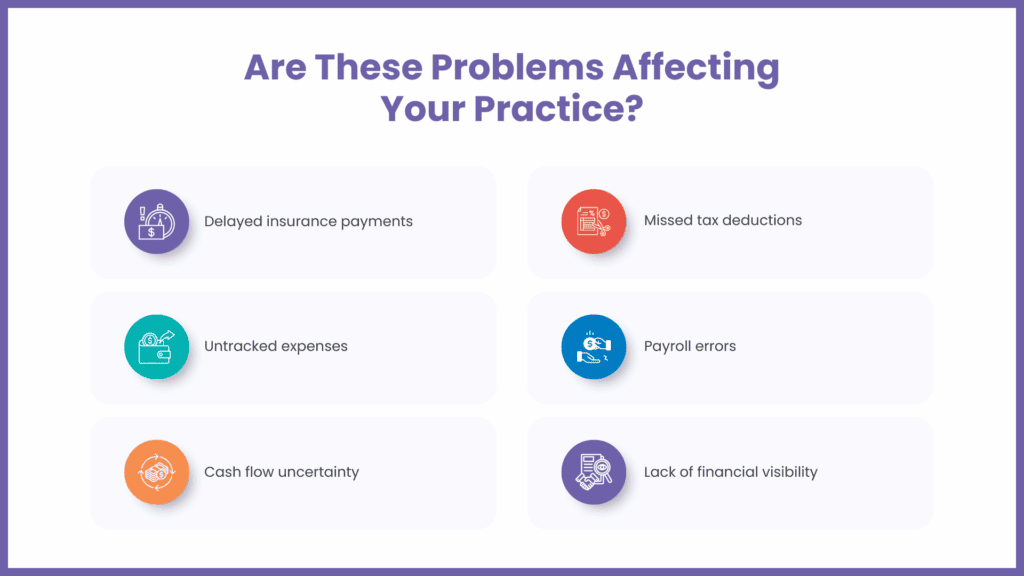
DIY dental accounting may result in:
- Inaccurate tracking of several payment sources, including co-pays and insurance reimbursements
- Missed tax rules and deductions due to insufficient industry knowledge
- Payment reconciliation and manual claims are taking too long.
- Audit risk resulting from incomplete or noncompliant documents
Want stress-free dental accounting? Let MyIVA Accounting handle your books, payroll, and tax compliance. Get in touch today.
People Also Ask:
What is dental accounting?
Dental accounting is a specific accounting solution created for dental practices. It covers bookkeeping, payroll, tax planning, VAT compliance, financial reporting, cash flow management, and performance analysis to assist dentists run a profitable practice.
Why are specialized accountants necessary for dental practices?
Dental practices have special financial needs, including private and NHS income, associate payments, equipment purchases, and industry-specific tax regulations. A qualified dental accountant offers more precise financial advice since they are aware of these complications.
Can a dental accountant assist with lowering tax obligations?
Sure. While maintaining compliance with IRS requirements, a qualified dental accountant can find qualified tax breaks, capital allowances, pension contributions, and other tax-saving options.
What are the advantages for a dental office of outsourcing dental accounting?
Dental accounting outsourcing lowers operating costs, increases accuracy, lessens administrative workload, gives dentists access to expert accountants, and frees them up to concentrate more on patient care.
Conclusion
Dental accounting isn’t just bookkeeping, it’s the foundation for financial stability and long-term practice growth. With the right approach, you can stay on top of revenue cycles, EFT reconciliation, financial reporting, and IRS compliance, keeping your practice running smoothly at every stage. Whether you manage it in-house or outsource, one thing is clear: investing in proper dental accounting pays off.
For most practices, outsourcing to a specialized provider like MyIVA Accounting is the smarter path forward, freeing you to focus on what you do best: patient care.
Our team of dental accounting specialists has helped countless practices simplify their finances and stay audit-ready. Ready to get your books in order? Connect with MyIVA Accounting, and let us handle the numbers.
