


The best accounting software for dental practices helps dentists automate bookkeeping, manage expenses, track payments, simplify payroll, and improve financial visibility. Dentists can see their practice’s finances more clearly thanks to these technologies, which also decrease manual labor and increase accuracy.
Accounting software that can manage various payments, track operating expenses, and integrate with current practice systems is essential for dental clinics. The top 10 accounting programs for dental practices in 2026 are covered in this guide, which highlights important characteristics to assist you in selecting the best option for your office.
What Is Dental Accounting Software?
Dental practices can manage income, expenses, payments, payroll, invoices, and financial reporting with the help of dental accounting software. It keeps information organized, automates repetitive accounting chores, and gives dentists greater financial insight into their practices.
Why Dental Practices Need Specialized Accounting Software
Dental offices handle a variety of intricate financial tasks, such as payroll, supplier bills, insurance transactions, patient payments, and expenses. Maintaining accurate financial records, automating these procedures, and lowering administrative workload are all made possible by using the best dental office accounting software.
Features like expenditure tracking, payment reconciliation, financial reporting, and interaction with practice management systems are all included in the top accounting software for dental office operations. It saves time on regular accounting procedures and gives dentists better control over their finances.
Key benefits include:
- Automated bookkeeping: Keeps financial records up to date and minimizes human data entry.
- Improved cash flow visibility: Helps track income, expenses, and outstanding payments.
- Better compliance management: Maintains records in order for reporting and tax purposes.
- Time-saving processes: Simplifies routine financial duties so that dental professionals can concentrate on patient care.
Key Features to Look for in Accounting Software for Dental Practices
It’s important to explore beyond basic bookkeeping capabilities when selecting accounting software for dental clinics. The perfect solution should support the unique requirements of dental clinics, enhance accuracy, and make financial management easier.
Key features to consider include:
- Expense and income tracking: Helps monitoring dental practice income, running expenses, supplier payments, and overall financial results.
- Automated bookkeeping: Reduces the need of human data entry by keeping records up to date, classifying expenses, and documenting transactions.
- Payment and reconciliation management: Makes it simpler to link transactions with bank records, track insurance receipts, and monitor patient payments.
- Payroll management: Helps in the effective management of payroll data, employee salaries, and deductions.
- Tax compliance support: Organizes financial data to make tax preparation and reporting simpler.
How We Selected the Best Accounting Software for Dental Practices
We assessed options based on the characteristics that dental clinics value most in order to determine the best accounting software for dental offices. Our choice was based on how well each program assists in money management, minimizes manual labor, and boosts practice productivity.
The key factors considered include:
- Ease of use: Software should be easy to use and appropriate for dental teams with hectic schedules.
- Automation capabilities: Priority was given to tools that increase accuracy and decrease repetitive chores.
- Security and reliability: Solutions should protect sensitive financial data and provide dependable performance.
- Integration options: Compatibility with other financial tools and dental office management systems was taken into account.
- Value for money: Pricing, features, and applicability for various practice sizes were all examined.
Top 10 Accounting Software for Dental Practices in the USA
A number of criteria, including practice size, financial complexity, automation needs, and integration requirements, influence the choice of best accounting software for small medical or dental practices. Dental companies may increase financial visibility, track revenue, automate bookkeeping, and manage expenses with the proper software.
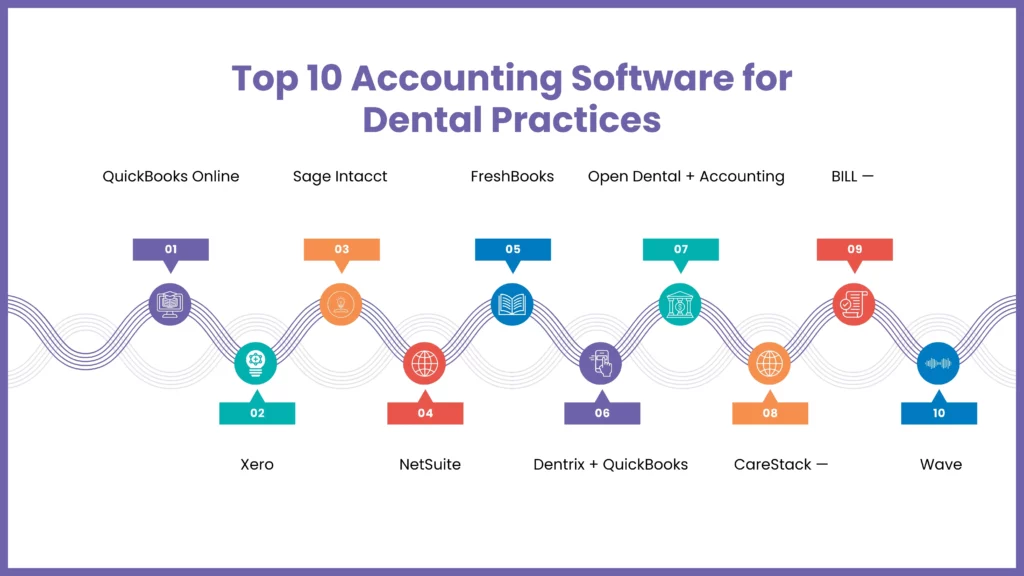
1. QuickBooks Online:
Best For: Small to mid-sized dental practices
Due to its robust small-business accounting capabilities and ease of use, QuickBooks Online is commonly used by small and mid-sized dental offices because it supports invoicing, payroll, bank reconciliation, expense tracking, and integration with dental practice management systems.
Its most recent enhancements concentrate on decreasing manual bookkeeping through more intelligent transaction matching, better classification, quicker reporting, and AI-powered insights that make it easier for companies to comprehend their financial data.
- Pros: Widest accountant familiarity in the U.S., strong bank reconciliation, and AI-assisted transaction classification and reporting.
- Cons: Pricing has climbed with recent increases, and payroll/add-on costs can push the real bill well above the sticker price.
- Pricing: Plans range from about $38/month (Simple Start) to $275/month (Advanced); payroll and payment processing are billed separately.
2. Xero:
Best For: Dental practices looking for simple cloud accounting
For handling routine financial duties like invoicing, tracking expenses, bank reconciliation, payroll, and reporting, Xero offers an intuitive accounting solution. Dentists and accountants can safely access financial data from any location thanks to its cloud-based technology.
Smaller dental offices that require effective bookkeeping procedures without complicated accounting settings can benefit from Xero.
- Pros: Unlimited users on every plan, a clean interface, and strong bank-feed automation.
- Cons: Fewer built-in dental-specific integrations than QuickBooks, and payroll/add-ons raise the effective cost.
- Pricing: Plans start around $25/month (Early) and go up to about $90/month (Established); payroll runs through a separate add-on.
3. Sage Intacct:
Best For: Growing dental groups and multi-location practices
Sage Intacct is intended for dental practices that need sophisticated reporting and financial administration. Accounts payable, revenue monitoring, budgeting, multi-entity accounting, and thorough financial analysis are all supported.
Expanded automation, AI-powered workflows, better accounts payable procedures, cash intelligence, and improved reporting features to reduce human finance work are among the most recent Sage Intacct upgrades.
- Pros: Multi-entity accounting, location and provider profitability tracking, and strong automation for accounts payable.
- Cons: Steeper learning curve and higher cost than single-location tools; usually requires implementation support.
- Pricing: Custom, quote-based pricing; typically positioned above QuickBooks and Xero for mid-market needs.
4. NetSuite:
Best For: Large dental organisations and enterprise-level practices
NetSuite is the best software for dental practice accounting especially, for larger dental practices. It offers a comprehensive cloud financial management system. Accounting, financial reporting, planning, business analytics, and multi-location management are all included. It is appropriate for businesses that require sophisticated financial controls, scalability, and in-depth operational insights.
- Pros: Comprehensive financial management, planning, and business analytics in one enterprise platform.
- Cons: Overkill and cost-prohibitive for small or single-location dental offices.
- Pricing: Custom, quote-based pricing that scales with users and modules; generally the highest-cost option on this list.
5. FreshBooks:
Best For: Independent dentists and small dental offices
Simple accounting tools for invoicing, tracking expenses, making payments, and organizing finances are provided by FreshBooks. Dentists who want simple accounting without complex features can use it because of its user-friendly interface. Smaller practices that require simple financial administration and effective billing procedures can benefit greatly from it.
- Pros: Simple, user-friendly interface built around invoicing and expense tracking.
- Cons: Lighter on advanced accounting features than QuickBooks or Xero as the practice grows.
- Pricing: Plans start around $23/month (Lite) up to roughly $70/month (Premium), based on client capacity.
6. Dentrix + QuickBooks Integration:
Best For: Dental practices already using Dentrix practice management software
A well-known dental practice management system called Dentrix can enhance financial procedures by integrating with QuickBooks. The interface facilitates the transfer of financial data, minimizes redundant data entry, and streamlines the tracking of revenue and expenses. Dental teams can use QuickBooks for accounting while managing clinical operations in Dentrix thanks to this combo.
- Pros: Cuts duplicate data entry by syncing patient billing and revenue data directly into QuickBooks.
- Cons: Requires both systems to be maintained and configured correctly for the integration to stay accurate.
- Pricing: QuickBooks Online subscription cost applies (see above); Dentrix is licensed separately.
7. Open Dental + Accounting Integration:
Best For: Dental practices needing flexibility and customization
Open Dental is an open-source platform for managing dental practices that enhances financial operations by integrating with accounting programs. It is the best software for dental practice accounting in managing transactions, organizing patient billing data, and integrating operational data with accounting procedures. Practices that seek flexibility in selecting their accounting solutions will find this option helpful.
- Pros: Full flexibility to pair with the accounting platform of your choice; strong for practices that want control.
- Cons: Integration setup often requires more hands-on configuration than out-of-the-box options.
- Pricing: Open Dental is free/open-source; connected accounting software (QuickBooks, Xero) is billed separately.
8. CareStack:
Best For: Multi-location dental groups and growing practice
Revenue cycle management, billing, patient administration, and operational reporting are all integrated into CareStack, a complete accounting software for dental practice. Its financial and reporting features help dental clinics track collections, improve revenue visibility, and manage business performance even though it isn’t a traditional accounting platform.
- Pros: Combines revenue cycle management, billing, and operational reporting in one platform.
- Cons: Not a dedicated accounting platform, so it typically still needs to feed into a core accounting system.
- Pricing: Custom, quote-based pricing tied to practice size and modules used.
9. BILL:
Best For: Dental practices managing supplier payments and accounts payable
Another most useful dental accounting software in the list, BILL is a financial automation platform that streamlines accounts payable procedures for dental offices. It eliminates the need for manual invoice processing and payment. Dental clinics that handle several suppliers, equipment payments, recurrent costs, and vendor invoices will find it especially helpful.
By enabling teams to capture invoices, automate approval workflows, schedule payments, and maintain improved insight over outgoing expenses, BILL assists dental clinics in centralizing bill administration. Its automation features lessen the amount of administrative work and aid in preventing payment problems brought on by human procedures.
- Pros: Strong accounts payable automation — invoice capture, approval workflows, and vendor payment scheduling.
- Cons: Per-user pricing plus transaction fees can add up quickly for practices with several approvers.
- Pricing: Plans start around $45/user/month (Essentials) up to $79–89/user/month (Corporate); Enterprise is custom.
10. Wave Accounting:
Best For: Small dental practices and new clinics
Basic accounting functions including tracking income, managing expenses, creating invoices, and maintaining financial records are all provided by Wave Accounting. It is a good choice for small dental practices seeking an easy-to-use and reasonably priced way to handle routine bookkeeping requirements.
Wave automates transaction imports, spending classification, receipt tracking, and financial reporting to make daily bookkeeping easier for smaller dentistry clinics. Its invoicing capabilities enable businesses to produce expert bills, monitor payments, and more effectively handle client billing.
- Pros: Lowest-cost entry point with core bookkeeping, invoicing, and receipt tracking included.
- Cons: Fewer advanced features and integrations than paid competitors as the practice grows.
- Pricing: Free starter plan; paid Pro plan runs around $16–19/month.
Quick Comparison of the Best Dental Accounting Software
The size, complexity, and financial requirements of a dental office determine which accounting software is best. Larger dental clinics may require sophisticated reporting, automation, and multi-location administration features, whereas small clinics could prefer basic dental accounting software.
| Software | Best For | Key Features |
| QuickBooks Online | Small to mid-sized dental practices | Financial reporting, bank reconciliation, payroll, invoicing, tracking of income and expenses, and interaction with dental practice management systems. |
| Xero | Dental practices needing simple cloud accounting | Automated invoicing, reporting, expenditure management, bank reconciliation, and third-party integrations. |
| Sage Intacct | Growing dental groups | Financial dashboards, automation, advanced reporting, multi-entity accounting, and location/provider profitability tracking |
| NetSuite | Large dental organisations | Advanced financial controls, planning, analytics, enterprise accounting, and multi-location management |
| FreshBooks | Independent dentists and small dental offices | Simple financial reports, time tracking, payment management, expense monitoring, invoicing. |
| Dentrix + QuickBooks Integration | Practices using Dentrix management software | Reduces manual entry and enhances financial tracking by integrating patient management data with accounting processes. |
| Open Dental + Accounting Integration | Practices needing flexibility | Open-source dental office administration featuring reporting, accounting integrations, and personalized workflow choices. |
| CareStack | Multi-location dental groups | Revenue cycle management, practice management, billing, reporting, and operational financial insights |
| Wave Accounting | Small dental practices and startups | Basic bookkeeping, invoicing, expense tracking, receipt management, and financial reporting |
| BILL | Practices managing vendor payments. | Payment automation, accounts payable management, approval procedures, and automated invoice processing |
Not sure which accounting solution fits your dental practice? Let our experts help you find the right fit.
Accounting Software vs Dental Practice Management Software: Which One Does Your Practice Need?
Different parts of a dental practice are supported by accounting software and dental practice management software. Knowing the difference makes it easier for dentists to select the best tools for handling their everyday operations and finances.
Dental Accounting Software
- Focuses on the dental practice’s financial administration.
- Monitors earnings, expenditure, bills, payments, and cash flow.
- Assists with financial reporting, payroll, bank reconciliation, and tax preparation.
- Gives information on overall company performance and profitability.
- Examples: QuickBooks Online, Xero, FreshBooks, Sage Intacct.
Dental Practice Management Software
- Focuses on patient care and daily dental treatments.
- Oversees insurance claims, billing, treatment plans, visits, and patient records.
- Enhances patient satisfaction and workplace efficiency.
- Keeps operational and clinical data in a single system.
- Examples: Dentrix, Open Dental, CareStack.
Which One Does Your Practice Need?
Small dental practices generally need accounting software for basic bookkeeping. Growing practices benefit from combining both systems through dental practice management accounting integration. Large dental groups usually need fully integrated solutions to manage complex workflows across multiple locations.
Common Accounting Challenges Faced by Dental Practices
The combination of patient payments, insurance transactions, running expenses, and compliance requirements can make managing finances in a dental business difficult. Financial chores can become time-consuming and challenging to manage in the absence of appropriate systems.
Common accounting challenges faced by dental practices include:
- Tracking multiple payment sources: Accurate tracking becomes more difficult since dental offices frequently handle patient payments, insurance reimbursements, and third-party payments.
- Managing cash flow: Cash flow management can be difficult due to unpaid insurance premiums, unpaid patient accounts, and ongoing operating costs.
- Difficulty monitoring profitability: Dentists may find it difficult to comprehend revenue, costs, and overall practice performance in the absence of accurate financial data.
- Tax compliance and reporting: Without appropriate accounting procedures, it can be difficult to maintain organized financial records and generate correct reports for tax purposes.
- Manual bookkeeping tasks: Manual account reconciliation, expense classification, and transaction recording can increase burden and error risk.
- Payroll and staff expense management: Accurate financial records and frequent updates are necessary for managing salary, benefits, and employee-related expenses.
Best Practices for Managing Dental Practice Accounting
Dental offices can better manage their finances, increase cash flow, and make more informed business decisions with the support of efficient accounting management. Daily financial chores can be made simpler and less error-prone by adhering to the correct procedures.
Best practices for dental practice accounting include:
- Keep financial records updated: To keep accurate financial records, keep regular records of your earnings, expenditure, payments, and transactions.
- Separate personal and business finances: To reduce confusion and streamline reporting, use specific company bank accounts and financial systems.
- Review financial reports: Examine revenue trends, expense records, profit and loss accounts to provide insight into practice performance.
- Maintain proper tax records: To facilitate tax preparation, maintain well-organized records of your spending, payroll, and financial activities.
- Automate routine accounting tasks: Utilize accounting software to expedite reporting, bank reconciliation, spending monitoring, and invoicing.
- Work with accounting professionals: Outsourced accounting services or experienced accountants can assist with handling challenging financial responsibilities and offer insightful advice.
Should Dental Practices Outsource Accounting and Bookkeeping?
Dental accounting software can automate transaction tracking, reporting, and reconciliation, but many practices still need expert support to manage complex financial work and keep books audit-ready, a case we break down further in our guide to outsourced bookkeeping for small businesses.
Dental practices should consider outsourcing when they:
- Need help beyond software: While accountants can offer financial analysis, tax advice, and strategic insights, dental accounting software can automate repetitive activities.
- Require accurate financial records: Expert bookkeeping keeps accounts current and helps minimize errors.
- Need support as they grow: Depending on the growth of the practice and evolving needs, external finance teams can scale services.
- Want to save administrative time: Payroll, invoices, bookkeeping, reconciliations, and financial reports can all be handled by outsourced teams.
- Need support as they grow: Depending on the growth of the practice and evolving needs, external finance teams can scale services.
Focus on growing your dental practice while our experts handle your accounting needs.
People Also Ask:
Is accounting software necessary for small dental offices?
Without depending on manual procedures, dental accounting software can assist small dental practices in tracking revenue, controlling expenses, keeping an eye on cash flow, and maintaining organized financial records.
What features should dental practices look for in accounting software?
Look for expense tracking, invoicing, bank reconciliation, payroll management, financial reporting, automation, cloud access, and integration with your dental practice management system.
How can dental offices benefit from accounting software?
Dental accounting software facilitates the automation of bookkeeping duties, payment tracking, financial report generation, expense management, and improved practice performance visibility.
Can dental offices lower errors with the use of accounting software?
Yes, by automating processes like transaction recording, bank reconciliation, expense classification, and financial reporting, accounting software reduces errors.
Can QuickBooks be used for a dental practice?
Yes. QuickBooks for dental practices is one of the most widely used options in the U.S., handling invoicing, payroll, bank reconciliation, and reporting, and it integrates with practice management systems like Dentrix through third-party bridges.
Is QuickBooks HIPAA compliant for dental offices?
QuickBooks isn’t marketed as a HIPAA-compliant platform by default, and it shouldn’t be used to store protected health information. Dental practices typically keep clinical and patient health data in their practice management system and use QuickBooks only for financial transactions.
What accounting software do most dentists use?
QuickBooks Online is the most commonly used accounting software among U.S. dentists, largely due to accountant familiarity and practice management integrations, followed by Xero and dental-specific combinations like Dentrix paired with QuickBooks.
Should dentists hire a bookkeeper or use accounting software?
Most growing practices benefit from both: software automates day-to-day transaction tracking, while dedicated dental accountants handle reconciliation accuracy, reporting, and the strategic financial guidance software can’t provide on its own.
Does dental practice management software replace accounting software?
No. Dental practice management software handles clinical and patient-facing operations like scheduling, treatment plans, and insurance claims, while accounting software manages the practice’s financial records. Most growing practices need both, connected through dental practice management accounting integration.
Conclusion:
Choosing the appropriate dental accounting software can improve control over revenue, expenses, and reporting, streamline financial administration, and minimize manual labor. The appropriate solution may increase accuracy, reduce time, and offer insightful information about financial performance for both small and multi-location dentistry clinics.
But not all accounting problems can be solved by software alone. Dental practices can maintain accurate records, enhance compliance, and make more informed financial decisions for long-term success by combining dependable dental accounting software with expert bookkeeping and accounting support.
