
Recent figures show that a significant number of self-employed individuals in the UK overpay tax every year. This usually happens not because they earn more, but because they fail to claim expenses they are legally allowed to deduct. Even small missed costs can add up over time and result in a higher tax bill than necessary.
For many sole traders and freelancers, tax filing feels confusing and stressful. The fear of getting something wrong often leads people to play it safe and underclaim. Others leave things until the last minute and rush through their Self Assessment tax return without fully understanding what they can include. This is where confusion around self-employed allowable expenses usually begins.
Self-employed allowable expenses are one of the most effective ways to reduce your taxable income while staying fully compliant with HMRC. When claimed correctly, they ensure you only pay tax on your actual profit, not on money spent to keep your small business running. Yet many people are unsure about what counts, what proof is needed, and how to report these costs properly.
In this blog, you will explore what self-employed allowable expenses really mean, how HMRC views them, and which costs you can and cannot claim. You will also learn how to calculate expenses correctly, keep the right records, and file your return without panic. By the end of this blog, you will understand how MyIVA can make the whole process simpler and less stressful for self-employed individuals.
If you want to know how to register as self-employed, read our other blog: How to Register as Self-Employed in UK
What is self-employed allowable expenses?
Allowable expenses are the costs you pay while running your business. These must be directly linked to your work and needed to help your business operate. HMRC lets you take these expenses away from your total income before working out how much tax you owe. This means you only pay tax on your actual profit, not on the money you spent to keep your business running.
In simple terms, if you spend money only to earn income from your work, that cost is likely to qualify as self-employed allowable expenses. The key rule is that the expense must be directly linked to your trade and not for personal use.
Understanding self-employed allowable expenses helps you file an accurate self-assessment tax return, avoid overpaying tax, and stay within HMRC allowable expenses rules. Claiming the right expenses is not about pushing boundaries, it is about claiming what you are entitled to.
Self-Employed Allowable Expenses List UK — Key Expense Categories
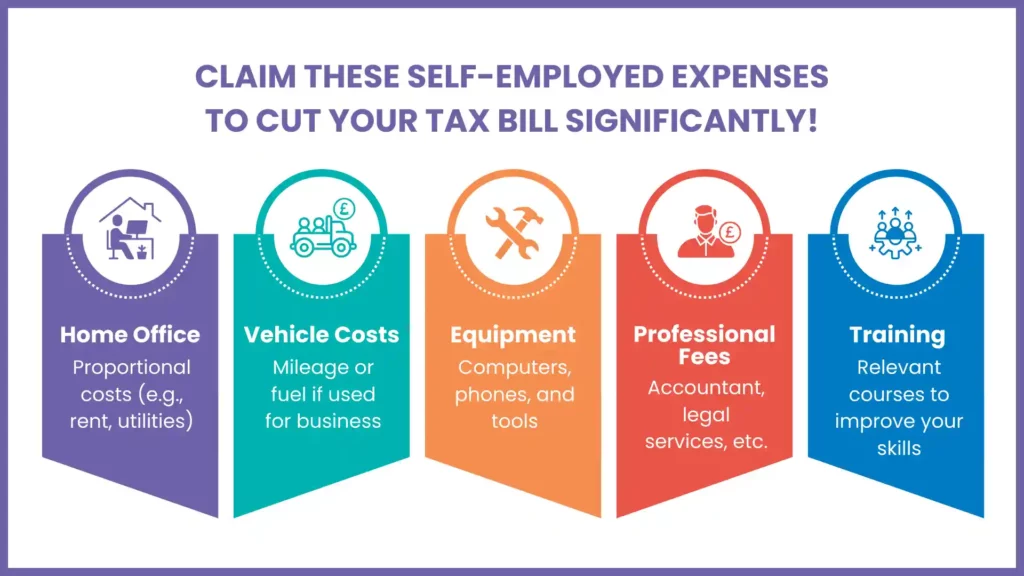
There is no single fixed list issued by HMRC, but there are clear categories that most self-employed people can claim under the self-employed allowable expenses list UK. These categories cover everyday costs linked to your work.
Common allowable expense categories include:
- Office costs such as stationery, printing, and phone bills
- Travel costs including fuel, public transport, parking, and vehicle insurance used for work
- Clothing costs for protective gear or uniforms used only for work
- Staff costs including wages, subcontractors, and freelance support
- Premises costs such as rent, utilities, and business rates
- Marketing and advertising including websites, hosting, and online ads
- Professional fees like accountant charges and legal advic
- Training courses related to improving existing skills
- Home office expenses self-employed UK, based on business use of your home
Knowing which category your costs fall under makes claiming self-employed allowable expenses easier and more accurate. Keeping things organised throughout the year also saves time during tax filing.
How to Claim Self-Employed Allowable Expenses on Your Tax Return
Claiming your expenses does not have to be complicated. With the right approach, adding self-employed allowable expenses to your Self Assessment tax return can be straightforward and stress free.
Keep records of all business-related expenses
Make a habit of saving receipts, invoices, and bank statements for anything you spend money on for work. This gives you clear proof if HMRC ever asks questions and makes tax filing much easier.
Separate personal and business costs wherever possible
Using a separate bank account for your business helps avoid confusion. When personal and business spending are mixed, it becomes harder to work out what you can legally claim.
Choose the right accounting method
Decide whether you are using the cash basis or traditional accounting under HMRC rules. This choice affects when income and expenses are counted, so it is important to use the method that suits your business.
Add expenses to the correct section of your tax return
Enter your deductible business costs in the expenses section of your Self Assessment tax return. Make sure each cost is placed under the correct category to avoid errors.
Check totals carefully before submission
Review your figures before submitting your return. Small mistakes or missing expenses can change how much tax you owe.
Submit your return by the HMRC deadline.
Filing on time helps you avoid penalties and last-minute stress. If you submit early, you will also have time to fix any problems if needed.
Once claimed correctly, self-employed allowable expenses lower your taxable profit. This means you only pay tax on what you actually earn after costs.
What Self-Employed Expenses Are Not Allowed by HMRC?
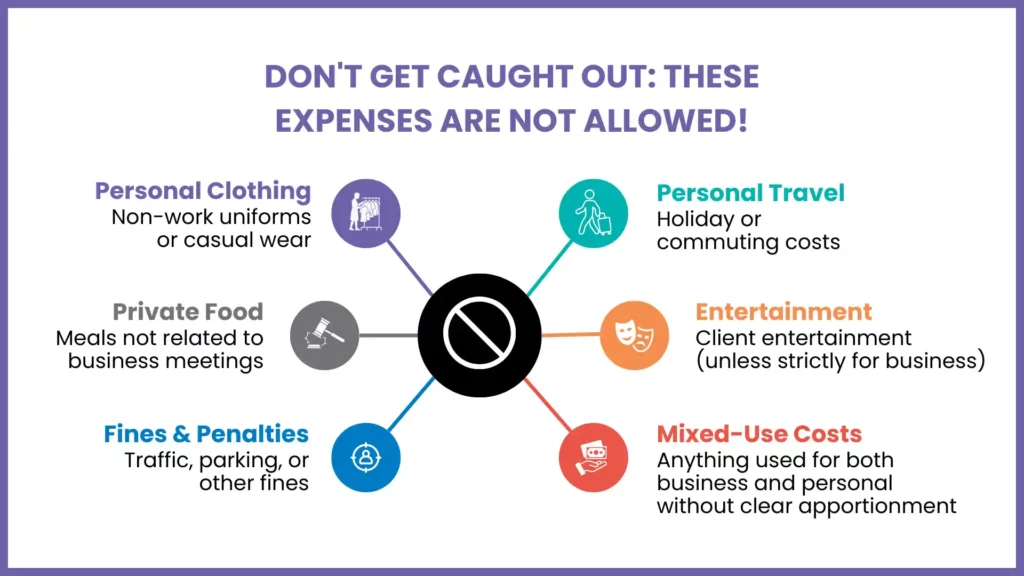
Not every cost can be claimed, even if it feels connected to work. HMRC has clear restrictions to prevent personal spending being claimed as business expenses.
Expenses HMRC does not allow include:
- Personal clothing that is not a uniform
- Private food and everyday meals
- Fines and penalties
- Personal travel not linked to work
- Entertainment of clients or customers
- Costs with mixed personal use unless properly apportioned
These expenses are not allowed because they are not wholly for business purposes. Claiming them can trigger questions from HMRC. Understanding the difference protects you from errors and helps you claim self-employed allowable expenses correctly.
Capital Allowances vs Allowable Expenses: What’s the Difference and Which Should You Claim?
Some purchases are treated differently for tax purposes, especially larger items.
| Capital Allowances | Allowable Expenses |
| Used for assets with long-term value | Used for day-to-day running costs |
| Claimed over time or through annual allowances | Claimed in the same tax year |
| Applies to capital assets | Applies to operational expenses |
| Examples include equipment and machinery | Examples include rent, utilities, and office supplies |
| Shown separately on the tax return | Included as normal business expenses |
| Helps spread the cost of large purchases | Reduces taxable profit immediately |
Which you should claim depends on the type of cost. Regular costs fall under self-employed allowable expenses, while larger assets may qualify for capital allowances. MyIVA helps you decide what is best for your situation.
How to Calculate Your Self-Employed Allowable Expenses Correctly
Calculating your expenses accurately is essential for a clean tax return. Incorrect figures can lead to overpaying tax or problems later with HMRC.
Add up all business costs only
Start by listing expenses that are used purely for your work. These are usually the easiest to calculate because there is no personal use involved.
Apportion mixed use expenses fairly
If an expense is used for both business and personal reasons, only the business portion can be claimed. For example, home office costs or phone bills should be split in a reasonable and consistent way.
Use mileage rates where applicable
If you use your personal vehicle for work, you can claim mileage using HMRC’s approved rates. This often works out simpler than calculating fuel, repairs, and insurance separately.
Follow HMRC allowable expenses rules
Only claim expenses that meet HMRC’s rules. Costs must be wholly and exclusively for business use, or properly apportioned if there is mixed use.
Keep totals supported by records
Make sure every figure you include is backed up by receipts, invoices, or logs. This protects you if HMRC ever asks for clarification.
When calculated properly, self-employed allowable expenses give a true picture of your profits. This helps HMRC understand your income and keeps your tax affairs in order.
Do You Need Proof of Self-Employed Expenses for HMRC?
Keeping proof of your expenses is not just a suggestion from HMRC; it is an expectation. If you claim self-employed allowable expenses, you must be able to show where those figures come from if asked. You usually do not send receipts with your tax return, but that does not mean you can ignore record-keeping.
HMRC is fine with different types of proof. This can be paper receipts, invoices, bank statements, email confirmations, or records from online purchases. The main thing HMRC looks for is clear information. It should show how much you paid, the date of the payment, and why the cost was for your work. If you claim mileage, keeping a basic note of the journey, the distance, and the reason for the trip is usually enough. Online records are accepted, which helps if you do not want to keep physical paperwork.
You need to keep these records for at least five years after the Self Assessment deadline. If HMRC looks at your tax return and you cannot back up an expense, they may remove it from your claim. This can lead to extra tax to pay, and sometimes a penalty as well. This is why keeping proof is as important as knowing what you can claim. With MyIVA, your expense records stay organized in one secure place, so you do not have to search for documents when it matters most.
Tips to Maximise Self-Employed Tax Deductions Legally
Reducing tax legally comes down to understanding the rules and staying organised.
Helpful tips include:
- Track expenses regularly
- Separate personal and business accounts
- Claim home office expenses self-employed UK correctly
- Choose the right accounting method
- Review your expenses before filing
- Get expert support when unsure
By following these tips, you can confidently claim self-employed allowable expenses without worry.

Maximize Your Tax Savings with MyIVA – Let Us Handle Your Self-Employed Tax Return
Let MyIVA help you claim all your allowable expenses, so you only pay tax on what you earn. Our experts will ensure everything’s accurate and filed on time.
FAQs: Frequently Asked Questions
What are self-employed allowable expenses?
They are business related costs that HMRC allows you to deduct from income before tax.
Can I claim phone bills as expenses?
Yes, but only the business portion of your phone usage.
Do I need receipts for all expenses?
Yes, proof is required if HMRC requests it later.
Can I use cash basis vs traditional accounting HMRC methods?
Most small businesses can use cash basis, but it depends on income level.
Are training courses allowable?
Yes, if they improve existing skills related to your work.
Conclusion
Claiming self-employed allowable expenses correctly can make a real difference to how much tax you pay each year. It allows you to reduce your taxable income legally, stay compliant with HMRC, and avoid the stress that often comes with Self Assessment deadlines. When you understand what you can claim and how to claim it, tax filing becomes far less intimidating.
From everyday running costs to home office expenses self-employed UK, every eligible expense matters. Keeping clear records, following HMRC allowable expenses rules, and choosing the right accounting method all play a role in getting it right. Small mistakes or missed claims can lead to overpaying tax or unnecessary worries later.
This is where MyIVA becomes the ultimate solution for self-employed individuals and small business owners. MyIVA takes care of your Self Assessment tax return expenses, reviews your deductible business costs UK, and ensures your filings are accurate and on time. With a fully digital process, real human support, and clear pricing, MyIVA removes confusion and replaces it with confidence.