
Thinking about going self-employed but unsure how to handle the tax side of things? You’re definitely not the only one. Lots of people feel confident about their work but pause the moment HMRC gets involved. The good news is that learning how to register as self-employed is far more straightforward than it first appears once someone talks you through it properly.
Registering as self-employed is a pretty straightforward process. You’ll first need to create a Government Gateway account, then register for Self-Assessment with HMRC, wait for the Unique Taxpayer Reference (UTR) to arrive, and finally get your online tax account up and running. Once that’s all wrapped up, you’ll be officially on the books as self-employed, and can go about filing your tax return each year.
Understanding the steps early on means fewer surprises, fewer last-minute panics and a lot more space to focus on earning money rather than worrying about paperwork. This guide explains who needs to register, how the process works, what HMRC will ask for and what happens once your registration is confirmed. You’ll also see how MyIVA can support you through the whole journey.
Who Needs to Register as Self-Employed in the UK
Registering as self-employed tells HMRC that you’re responsible for managing your own tax. Without registering, HMRC simply doesn’t know what you’re earning — which is how people end up with penalties, stress and unnecessary back-and-forth later on.
You must register if:
- You work for yourself as a sole trader
- You run a small business where you keep the profits
- You freelance, contract or do gig-based work
- You earn untaxed income over £1,000 in a tax year
Example: This applies whether you work full time, part time or just take on occasional projects. As soon as you expect to earn more than £1,000, it’s wise to register early to avoid any issues later.
How to Register as Self-Employed: Step-by-Step Process
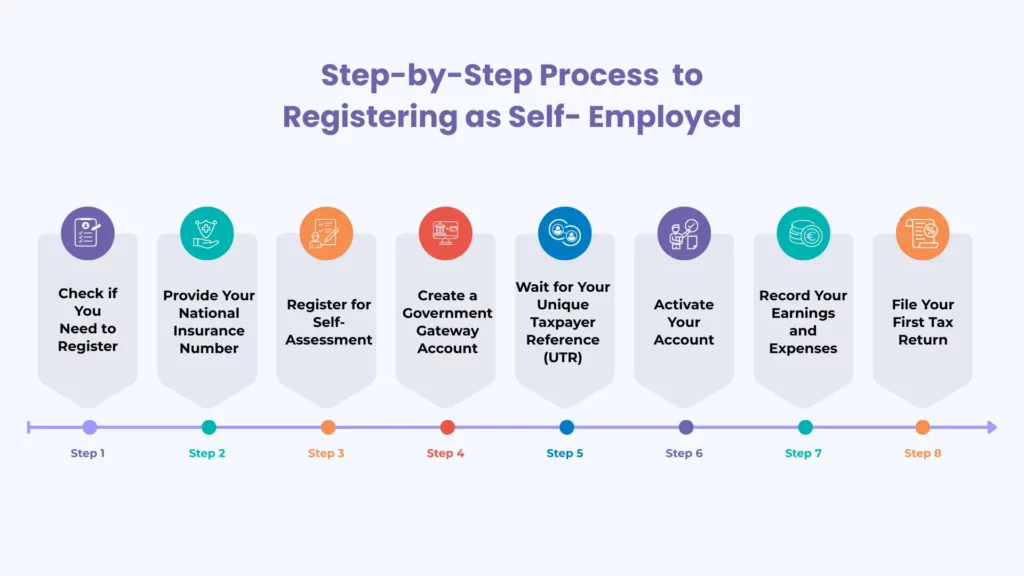
The list may look long, but once you begin, the process is straightforward. You mainly need your personal info, your National Insurance number and access to your Government Gateway account.
Step 1: Check that you need to register
If your self-employed income goes over £1,000 in a tax year, registration is required. Many people choose to register early once they know work is coming in.
Step 2: Create a Government Gateway account
You’ll use this account every time you file a tax return or check anything with HMRC.
Step 3: Start the Self-Assessment registration
Once logged in, choose the option to register for Self-Assessment and Class 2 National Insurance. You’ll be asked for your personal details and the type of work you do.
Step 4: Provide your National Insurance number
This allows HMRC to connect your tax and NI records.
Step 5: Wait for your UTR
HMRC sends a Unique Taxpayer Reference (UTR) by post. This 10-digit number is essential for every tax return you submit.
Step 6: Activate your account
HMRC will send an activation code. Once entered, your registration is officially complete.
Step 7: Set up a simple record-keeping system
A spreadsheet is fine, or you can use an app. Keep records from day one — it saves a lot of trouble later.
Step 8: File your first tax return
Your first return covers everything you earned from 6 April onwards during that tax year. Filing a return is how you officially report your self-employed income.
2025/26 Key Deadlines
- Register: By 5 October following the tax year you began trading (e.g., started July 2025? Register by 5 Oct 2026). Late penalty: £100+.
- File SA return: 31 January online (2025/26 return due Jan 2027).
- Pay tax: 31 January + 31 July payments on account.
If It’s Your First Time Registering
Starting out can feel overwhelming, but a bit of organisation makes life much easier. Try to:
- Keep receipts, invoices and notes from the beginning
- Store documents in one place
- Track work-related expenses
- Learn the basics of how Self-Assessment works
- Set reminders for key tax deadlines
- Register early rather than rushing
Good habits early on make self-employment far less stressful.
When Do You Need to Register as Self-Employed?
HMRC expects you to register as soon as you start earning from self-employed work.
The official rule:
You must register by 5 October following the end of the tax year you began trading.
Example:
If you started working for yourself in July 2025, you must register by 5 October 2026.
Register late and you risk penalties. Register early and you give yourself time to prepare, understand your tax position and avoid unnecessary pressure.
What happens after you register as Self-Employed?
HMRC will update your status, and you’ll have new responsibilities:
Your UTR arrives
Keep it safe — you’ll use it every year.
You’ll pay income tax on your profits
Your rate depends on your total income.
National Insurance applies
Most self-employed people pay Class 2 and Class 4 NI.
You must file a tax return every year
The deadline is 31 January.
HMRC may ask for extra details
This is normal, especially in your first year. Good records make this easy.
After that, it’s mostly about staying organised and filing your tax return in good time.
Do I Need to Register as a Sole Trader?
If you work for yourself and keep the profits, you’re considered a sole trader, and yes, you need to register with HMRC.
You don’t need to set up a limited company to get started. Many people begin as sole traders because it’s simple, flexible and quick. You can switch to a limited company later if your business grows.
What Taxes & NI Do Self-Employed Pay in 2025/26?
Once you’re self-employed, you’ll pay tax based on your profits, not your total income.
- Income Tax: Calculated on profits after expenses.
- Class 2 National Insurance: Voluntary £3.50/week if profits <£6,845 (benefits still credited).
- Class 4 National Insurance: 6% on £12,570–£50,270 profits; 2% above £50,270.
- VAT: Register if taxable turnover >£90,000 (12-month rolling). Voluntary below.
- Other: Student loans (above thresholds), pension contributions (recommended).
Understanding these early helps avoid surprises when tax season arrives
Frequently Asked Questions
Can I be self-employed while having a full-time job?
Yes. If you earn over £1,000 from self-employed work, you must register with HMRC and file a tax return.
How long does registration take?
The online registration takes around 20 minutes. Once HMRC processes it, your Unique Taxpayer Reference (UTR) normally arrives in the post within two weeks.
Can I register before I start trading?
Yes, and many people prefer to do this. Registering early means you have your Government Gateway account, UTR and HMRC access ready before you begin earning.
Is a sole trader the same as self-employed?
In most cases, yes. A sole trader is the most common type of self-employed person in the UK.
What if I forget to register?
You may face penalties. Register as soon as possible to limit any issues.
Conclusion
Knowing how to register as self-employed gives you a strong start. Once you understand the steps, the whole process becomes easier and you can focus on your work instead of worrying about HMRC. Registering early helps keep a lid on the organisational side of things and makes sure your finances are in check.
With self-employment comes a degree of freedom and flexibility, but that also means taking charge of your tax responsibilities – it’s all about keeping your paperwork in order and filing on time.
If you want help with how to register as self-employed, MyIVA can guide you through every stage and make sure your tax affairs are set up correctly. Our team supports sole traders, small businesses and individuals who want a smooth, accurate and stress-free start.
Get started with MyIVA today and register with confidence.