Each year, thousands of UK taxpayers fail to submit their Self Assessment tax return on time. In January 2026, over 1.2 million people missed the 31 January deadline set by HM Revenue & Customs (HMRC). Many faced automatic penalties, interest charges, and added stress that could have been avoided with earlier action.
If you have missed the Self Assessment deadline, you are not alone. The most important thing now is to act quickly. Delaying further only increases penalties and interest. The good news is that there are clear steps you can take to reduce the damage and bring your tax affairs back under control.
In this blog, we have explored what happens after you miss the filing date, how penalties work, how to submit your return late, and how to prevent the same problem next year. Whether you are a sole trader, landlord, contractor, or individual filing a tax return, this guide will help you move forward confidently.
What to Do If You Missed the 31st January Deadline
Missing the 31 January Self Assessment deadline can feel stressful. In the UK, this deadline applies to online Self Assessment tax returns submitted to HM Revenue & Customs. But the key is simple: act quickly to limit penalties and interest.
Here’s what you should do next.
1. Submit Your Tax Return Immediately
Even if you cannot pay your tax bill right now, submit your Self Assessment return as soon as possible.
- A £100 fixed penalty applies as soon as you miss the deadline.
- Further penalties are added after 3 months, 6 months, and 12 months.
- The longer you wait, the higher the total cost.
Filing stops additional late filing penalties from building up. If you have missed the Self Assessment daeadline, submission is your first priority.
2. Check Your Penalties and Interest
After submission, log in to your HMRC online account to:
- See the £100 late filing penalty
- Check any additional penalties
- Review interest charged on unpaid tax
Interest is charged daily from 1 February until the tax is paid in full at the Bank of England base rate plus 2.5% (currently around 7.25%). When you have missed the Self Assessment deadline, understanding the numbers helps you plan properly.
3. Pay What You Can
If you can pay in full, do it as soon as possible to stop further interest.
If you cannot pay the full amount:
- Pay as much as you can immediately
- This reduces the interest charged on the remaining balance
Even partial payments help limit the financial impact after you have missed the Self Assessment deadline.
4. Set Up a Time to Pay Arrangement
If you cannot afford to pay your tax bill in one go, you may be able to set up a Time to Pay arrangement with HMRC (online for debts under £30,000; phone for higher).
This allows you to:
- Spread payments over monthly instalments
- Avoid further enforcement action
- Manage cash flow more effectively
You can usually set this up online if you owe below a certain amount and meet HMRC’s criteria.
5. Consider Appealing the Penalty
HMRC may cancel penalties if you had a reasonable excuse, such as:
- Serious illness
- Bereavement
- Technical issues beyond your control (e.g., HMRC system outages)
You must appeal within 30 days of receiving the penalty notice. Supporting evidence is important.
6. Plan Ahead for Next Year
(Note: New ‘penalty points’ system starts late 2026 for quarterly filers)
Once things are settled:
- Keep records organised throughout the year
- Consider filing early from 6 April
- Set reminders well before 31 January
If you have missed the Self Assessment deadline, treat this as a lesson rather than a long term setback.
Understanding the Penalties for Late Submission
When you miss the Self Assessment filing date, penalties increase over time. Many people assume the £100 fine is the only charge, but that is rarely the case if the delay continues. (updated for 2025/26 tax year)
Below is a clear breakdown.
| Delay Period | Penalty Applied |
| 1 day late | £100 fixed penalty |
| 3 months late | £10 per day up to £900 |
| 6 months late | £300 or 5% of tax due, whichever is higher |
| 12 months late | Further £300 or 5% of tax due |
Note: From late 2026, a new ‘penalty points’ system may apply to quarterly Making Tax Digital filers (4 points = £200 fine). The longer you delay after you have missed the Self Assessment deadline, the more serious the financial impact becomes. Filing quickly limits these escalating penalties.
How to Submit Your Self-Assessment After Missing the Deadline
If you missed the 31 January deadline, you can still submit your Self Assessment return. HMRC does not close the system—it remains open year-round (paper filers: 31 Oct deadline). Follow these steps
Follow these steps.
1. Log in to Your HMRC Online Account
Go to your Government Gateway account and sign in using:
- User ID
- Password
- Security code
If you have forgotten your details, recover them first. Avoid creating duplicate accounts.
2. Gather the Required Information
You will typically need:
- UTR
- National Insurance number
- P60 or P45
- Bank interest statements
- Dividend statements
- Self-employment income and expenses
- Pension income details
For sole traders, bookkeeping records are essential.
3. Complete the Tax Return Carefully
Fill in each relevant section including employment, self-employment, property income, dividends, and student loans if applicable.
Errors can trigger HMRC checks. Take your time.
4. Check the Tax Calculation
HMRC will automatically calculate:
- Tax due
- Payments on account
- Interest charged
Review everything carefully before submitting.
5. Submit the Return Online
Confirm the declaration and submit electronically. Save the confirmation receipt.
Once submitted, additional late filing penalties stop increasing.
6. Pay or Arrange Payment
After submission:
- Pay in full, or
- Arrange a Time to Pay plan
If you have missed the Self Assessment deadline, filing now is the most effective way to control further damage.
Can HMRC Waive Your Penalty? What You Need to Know
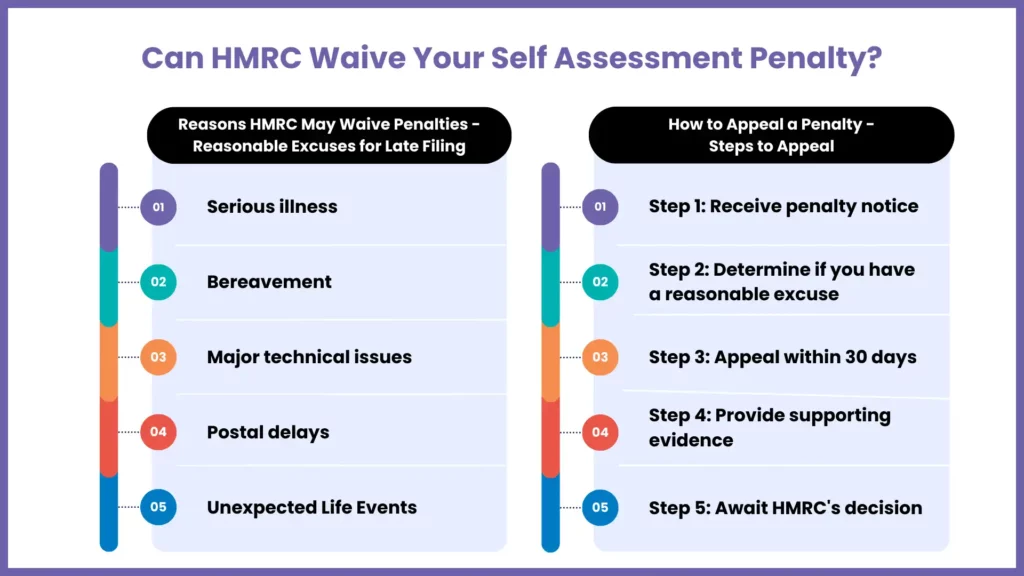
If you have missed the Self Assessment deadline, you may wonder whether HMRC can cancel the penalty. The answer depends on whether you had a reasonable excuse and acted promptly once the issue was resolved.
A reasonable excuse means something serious and unexpected prevented you from filing on time. It must be beyond your control. Forgetting the date or being too busy is not accepted.
HMRC may consider cancelling penalties in situations such as:
- Serious illness that prevented you from managing your affairs, supported by medical evidence
- Bereavement close to the deadline, particularly involving immediate family
- Major technical failures of HMRC systems on the final day
- Postal delays outside your control if filing by paper
You must submit an appeal within 30 days of receiving the penalty notice. Provide evidence and explain clearly what happened and when the issue ended.
If accepted, HMRC can remove the penalty, but interest on unpaid tax usually still applies.
What Happens If You Miss the Payment Deadline?
The Self Assessment payment deadline is also 31 January. If you filed but did not pay, this is treated separately from late filing.
1. Interest Starts Immediately
From 1 February, daily interest applies to unpaid tax.
- Interest accrues every day
- It applies to the full balance
- Partial payments reduce the interest
2. First Late Payment Penalty
If unpaid after 30 days:
- 5% of unpaid tax is charged
3. Second Late Payment Penalty
After 6 months:
- Another 5% applies
4. Third Late Payment Penalty
After 12 months:
- A further 5% is added
If you have missed the Self Assessment deadline and ignored payment, the costs can increase significantly.
HMRC may also escalate action, including debt collection or deductions from bank accounts.
Keep Track of Payment on Account: Avoid Future Surprises
Many taxpayers are caught out by payments on account because they do not realise these are advance payments towards the next year’s tax bill. You usually have to make them if your tax bill is more than £1,000 and less than 80% of your tax has been collected at source, such as through PAYE. These payments are due in two instalments, on 31 January and 31 July. If you have missed the Self Assessment deadline before, understanding how payments on account work can help you avoid unexpected bills and stay on track in the future.
What to Do Now: Submit Your Tax Return as Soon as Possible
If you have missed the Self-Assessment deadline, focus on action, not worry.
- Log in to your HMRC online account and complete the outstanding return without further delay
- Double-check all figures including income, expenses, dividends, CIS deductions, and tax already paid
- Submit the return electronically and download or screenshot the confirmation receipt for your records
- Review updated penalties, interest, and any payments on account shown in your tax summary
- Pay the full balance if possible, or set up a Time to Pay instalment plan to manage the amount owed
Filing first limits the damage. Delay increases it.
Avoiding Future Mistakes: How to Stay on Top of Self-Assessment Deadlines

Missing the Self Assessment deadline once is common. Repeating it becomes expensive.
1. File Early
You can file from 6 April. Filing early gives time to plan payment.
2. Keep Records Throughout the Year
Maintain:
- Monthly bookkeeping
- Digital receipts
- Separate bank accounts
3. Set Calendar Reminders
Add alerts for 31 July and 31 January well in advance.
4. Budget Monthly for Tax
Set aside a percentage of income each month.
5. Seek Professional Support
If your income sources are varied, support from accounting firm can reduce risk and improve accuracy.
How an Accountant Can Help with Your Self-Assessment
If you have missed the Self Assessment deadline, working with a professional can reduce stress and prevent repeat mistakes.
Here is how support from a small accounting firm such as MyIVA can help:
1.Accurate Preparation
Ensures income and expenses are recorded correctly, reducing errors.
2.Penalty Management
Reviews penalties and submits appeals where valid.
3.Time to Pay Support
Helps negotiate manageable instalment plans.
4.Payment on Account Planning
Calculates and forecasts future liabilities.
5.Ongoing Bookkeeping Advice
Improves record keeping to avoid future delays.
6.Deadline Monitoring
Provides reminders and structured planning so you do not miss important dates again.
MyIVA supports small firms, sole traders, and individuals who need reliable guidance with Self Assessment.

Fix Your Late Self Assessment Now – From Just £99!
Stop penalties growing: File late, appeal fines & setup Time to Pay with MyIVA experts. Claim your £99 Self Assessment package today
FAQs: Frequently Asked Questions
What happens if I missed the Self Assessment deadline by one day?
You will receive an automatic £100 late filing penalty, even if you do not owe any tax. This penalty is applied immediately after the deadline passes. Paying your tax does not remove the filing penalty, so you should still submit the return as soon as possible.
Can I still submit my return after 31 January?
Yes. The online system remains open throughout the year, so you can file at any time. However, the longer you wait, the more penalties may be added. Submitting quickly stops further late filing charges from increasing.
Will HMRC take money from my bank account?
If tax remains unpaid and you ignore reminders, HMRC can begin recovery action. This may include contacting debt collection agencies or using powers to recover money directly from your bank account. It usually happens only after repeated attempts to contact you.
Can penalties be removed?
Penalties may be cancelled if you had a reasonable excuse, such as serious illness or bereavement. You must appeal within 30 days of the penalty notice and provide clear evidence to support your claim.
Does filing late affect my credit score?
Late filing penalties alone do not affect your credit rating. However, if the debt leads to court action or a formal judgment, it could have an impact. It is always better to deal with the issue early.
Should I ignore letters if I cannot pay?
No. Ignoring HMRC letters can make the situation worse. If you cannot pay in full, contact HMRC or arrange a Time to Pay plan. Showing that you are willing to cooperate often prevents further action.
Conclusion
If you have missed the Self Assessment deadline, the worst step is doing nothing. Filing quickly stops further late filing penalties. Paying or arranging instalments limits interest and surcharges.
Many sole traders and individuals fall behind once. What matters is how you respond. With better planning, organised records, and early submission, future deadlines become manageable.
MyIVA works with small firms, sole traders, and individuals across the UK to manage Self Assessment tax returns accurately and on time. If you have missed the Self Assessment deadline and need clear, practical support, speak to MyIVA today and take control of your tax position before costs rise further.