Have you ever told yourself that it’s too early to file your Self-Assessment, only to realise later that the deadline is suddenly around the corner? It happens to a lot of people. Life gets busy, work builds up and the paperwork you planned to finish quietly slips down the list
Many people across the UK go through the same struggle each year. The Self-Assessment system is not difficult, but it does require time, the right documents and a bit of planning. When any of those are missing, the process can easily get delayed.
This is why knowing the Self-Assessment Tax Return Filing Deadline matters so much. When you understand the dates and prepare a little earlier, you avoid late penalties and last-minute stress. In this blog, you will find a clear breakdown of the key deadlines for the 2025 to 2026 tax year, what can happen if you miss them and simple ways to stay organised.
In this blog, you will also learn how the Self-Assessment Tax Return Filing Deadline impacts small firms, sole traders and individuals who file their personal tax. You will also discover how MyIVA can guide you throughout the process with quick support and clear communication.
Self-Assessment Tax Return Filing Deadline for the 2025/26 Tax Year
The tax year for 2025 to 2026 begins on 6 April 2025 and ends on 5 April 2026. Anyone who earns income that is not taxed automatically must file a Self-Assessment Tax Return. This includes sole traders, landlords, partners in small firms and individuals with untaxed income.
The Self-Assessment Tax Return Filing Deadline helps you plan your year. If you prepare early, you get enough time to gather documents, track your income and claim your allowable expenses without any mistakes. Filing early also gives you an idea of your tax bill, so you can plan your payments and avoid any financial pressure at the end.
Late filing is one of the most common reasons people end up with HMRC penalties. The deadline doesn’t change each year, so it’s worth adding it to your calendar well in advance.
Key Dates to Remember for the 2025–2026 Tax Year
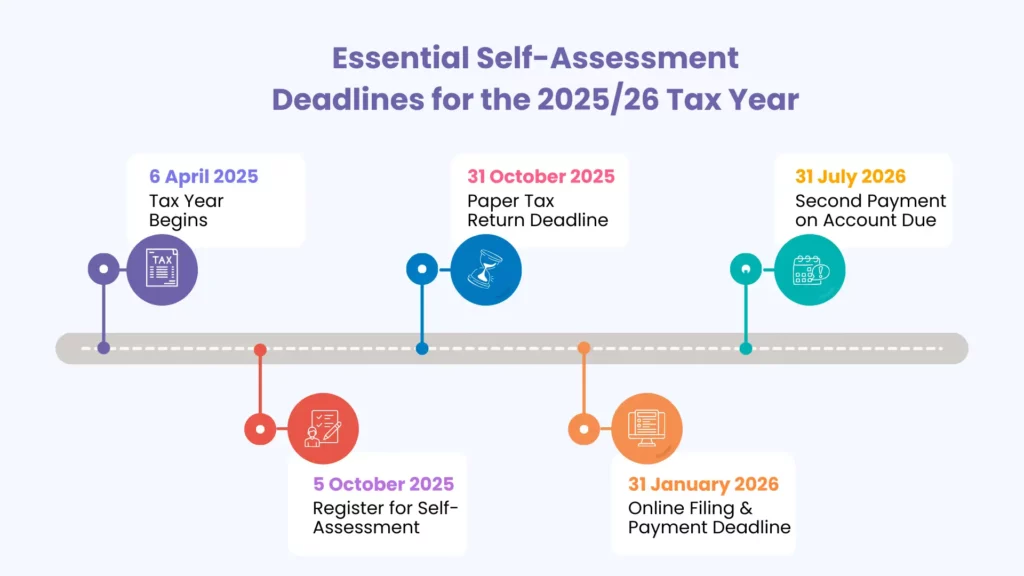
6 April 2025
The new tax year begins. This is a good time to start organising your records for your next return.
5 October 2025
Deadline to register for Self-Assessment if it’s your first time filing. This applies to new sole traders, landlords, or anyone who has started earning income that isn’t taxed at source.
31 October 2025
Deadline for filing a paper tax return. Most people file online, but if you use paper forms, make sure your return reaches HMRC by this date.
31 January 2026
The big one. This is the deadline for filing your online Self-Assessment return and paying any tax you owe for the year.
31 July 2026
Deadline for your second payment on account for the next tax year.
Preparing for Making Tax Digital (MTD) for Income Tax Self-Assessment
Starting from 6 April 2026, Making Tax Digital (MTD) for Income Tax will change the way many sole traders and landlords manage their Self-Assessment. Instead of the usual annual return, you’ll need to keep digital records and send quarterly updates to HMRC using compatible software.
Here’s what you need to know:
- The rollout will happen in stages. From April 2026, if your combined income from self-employment and property is over £50,000 (before expenses), MTD applies to you. This threshold will then reduce to £30,000 in April 2027, and £20,000 in April 2028.
- You’ll be required to keep all your records digitally, no more paper files, and submit four quarterly updates along with a final declaration at the end of the year. Software like QuickBooks or Xero will help you do this smoothly.
- MTD affects sole traders and landlords with what HMRC calls “qualifying income,” which means your total gross income before deducting expenses. If your income is below the thresholds or you have special circumstances, there might be an exemption.
- If you’re new to Self-Assessment, make sure to register by 5 October 2025. It’s also a good idea to try out HMRC’s free pilot software and check your eligibility through your online HMRC account so you’re fully prepared and avoid any penalties.
At MyIVA, we’re here to help you get set up with the right software and guide you through quarterly filings, making sure you stay compliant without the hassle.
Why Missing the Self-Assessment Deadline Can Cost You?
Missing the Self-Assessment Tax Return Filing Deadline can lead to more trouble than just a late night of paperwork. HMRC penalties can add up quickly and cause unnecessary financial pressure.
Here is what can happen if you miss the date.
Automatic late filing penalty
HMRC charges a fixed penalty even if you have no tax to pay.
Additional daily penalties
If your return is still late after three months, daily penalties may be added.
Six-month penalty
A further percentage of your tax bill may be added once you pass six months late.
One-year penalty
This applies if you continue ignoring your return for a full year.
Interest added on unpaid tax
If you owe tax and do not pay on time, interest starts to accumulate.
These penalties are avoidable. Stay aware of the deadline and plan ahead.
Beat the Self-Assessment Deadline with MyIVA – File Your Tax Return for Just £99
Get your return reviewed and filed by an expert, avoid HMRC penalties, and stay stress-free this tax season
How to Avoid Missing the Filing Deadline: Tips to Stay on Track
Loads of small businesses and sole traders find themselves in a bit of a muddle when it comes to the Self-Assessment season. There’s just so much to keep on top of, that the tax return can easily get put off until the very last minute. But it doesn’t have to be that way.
Keep on top of your paperwork
One of the simplest things you can do is keep your records in order. That means saving those receipts, invoices and bank statements as you go along, not leaving them until the end of the year when you’ve got a big job on your hands.
Start preparing as soon as the tax year ends
April is the best time to start. Everything is fresh and you get plenty of time.
Use online accounting tools
Using simple digital tools helps you track income and expenses easily.
Set reminders for major dates
Add the Self-Assessment Tax Return Filing Deadline to your phone calendar and set alerts.
Work with a trusted accountant
An accountant makes sure everything is accurate and filed on time. It also removes the stress of last-minute work.
What Happens if You Miss the Self-Assessment Filing Deadline?
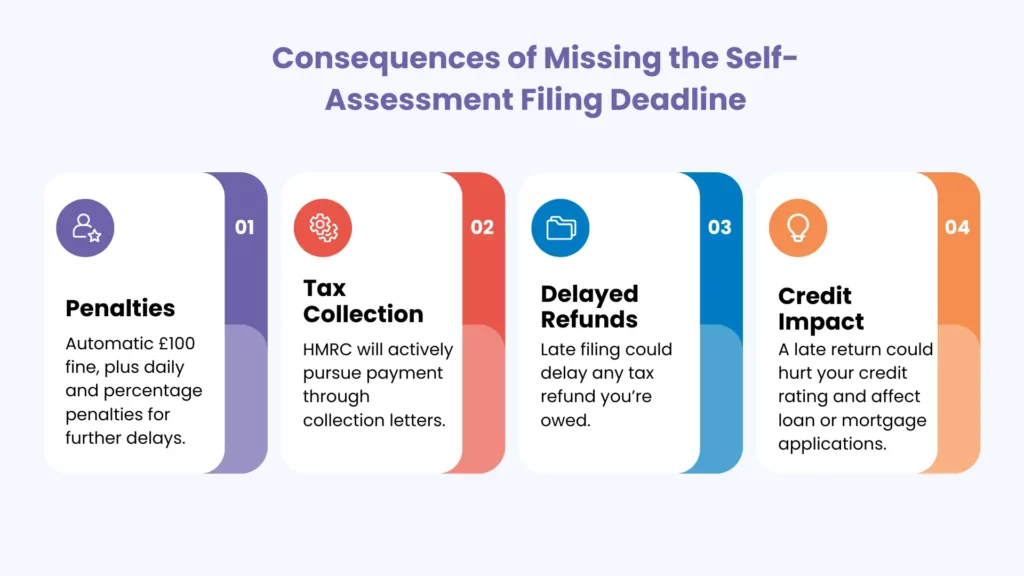
When you miss the Self-Assessment Tax Return Filing Deadline, the system does not wait. HMRC begins charging penalties immediately. It can also affect your financial planning for the year ahead.
Here is what you may face if your return is late.
- A fixed £100 penalty
- Daily penalties after three months
- An extra 5% of your tax bill at six months
- Further percentage penalties after twelve months
- Interest on unpaid tax
- Collection letters from HMRC
- Restrictions or extra checks on future returns
- Difficulty applying for loans or mortgages
- Loss of repayment claims if you delay too long
Missing your deadline creates more work and more cost. The earlier you submit your return, the smoother your year will be.
What to Do If You Can’t Pay Your Tax Bill by the Deadline?
There are times when you may be able to file your return but still struggle to pay the bill. This happens often with small firms and individuals whose income varies. If you cannot pay your tax bill by the deadline, the first step is not to ignore it. HMRC is open to helping taxpayers who reach out early.
You can check if you qualify for a Time to Pay Arrangement. This allows you to spread your tax bill into monthly instalments based on what you can afford. Many people find this helpful because it reduces the pressure of one large payment.
Make sure you still file your return by the Self-Assessment Tax Return Filing Deadline even if you cannot pay. Late filing and late payment are treated separately. You can avoid late filing penalties by submitting the return on time and arranging payments later.
Final Tips for a Smooth Self-Assessment Filing
Staying on top of your paperwork throughout the year is a great way to beat the stress that comes with Self-Assessment season. Keep your documents tidy and easily accessible, know your key deadlines inside out and give yourself plenty of time to get everything sorted without panicking.
MyIVA makes filing your Self-Assessment Tax Return a breeze – our team gives you straight talking guidance, fast responses and straightforward support to help with all the little things like getting your documents in order and making sure you meet the accurate filing deadline.
We’ll also send you gentle reminders about the Self-Assessment Tax Return Filing Deadline so you never miss a crucial date. Whether you’re a sole trader or part of a small business, MyIVA makes the whole process a whole lot easier and quicker.
Frequently Asked Questions
Who needs to file a Self-Assessment Tax Return?
Anyone with untaxed income on the cards – sole traders, landlords, business partners from tiny firms and high flyers all need to get involved.
What documents do I need to sort out my tax return?
You’ll need all the relevant paperwork – that’s invoices, bank statements, expenses receipts, a record of your employment, and your P60 or P45 forms.
Can I file my Self-Assessment early?
Absolutely, you can get a head start. Once the tax year wraps up on 5th April you can file at any point right up until the deadline.
What if I miss the payment deadline?
Well, HMRC won’t take kindly to that – they might stick you with some interest and additional penalties on the amount you owe.
Can MyIVA help with Self-Assessment filing?
Yes. MyIVA offers full support, quick filing and guidance for small firms and individuals.
Conclusion
Filing your Self-Assessment on time helps you avoid penalties, cut down on stress and stay compliant with HMRC. Keep the deadline in mind, get organised early and make the process smoother for yourself. If you’d like straightforward guidance and quick filing, MyIVA is here to support you from start to finish.
Ready to file with confidence? Get in touch with MyIVA today and make your Self-Assessment easier than ever.