A lot of small business owners worry about whether they are handling customer information the right way. It might be a name saved in your phone, a few emails in your inbox, or a spreadsheet with invoices. It does not take much for something to go wrong. A lost laptop. A wrong email was sent. A password written on a sticky note that someone else sees. Moments like these can turn into trouble if personal data is involved.
That is where GDPR comes in. Think of it as a set of rules that helps small businesses handle data properly. Being GDPR-Ready is not only about avoiding fines. It also reassures your customers that their details are protected. This is important, as most people only trust small businesses that handle their financial information with care.
GDPR outlines the proper way for UK businesses to gather, store, and protect customer information. Any small business that handles customer details must follow these rules.
In this blog, we will look at what GDPR is really about, why it affects even the smallest businesses, what type of data it covers, common mistakes, easy steps to become GDPR Ready, and why financial data needs more protection than ever.
Understanding GDPR and Its Impact on Businesses
GDPR was brought in so people have control over how their personal information is used. Before it came in, different businesses had different habits. Some kept data forever. Some shared it without asking. Some had very weak security. GDPR sets one clear standard for everyone, including micro-businesses and sole traders.
Since Brexit, the UK has been running its own version of GDPR , called UK GDPR – and while it’s still closely linked to the EU’s GDPR, it can be updated in ways that are specific to British law. To make sure your business stays on the right track, keep an eye out for guidance published by the ICO – they’ll help you keep on top of the UK-specific regulations, even if some of them do differ from what was in use before the EU rules applied.
What GDPR Means
It is a set of rules that explains how businesses should look after people’s personal information. The UK follows its own version called UK GDPR, but the ideas are basically the same. If your company holds personal information of any kind, you are included under GDPR.
Key Impacts of GDPR on Small Businesses
- You must explain why you collect data
- You must only keep data you actually need
- You must keep it safe
- You must report serious breaches
- You need consent in some situations
- You must be prepared for audits
For small businesses, GDPR is more than just a rule you have to follow. It’s a good practice that helps protect your business and the customers who rely on you.
What Does It Mean to Be GDPR Compliant?
Being compliant means looking after personal information properly. It means having simple processes, clear procedures and the right basic documents in place.
Key Parts of GDPR Compliance
- You collect data for a clear and genuine reason
- Straightforward consent when needed
- Safe places to store information
- Clear time limits for keeping files
- Letting customers see or delete their data if they ask
How Compliance Looks Day-to-Day
For a small business, compliance might be:
- Using updated privacy notices
- Keeping a simple log of what data, you hold
- Training a staff member who handles customer data
- Using secure software for accounts or emails
Compliance only works when it becomes a habit, not a once-a-year task. When these habits become normal staying GDPR Ready feels easier and less stressful.
What Does GDPR Protect?
GDPR covers any information that identifies a person. Some owners do not realise how much of this they collect without thinking.
Personal Data Examples:
- Names and addresses
- Emails and phone numbers
- Bank details
- Online behaviour like cookies or IP addresses
- Payment or invoice information
Sensitive Data Examples:
Some data is more private and needs stronger protection:
- Health details
- Financial vulnerability details
- Biometric data
Once your business knows what data you have, you can protect it.
Does My Small Business Need to Be GDPR Compliant?
Yes. GDPR applies even if you work from home. If you collect anything like a name, email address, phone number or payment details you are handling personal data.
Real Situations Where GDPR Applies
- Sending invoices
- Keeping client contact details
- Storing tax information
- Using an online accounting tool
- Running email marketing campaigns
Common Myths
- “My business is too small.”
- “I don’t have many clients.”
- “I only keep the data on my laptop, so it is fine.”
The truth is simple. If you hold personal information, GDPR applies. The size of the business does not change the rules.
Steps to Make Your Business GDPR-Ready
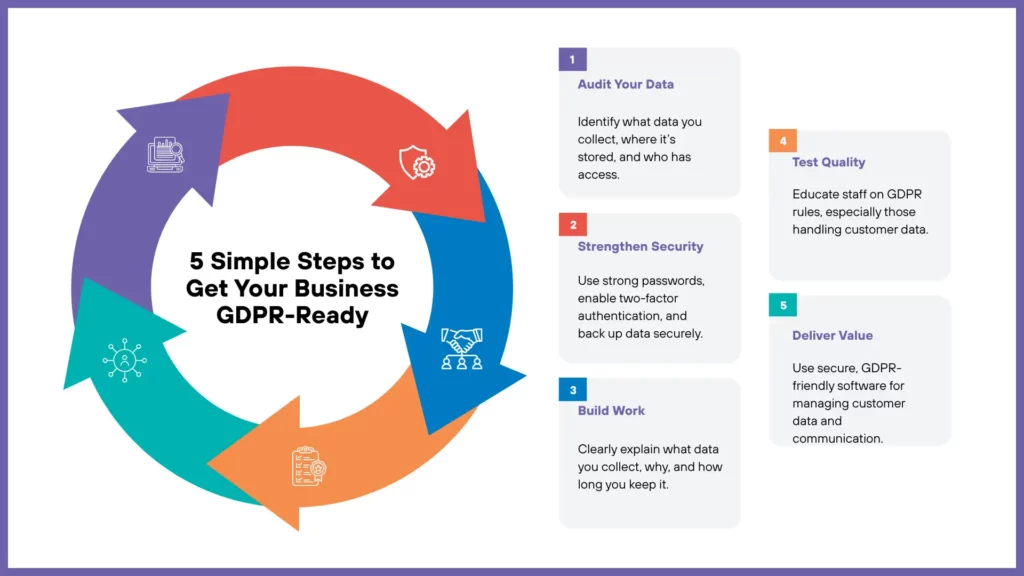
Being GDPR-Ready is easier when you break it down into smaller tasks. You don’t have to be technical to get started.
Step 1: Check the Data You Hold
Make a note of the info you collect, where you store it and who has access to it. It doesn’t have to be perfect.
Step 2: Add Better Security
Use stronger passwords, turn on two-factor login where possible, store files in secure cloud folders and back up your data regularly. These simple steps will protect you from everyday risks.
Step 3: Refresh Your Privacy Data
Write a clear privacy notice that explains what data you collect, why you collect it and how long you keep it. Keep it simple so customers can understand it.
Step 4: Talk to Anyone Who Helps You
If you have staff or contractors who handle customer data, have a quick chat with them about the rules. Even a 5-minute chat can stop avoidable mistakes.
Step 5: Use Tools That Support GDPR
Choose software with proper security for accounts, payments, CRM, or data storage.
If you need some proper help and guidance, then you should be checking out the ICO website regularly – they’re the UK’s official data protection regulator, after all. The ICO’s got all sorts of useful stuff on there too – such as checklists, privacy notice templates and self-assessment tools, all designed with small businesses in mind – to help you do it right.
Why Financial Data Needs Extra Protection?
Financial data is more sensitive than most other information. If it falls into the wrong hands, the damage can be immediate.
Risks Involving Financial Data
- Identity theft
- Fraudulent transactions
- Unauthorised access
- Loss of business money
Why Micro Businesses Are More Vulnerable
- Smaller budgets for security
- Limited technical knowledge
- Older devices or software
- Fewer layers of protection
Protecting financial data is not only part of GDPR. It protects the reputation and stability of the business.
Common GDPR Mistakes Small Businesses Make
Mistakes happen because people are busy or unaware. Here are the most common ones:
Mistake 1: Collecting Too Much Data
The more data you hold the more risk.
Mistake 2: Weak Passwords
Short passwords and repeated passwords put data at risk. Mistake
3: No Data Retention Rules
Data should not be kept forever. Clear timeframes matter.
Mistake 4: Ignoring Customer Data Rights
You must be able to show or delete a person’s data if they ask.
Mistake 5: Using Unsecured Devices
Personal devices, old laptops and shared phones create vulnerabilities.
Avoiding these mistakes reduces risk and builds customer trust.
Stay GDPR-compliant with expert accounting support! Contact us today to protect your clients’ financial data and ensure your business meets all regulations.
What Happens If Your Business Isn’t GDPR Compliant
Non-compliance has real consequences even for small businesses.
Financial Penalties:
Fines can be huge, even for small mistakes.
Loss of Trust:
Customers may stop working with you if they feel unsafe.
Operational Issues:
- Investigations
- Reporting obligations
- Delays
- Costs of repairing breaches
Being GDPR-Ready is easier and cheaper than fixing a breach after it happens.
FAQs: Frequently Asked Questions
What does “GDPR Ready” mean for my small business anyway?
It means your business actually takes the time to sort out how to deal with personal data properly. You only collect the bits you really need, keep them safe and sound and generally try to follow those rules we’re all supposed to be aware of as part of the UK GDPR deal. Being properly set up for GDPR just shows your customers that you care about their personal info.
Do I need consent for every bit of data I collect?
Not all the time. You can collect some data for proper business reasons like sending out invoices or keeping track of accounts. But basically, people should have a clue what you’re doing with their details and why.
How do I check if my software is up to speed on GDPR?
Most tools that claim to be GDPR-friendly usually have some decent security features built in like encryption, strong passwords, secure storage and clear-cut privacy settings. Just check the security settings or have a look at the provider’s website to see how they protect your customers data.
What do I do if I get a feeling that there has been a data breach?
Get on it ASAP. Try to stop anyone else from getting to it, change any passwords that might have been compromised and take a few notes about what happened. In a few cases, you may even need to get in touch with the ICO and let anyone whose data might have been mixed up know what’s going on.
Does GDPR apply to businesses outside the UK that end up working with UK clients?
Yeah, it does. If a business collects or uses data from people in the UK then they need to follow the rules, even if they’re based in a different country.
How quickly do I need to act if we have a data breach under the UK GDPR?
If a data breach is serious, you need to tell the ICO within 72 hours of realising it’s happened – the ICO even has some step-by-step advice on how to go about reporting it properly
Conclusion
Becoming GDPR ready is a pretty serious business for any small operation – it gives customers peace of mind that their personal info is safe, builds trust in your business, and helps prevent you from ending up on the wrong end of a costly lawsuit or PR nightmare. Taking it one step at a time will keep your customer data under lock and key, and things running smoothly in the long run.
If you’re a small business owner or manage personal tax clients and need some guidance on how to stay compliant, MyIVA is here to help with some practical steps to beef up your data protection