


Sarah, who owns a small online business, discovered a few months back that she hadn’t updated her bookkeeping in more than six months. Keeping her financial records updated continued falling down her to-do list since she had been preoccupied with managing orders, serving customers, and expanding her business. She had trouble finding records, reconciling bank transactions, and figuring out how her business was actually doing when tax season rolled around.
If you recognize this, you are not alone. Because many small business owners are preoccupied with operating their businesses, therefore daily bookkeeping is neglected.
Catch-up bookkeeping is useful in this situation. Through account reconciliation, bookkeeping, and the recording of missed transactions, it assists you in updating your financial records. This blog will explain what catch-up bookkeeping services is, why it’s crucial for small businesses, and how it can help you take back control of your finances while reducing stress.
Behind Your Books? Here’s What Catch-Up Bookkeeping Means
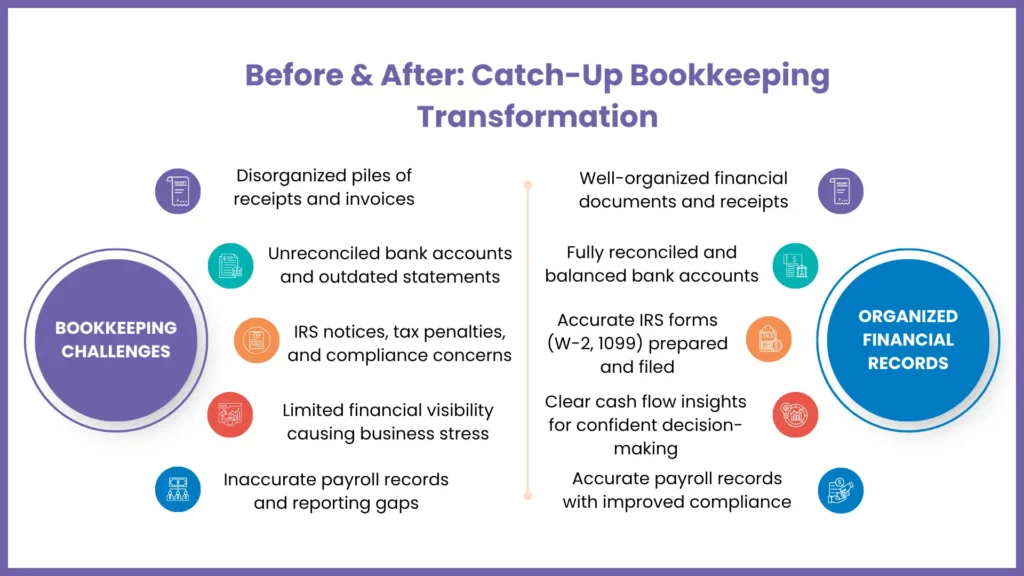
The process of correcting financial records that have fallen behind is known as “catch-up bookkeeping.” To make sure your financial records are correct and comprehensive, it means keeping track of missed transactions, balancing bank and credit card accounts, organizing invoices and receipts, and filling in any gaps in your books.
Catch-up bookkeeping can help you get your accounts up to date, regardless of how far behind you are. You can keep an eye on cash flow, be ready to file taxes, make wise business decisions, and prevent expensive mistakes with correct records.
In a simple way, catch-up bookkeeping helps you take back control of your finances so you can focus on expanding your business rather than worrying about past-due records.
Note on US Tax Compliance: Maintaining accurate and up-to-date bookkeeping helps ensure timely filing of IRS forms, including 1099s and W-2s, while keeping your business compliant with federal and state tax deadlines. This reduces the risk of penalties, errors, and potential audits.
When Your Books Fall Behind: 8 Signs It’s Time for Catch-Up Bookkeeping
Most business owners are unaware that they can fall behind in bookkeeping more quickly. It might be challenging to comprehend your financial flow, calculate taxes, or make confident company judgments when a few overlooked transactions quickly result in months of inadequate data.
Here are eight common signs that your business may need catch-up bookkeeping:
- Your Bank Accounts Haven’t Been Reconciled Recently: Your books might no longer give a true picture of your finances if your bank statements don’t match your accounting records or if transactions are accumulating without being reviewed.
- You are Missing Receipts or Invoices: Incomplete invoices, unrecorded spending, and lost receipts can leave gaps in your financial records and complicate tax preparation.
- Unsure About Your Cash Flow: Outdated bookkeeping may be the cause of your inability to determine how much money is coming in, going out, or what you can afford to spend.
- Tax Deadlines Are Approaching: It might be frustrating to try to arrange months’ worth of financial documents before paying taxes. Maintaining correct and timely accounts is made easier with catch-up bookkeeping.
- Your Financial Reports Are Outdated: Reports such as balance sheets and profit and loss statements are only helpful if your books are updated. Poor business judgments may result from delayed records.
- Spending Too Much Time Fixing Bookkeeping Issues: It could be time to get your books back on track if you are often looking for paperwork, fixing errors, or attempting to arrange transactions.
- You’ve Fallen Behind on Invoicing or Expense Tracking: Inaccurate reporting or missed payments may result from unrecorded invoices and expenses, which can also have an impact on your comprehension of business performance.
- Your Accountant Is Asking for Missing Information: It’s obvious that your bookkeeping needs attention if your accountant frequently asks for missing transactions or paperwork.
What Happens When You Ignore Overdue Bookkeeping?
Challenges of ignoring bookkeeping may initially appear harmless, but minor setbacks can quickly escalate into more serious financial issues. You can’t see your company’s finances when your records aren’t updated, and you can find it difficult to make wise judgments.
Here are some common problems caused by delayed bookkeeping:
Poor Understanding of Your Cash Flow:
It becomes challenging to determine how much money is available, what payments are due, or whether your organization is actually profitable without precise and current records.
Increased Risk of Mistakes:
It is simpler to overlook expenses, create duplicate entries, or make mistakes that could impact your financial reporting when months’ worth of transactions go unreported.
Stress During Tax Season:
If you don’t do monthly bookkeeping it can be very difficult to organize month’s of transactions, invoices, and receipts before a tax deadline. Additionally, it can raise the possibility of inaccurate filings or overlooked deductions.
Difficulty Making Business Decisions:
You may be unable to recognize significant patterns, such as growing expenses, diminishing earnings, or expansion prospects, if you are using outdated books.
Cash Flow Problems:
It might be more difficult to manage finances and keep a healthy cash flow when there are missing invoices, untracked spending, or delayed payment records.
More Time Spent Fixing Problems Later:
Cleaning up records takes more effort the longer bookkeeping is neglected. Early catch-up can minimize stress and save important time.
How the Catch-Up Bookkeeping Process Works: A Step-by-Step Guide
It might be difficult to get your books back on track, particularly if months’ worth of transactions have gone unprocessed. Nonetheless, a methodical catch-up bookkeeping procedure can assist in transforming disorganized financial data into precise and well-organized accounts.
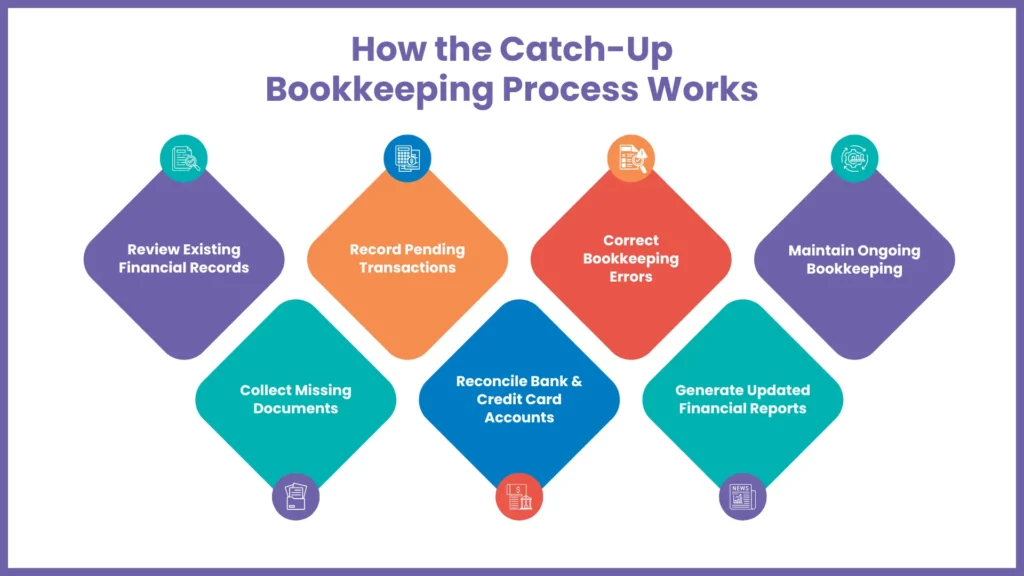
Here are the key steps involved:
Review Your Existing Records:
Reviewing your current financial records, such as bank statements, invoices, receipts, costs, and prior bookkeeping entries, is the first step in the process. This makes it easier to determine what is lacking and how far behind your books are.
Gather Missing Financial Documents:
To make sure every transaction is recorded, any missing documents such as unpaid invoices, supplier bills, receipts, or payment records are gathered and arranged.
Record Outstanding Transactions:
Your accounting system is updated with all overlooked revenue and costs. This guarantees that your books fairly depict your business operations throughout the time frame that was missed.
Reconcile Bank and Credit Card Accounts:
To find mistakes, missing transactions, or inconsistencies and make sure your records reflect your real financial activity, your accounts are checked with bank and credit card statements.
Review and Correct Errors: To increase the accuracy of your financial records, any duplicate entries, inaccurate categories, or accounting errors are found and fixed.
Maintain Regular Bookkeeping Going Forward:
Maintaining a regular bookkeeping schedule after catching up helps stop the backlog from growing again. Therefore, bookkeeping catchup services for small businesses are necessary.
Generate Updated Financial Reports:
Reports like balance sheets and profit and loss statements can give you a clear view of your company’s performance after your records are updated.
DIY Bookkeeping or Professional Support: Which Option Works Better?
| DIY Bookkeeping | Professional Support |
| Ideal for companies with few past-due records and straightforward transactions. | Perfect for companies with complicated financial records or months of incomplete bookkeeping. |
| Reviewing and updating transactions takes time, expertise, and effort on your part. | The procedure is handled by a qualified bookkeeper, saving you important time. |
| Finding lost invoices, receipts, and financial records is your responsibility. | Experts assist locate missing information and manage your financial data effectively. |
| If you are not familiar with bookkeeping procedures, you are more likely to make mistakes. | Experts are able to increase accuracy, reconcile accounts, and spot mistakes. |
| It might take longer if you are juggling everyday company obligations with bookkeeping. | Your books can be updated faster using a methodical approach. |
Catch-Up Bookkeeping Costs: What Affects the Price?
The amount of effort required to update your financial records will determine the cost of bookkeeping catch-up. Since every firm is unique, cost is usually determined by the amount and complexity of unfinished bookkeeping.
The main factors that affect the cost include:
- How far behind your books are: The more labor involved, the longer the backlog.
- Number of transactions: Processing more income and spending entries takes longer.
- Business complexity: Payroll, inventories, VAT, and several accounts can all add to the workload.
- Quality of your records: Documents that are well-organized save time and money.
- Extra services: Payroll, year-end accounts, and VAT returns are examples of tasks that could raise the total cost.
Should You Hire a Professional for Catch-Up Bookkeeping?
If your finances are simple and your bookkeeping is only a few weeks behind, you might be able to catch up on your own. However, expert assistance can save you time and lower the likelihood of expensive errors if your records are several months past due, contain errors, or involve complicated transactions.
You should consider hiring a catch-up bookkeeping professional if:
- Your accounting is months behind schedule.
- Financial records, invoices, or receipts are absent.
- There is no reconciliation of your bank accounts.
- Deadlines for taxes are coming up.
- You don’t know if your financial records are correct.
- You would like to concentrate on managing your company rather than finishing off paperwork.
A professional bookkeeping catchup services can provide you with precise financial information and peace of mind by organizing your records, fixing mistakes, and updating your books.
Our skilled bookkeeping staff at MyIVA Accounting assists companies in effectively clearing backlogs, retaining correct records, and regaining complete financial insight. Whether you’re a few months behind or dealing with a major bookkeeping backlog, we can help get your books back on track swiftly and properly.
Behind on Your Books? Get Expert Catch-Up Bookkeeping Support and Restore Accurate Financial Records.
People Also Ask:
How far back is it possible to complete catch-up bookkeeping?
Depending on how far behind your bookkeeping is and the accessibility of your financial documents, it may span a few weeks, several months, or even several years.
Can I handle my own catch-up bookkeeping?
Yes, if your finances are simple and your books are only a little behind schedule. However, expert assistance is frequently quicker and more precise for complicated records or big backlogs.
What makes catch-up bookkeeping crucial?
Accurate financial records, better cash flow insight, easier tax preparation, and the ability to make well-informed business decisions are all provided by catch-up bookkeeping.
Can small businesses benefit from catch-up bookkeeping?
Definitely. Small enterprises who have lagged behind because of staffing shortages, time constraints, or rapid business expansion may particularly benefit from it.
Before filing taxes, can catch-up bookkeeping be helpful?
Yes. Updating your books prior to paying taxes ensures correct returns, lowers errors, and streamlines the filing process.
Conclusion:
Many business owners are unaware of how frequently they get behind on their bookkeeping, but it doesn’t have to be a hindrance to your company. Catch-up bookkeeping facilitates the restoration of accurate financial records, enhances cash flow visibility, makes tax preparation easier, and gives you the assurance to make wise business decisions. It’s easier to get your finances back on track the sooner you take care of overdue books.
MyIVA Accounting will assist you if your bookkeeping backlog is causing you problems. Our skilled staff guarantees that your records are correct, well-organized, and current by offering dependable catch-up bookkeeping services that are customized to your company’s requirements. Get in touch with MyIVA Accounting right now to get your books back on track and confidently concentrate on expanding your company.
