


Bookkeeping and accounting are often used interchangeably, but they’re not the same thing. Bookkeeping is the day-to-day process of recording financial transactions — sales, purchases, receipts, and payments. Accounting takes that recorded data and interprets it, using it to analyze performance, ensure compliance, and guide business decisions. In short: bookkeeping tracks the numbers, accounting makes sense of them.
Small business owners often confuse bookkeeping and accounting, and that confusion has real consequences. Bookkeeping records daily financial transactions like sales, invoices, and expenses, while accounting takes that data and turns it into reports, tax strategy, and business decisions. Put simply: bookkeeping tells you what happened with your money; accounting tells you what to do about it. Get the two mixed up, and you either overpay for basic data entry or go without the financial insight you actually need to grow. Here’s exactly where one ends and the other begins — and how to know which your business needs right now.
The Short Answer: Bookkeeping vs Accounting in One Minute
The practice of documenting and arranging everyday financial transactions, including sales, expenses, invoices, and payments, is known as bookkeeping. This financial information is used by accounting to create reports, evaluate company performance, handle taxes, and help in decision-making. In simple terms, accounting explains the meaning of the numbers that bookkeeping records.
What Bookkeeping Actually Covers
Bookkeeping is the process of tracking, organizing, and documenting a company’s financial transactions as they happen. It’s what keeps your financial records accurate, complete, and current enough to rely on.
Key bookkeeping tasks include:
- Bank reconciliation — matching your books against actual bank and credit card statements so nothing falls through the cracks
- Invoice management — issuing, tracking, and following up on customer invoices so revenue doesn’t get lost in the gaps
- Expense tracking — recording and categorizing every business expense so nothing is missed at tax time
- Accounts payable and receivable — making sure vendors get paid on time and customers pay you on time
- Ledger maintenance — keeping the general ledger current, accurate, and audit-ready
In simple terms, bookkeeping establishes the solid financial base that companies require prior to accounting and analysis. If your records have already fallen behind, catch-up bookkeeping can bring months of backlogged transactions current before it becomes a bigger problem at tax time, and clean-up bookkeeping can fix inconsistent or inaccurate records before they get handed off to an accountant.
What Accounting Adds On Top
When comparing bookkeeping vs accounting, accounting transforms bookkeeping’s structured financial data into useful company insights.
Key accounting tasks include:
Financial reporting — profit & loss statements, balance sheets, and cash flow statements that give a real picture of business health
Profitability analysis — identifying which products, services, or clients are actually making money and which are quietly losing it
Budgeting — setting spending targets tied to real performance data, not guesswork
Cash flow forecasting — projecting where cash will be in 30, 60, or 90 days so surprises don’t turn into emergencies
Tax planning support — working with bookkeeping data throughout the year (not just at filing time) to reduce tax liability and avoid last-minute scrambles
Where bookkeeping tells you what happened, accounting tells you what it means and what to do next. This is largely the work of management accounting, which turns bookkeeping data into the budgets, KPI tracking, and performance reports business owners actually use to make decisions, while ongoing tax planning support keeps that same data working in your favor come filing season. Bookkeeping vs accounting go hand in hand — you can’t work with one separately from the other.
Bookkeeping vs Accounting: Side-by-Side Comparison
The following comparison highlights the key differences between bookkeeping vs accounting and how each function contributes to business finance management.
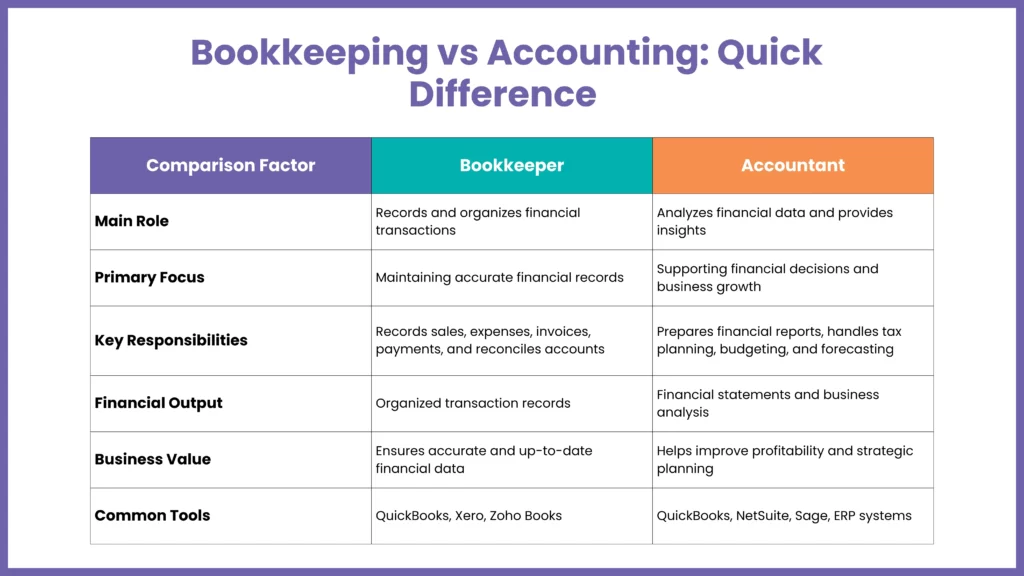
Bookkeeper vs Accountant: What Each Person Actually Does
What does a bookkeeper do?
A bookkeeper keeps accurate records of a company’s daily financial transactions. That means preparing invoices, tracking payments, managing accounts payable and receivable, reconciling bank accounts, and keeping the books current. Their job is to make sure the business always has accurate, up-to-date financial information on hand.
What does an accountant do?
An accountant takes the financial data a bookkeeper produces and turns it into insight. That includes preparing financial statements, overseeing tax compliance, evaluating profitability, building forecasts and budgets, and advising owners on financial decisions. Accountants help businesses understand their numbers well enough to plan around them.
Real Business Examples
Ecommerce business:
A bookkeeper tracks Shopify and Amazon sales, marketplace payment fees, refunds, and day-to-day operating expenses — making sure every transaction across multiple sales channels is recorded and reconciled correctly. The Ecommerce accountant then steps in to analyze profitability by product line, calculate true margins after fees and shipping costs, and flag which categories are worth scaling versus which are eating into profit.
Restaurant:
A bookkeeper manages daily sales records, supplier payments, and payroll — the constant, high-volume transaction flow a restaurant generates every single day. The accountant reviews food and labor costs against revenue, tracks profitability by location or shift, and helps the owner decide whether a menu change, price adjustment, or staffing shift actually makes financial sense.
In both cases, the bookkeeper keeps the engine running; the accountant tells the owner where to steer it.
Accounting Software Used for Bookkeeping and Accounting
Most modern bookkeeping and accounting runs through cloud-based software rather than spreadsheets — and the tool matters less than how consistently it’s used.
- QuickBooks — the most widely used platform for small and mid-sized businesses, covering everything from invoicing to reporting
- Xero — a strong alternative popular with service-based and international businesses, known for clean bank feed automation
- NetSuite — used by growing and mid-market businesses that need accounting tied into broader ERP functions like inventory and operations
- Zoho Books — a cost-effective option often used by small businesses already in the Zoho ecosystem
Professionals managing these tools do more than data entry — they set up the chart of accounts correctly, automate bank feeds and categorization rules, and build in the reconciliation checkpoints that keep the software’s automation from quietly compounding errors. Software speeds up the process; it doesn’t replace the judgment of someone who knows what to look for.
When to Hire a Bookkeeper vs Accountant
The decision to hire a bookkeeper or accountant is simple as compared to other important business decisions. It depends on many factors including the size of the company, complexity of the financial operations involved, and level of help needed for finance management purposes. The bookkeeping process is most often enough for many small firms, but larger businesses typically require both services — a distinction covered in more depth in our guide on outsourced bookkeeping for small businesses.
Signs that you may require a bookkeeper:
If you find it too difficult to manage your financial records and it takes too much time for managing your business, you may require specialized bookkeeping services. Missing your payments or having difficulties in tracking your expenses, or having the need for the bank reconciliation are some of the most typical signs.
Signs you need an accountant:
An accountant becomes essential when you need more than just transaction records. If your needs include tax planning, financial reporting, forecasting, budgeting, business performance analysis, or advice with major financial decisions, you may need an accountant. Our roundup of the best accountants for small businesses in the US walks through what to look for.
Signs you need both (most growing businesses):
Growing companies frequently require both an accountant and a bookkeeper. While the accountant uses this data to manage compliance, provide reports, offer insights, and assist with strategic planning, the bookkeeper makes sure that daily financial records are correct and well-organized.
How much each costs:
The size of the company, the amount of transactions, and the degree of experience needed all affect how much bookkeeping and accounting services cost. Accounting services are typically more expensive because of the additional analysis, reporting, tax, and advising work required, whereas bookkeeping services are typically less expensive and concentrate on keeping records. For financial flexibility and access to professional experience, many firms choose for outsourced bookkeeping and accounting services.
What Happens When Businesses Get This Wrong
- Inaccurate, missed, or duplicated transaction records
- Compliance risk, including missed sales and use tax filings
- No real visibility into actual profitability
- Weak planning and forecasting without reliable data
- Last-minute tax or cash flow surprises
Why Small Businesses Need Both, Not One
It is tough to decide between bookkeeping vs accounting as both are inseparable from each other. Here are some points that say why small businesses need both for financial growth of business.
- Accurate financial records: Bookkeepers manage well-organized records of everyday transactions, guaranteeing that companies always have accurate financial information.
- Improved compliance: Accountants use proper bookkeeping records to help handle tax duties, reporting, and regulatory obligations, including staying current with business income tax filings.
- Better cash flow control: While accounting assists in identifying trends and planning for future financial demands, bookkeeping monitors the flow of money.
- Scalable financial management: As businesses grow, having both ensured financial processes remain organised and effective.
- Smarter decision making: Accounting insights assist business owners to make informed decisions about growth, spending, investments, financial reporting.
How to Set This Up Without Overcomplicating It
Businesses can avoid needless complexity and assign the correct responsibilities to the right professionals by having a clear grasp of bookkeeping vs. accounting. The secret is to recognize the difference between accounting and bookkeeping and assign the appropriate work to the right professional or a service provider.
- Begin with bookkeeping: Establish a trustworthy finance bookkeeping procedure to monitor daily transactions, handle invoices, keep check on spending, and maintain current financial records.
- Know when to hire a bookkeeper vs accountant: An accountant is required for tax planning, reporting, forecasting, and financial guidance; a bookkeeper is best for handling day-to-day financial responsibilities.
- Combine accounting and bookkeeping: Combine bookkeeping and accounting as your company grows to transform financial data into insightful information that helps you make better decisions.
- Keep systems connected: Your bookkeeping and accounting will function well together if you use accounting software and have defined procedures.
- Choose the right level of support: When financial demands get more complicated, small firms might add accounting support after beginning with outsourced bookkeeping services.
Simplify Your Bookkeeping and Accounting Process
Get accurate financial records, better reporting, and expert support without the complexity. Myiva helps small businesses streamline bookkeeping and accounting so they can focus on growth.
People Also Ask:
Is it possible to outsource accounting and bookkeeping?
Yes, a lot of companies outsource bookkeeping and accounting services in order to gain access to specialist knowledge, cut expenses, and guarantee that their financial procedures are handled effectively.
Can a bookkeeper do accounting tasks?
Basic accounting duties may be handled by some experienced bookkeepers, but more complicated areas like financial analysis, tax planning, and business forecasting commonly call for an accountant.
How do bookkeeping vs accounting differ from each other?
The main difference between bookkeeping vs accounting is that bookkeeping focuses on keeping track and organizing everyday financial activities, whereas accounting analyzes financial data, creates reports, and assists companies in making wise decisions.
Can accounting and bookkeeping be done by the same person?
Yes, a single individual may manage both responsibilities in smaller businesses. However, for more efficiency and expertise, larger or expanding firms frequently divide accounting and bookkeeping duties, often turning to small business accounting specialists as they scale.
Conclusion
Understanding how both contribute to corporate success is more important in the bookkeeping vs accounting debate than picking one over the other. While bookkeeping maintains the accuracy and organization of financial data, accounting transforms that data into insightful knowledge that informs critical choices.
To maintain control over day-to-day finances, enhance compliance, and foster long-term growth, a robust financial system integrates bookkeeping and accounting. Businesses may focus more on building their future and less on controlling numbers if they have the proper assistance in place.
At Myiva Accounting, we help small businesses streamline bookkeeping, accounting, and financial reporting processes with expert support tailored to their business needs.
Get reliable financial insights and spend more time growing your business. Contact Myiva today.
