
Every year, plenty of small businesses in the UK end up paying penalties for one reason more than any other. A deadline gets missed. Most of the time, it is not deliberate and it is not about avoiding tax. It usually happens because dates are misunderstood or something slips through while the business owner is focused on day-to-day work.
Corporation Tax deadlines are a common cause of this confusion. There is not just one date to deal with. A company has to register for Corporation Tax, file a Corporation Tax return, and pay the tax due. Each of these comes with its own deadline. Missing any one of them can lead to interest, penalties, and letters from HMRC that nobody wants to receive.
Corporation Tax deadlines are the dates set by HMRC for registering a company, submitting the Corporation Tax return, and paying Corporation Tax. The exact dates depend on the company’s accounting period and, in some cases, how HMRC treats the company.
This blog goes through the main Corporation Tax deadlines that apply to small businesses, when returns and payments are due, what usually happens if a deadline is missed, and how to keep things on track without turning tax into a constant worry.
What Is Corporation Tax and Why Are Deadlines Crucial?
Corporation Tax is a tax paid by limited companies and certain other organisations on their taxable profits. These profits may come from trading income, investments, or selling company assets.
Once a small business is registered for Corporation Tax, HMRC expects regular reporting through a Corporation Tax return and payment by fixed deadlines. Corporation Tax Deadlines exist to ensure tax is reported consistently and collected on time across the UK.
Deadlines are crucial because HMRC applies penalties automatically when they are missed. Even if no tax is owed, failing to meet a deadline can still result in fines. Knowing your deadlines helps your small business stay compliant, protect cash flow, and avoid unnecessary costs.
Key Corporation Tax Deadlines Every Business Owner Should Know
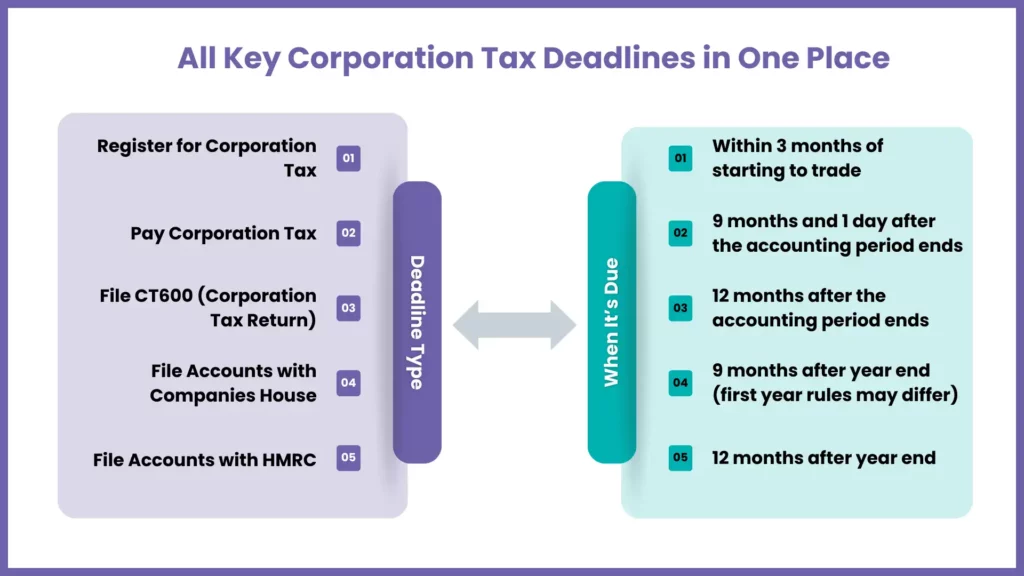
Understanding Corporation Tax Deadlines is essential for every small business owner. These dates affect when you must register, when returns must be filed, and when tax must be paid. Missing one deadline can trigger penalties even if everything else is correct. Many problems arise simply because business owners are not aware of how these dates work together. Keeping a clear view of all deadlines helps avoid last minute stress and HMRC follow ups.
Corporation Tax Deadlines Table
| Deadline Type | Deadline Date |
| Register for Corporation Tax | Within 3 months of starting to trade |
| End of accounting period | Chosen by the company |
| File Corporation Tax return (CT600) | 12 months after accounting period ends |
| Pay Corporation Tax | 9 months and 1 day after accounting period ends |
| File statutory accounts with Companies House | 9 months after year end for first year |
| File statutory accounts with HMRC | 12 months after year end |
Each deadline serves a different purpose and missing one does not cancel the others. A small business can still face penalties for late payments even if they file their tax return right on time. Keeping a simple calendar of deadlines helps reduce that risk & gives you a bit more breathing space. Planning ahead also keeps your cash flow from getting out of hand and avoids the last minute rush to get your submissions in on time.
When Is Your Corporation Tax Return Due?
A Corporation Tax Return, also known as a CT600, is the form that lets your small business tell HMRC how much profit it made over the course of the year. Its where you lay out your income , your business expenses, and how its all worked out to get that final tax figure .
Corporation Tax Return due date:
- You must file your CT600 within 12 months of the end of your accounting period.
It is important to file your Corporation Tax Return on time even if your small business made no profit or has no tax to pay. HMRC issues penalties automatically for late returns. Filing early also gives you time to fix any mistakes and plan how you will pay your tax.
When Is Your Corporation Tax Payment Due?
Paying Corporation Tax is a separate step from filing your return. Even if your return deadline is months away, HMRC still expects the tax to be paid by the payment deadline.
Corporation Tax payment due date:
- Corporation Tax must be paid within 9 months and 1 day after the end of your accounting period.
If you miss this payment date, HMRC starts charging interest straight away. If the delay continues, penalties or debt recovery action may follow. Paying on time helps your small business avoid extra costs and stay in good standing with HMRC.
How Do I Know If My Corporation Tax Deadlines Are Different Due to My Company Size?
Corporation Tax Deadlines do not depend only on company size. They are also affected by profit level, accounting period, and whether the company is classed as large by HMRC.
Small to medium sized companies
- Profits up to £1.5 million
- Corporation Tax payment due 9 months and 1 day after year end
- Corporation Tax return due 12 months after year end
Large companies
- Profits above £1.5 million
- Corporation Tax paid in instalments
- Earlier and more frequent payment deadlines
How to check your deadlines on HMRC
- Log in to your HMRC online account
- Review your accounting period dates
- Check whether HMRC has classed your company as large
- Confirm payment and filing deadlines listed in your account
Checking directly with HMRC ensures your small business follows the correct schedule.
What Happens If I Miss My Corporation Tax Deadlines?
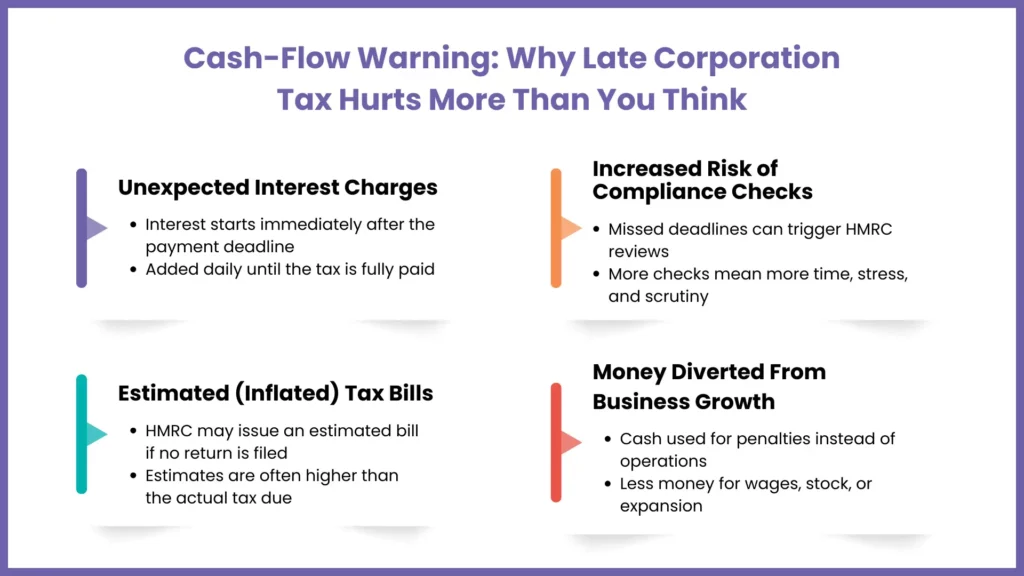
Missing Corporation Tax Deadlines can cause more problems than many small business owners expect. HMRC does not wait for explanations or reminders. Most penalties are added automatically as soon as a deadline is missed. The longer the delay continues, the more costly the situation becomes. Even small delays can lead to stress, extra costs, and loss of control over your tax position.
Late filing penalty
If your Corporation Tax Return is filed late, HMRC charges a fixed penalty straight away. This applies even if your small business made no profit or has no tax to pay. Filing late once may seem minor, but penalties start from day one.
Additional penalties after 3 months
If the return remains unpaid or unfiled after three months, HMRC adds further penalties. These extra charges grow the longer the return is delayed. This is where small fines can quickly turn into larger amounts.
Late payment interest
If your Corporation Tax is not paid by the deadline, HMRC charges interest every day on the amount owed. This interest keeps adding up until the full tax bill is paid. Even a short delay can increase the final cost.
Estimated tax bills
If HMRC does not receive your Corporation Tax Return, they may issue an estimated tax bill. This estimate is often higher than the actual amount owed. You are expected to pay it until the correct return is submitted and processed.
Flow pressure
Penalties, interest, and estimated bills can place sudden pressure on your small business cash flow. Money that should support growth or daily costs may end up going towards fines that could have been avoided.
HMRC compliance checks
Missing Corporation Tax Deadlines more than once can attract attention from HMRC. Your small business may be selected for further checks or reviews, which take time and add extra stress.
Enforcement action
If deadlines continue to be ignored, HMRC may take stronger action. This can include debt collection, charging additional fees, or starting legal proceedings to recover unpaid tax.
With MyIVA, small business owners get help tracking deadlines, preparing accurate returns, and submitting everything on time. This means fewer worries, fewer penalties, and confidence that your tax affairs are handled properly.
Can I Change My Corporation Tax Filing Period?
Yes, you can change your Corporation Tax filing period, but only in certain situations. HMRC allows changes for genuine reasons such as aligning with a group or correcting errors.
Filing period changes
| You can change when | You cannot change when |
| First accounting period | To delay tax payment |
| Joining a group | After repeated changes |
| Short accounting periods | Without valid reason |
Changing periods affects deadlines, so careful planning is required.
What Are the Penalties for Filing Late or Paying Late?
Late filing or payment affects more than just tax costs. Penalties add up and can harm a small business financially.
Penalties overview
| Issue | Penalty |
| 1 day late payment | Interest starts |
| 3 months late return | £100 penalty |
| 6 months late return | Additional £100 |
| 6 months late payment | 10% of unpaid tax |
| 12 months late | Further penalties and enforcement |
Understanding these penalties highlights why Corporation Tax Deadlines matter.
Do I Need an Accountant to Manage My Corporation Tax Deadlines?
A lot of small business owners deal with Corporation Tax on their own at the start. That makes sense. When money is tight, paying for help can feel optional. The problem is that tax rules are rarely as straightforward as they look online.
Corporation Tax deadlines are fixed. HMRC does not allow leeway because someone is new or unfamiliar with the process. Missing a deadline by a few days can result in charges that cost more than professional support would have in the first place. Many directors only realise this after the first penalty arrives.
An accountant does more than file paperwork. They keep track of deadlines, flag what is coming up, and make sure payment dates are planned for in advance. This removes last minute pressure and reduces the chance of something being missed.
Over time, having an accountant also helps directors understand how HMRC works. Instead of guessing or reacting after the fact, decisions are made with clearer information. That usually means fewer surprises and fewer penalties.
Avoid HMRC Penalties and Cash Flow Pressure Caused by Missed Corporation Tax Deadlines
Missing Corporation Tax deadlines leads to fines, interest, and cash-flow strain. MyIVA prepares and files your return on time for a fixed £325.
FAQs
How Do I Pay My Corporation Tax on Time?
Corporation Tax is usually paid by bank transfer, debit card, or direct debit. The payment must reach HMRC by the due date. Sending it on the day is not always enough.
Can I Get an Extension for My Corporation Tax Payment?
HMRC does not give automatic extensions. In some cases, they may agree to a Time to Pay plan. This only happens if you contact them early.
Do I Have to File a Corporation Tax Return if My Business Made No Profit?
Yes. A return is still required. HMRC expects one for each accounting period once the company is registered.
Can I Delay My Corporation Tax Payment?
Delaying payment usually leads to interest. If it goes on, penalties can follow. It is better to speak to HMRC than ignore it.
What Happens If I Miss a Corporation Tax Deadline?
HMRC applies penalties automatically. Interest may also be charged. Missing deadlines more than once can lead to further action.
Can HMRC Estimate My Corporation Tax If I Don’t File on Time?
Yes. HMRC can issue an estimated bill. This often stays in place until a proper return is filed.
Conclusion
Corporation Tax deadlines are part of owning a small business. When they are missed, the cost builds up quickly and fixing the problem usually takes more time than expected. In most cases, the issue is not the tax itself but a missed date.
Knowing when tax is due, what needs to be filed, and how HMRC applies penalties puts you in a stronger position. It allows you to plan payments properly and deal with Corporation Tax as part of normal business activity, not as a last-minute problem.
MyIVA works with small businesses, sole traders, and people who file taxes to keep Corporation Tax deadlines under control. Returns are filed on time, payments are planned, and HMRC contact is handled properly.
If you want fewer reminders, fewer penalties, and fewer surprises, MyIVA can take care of it.