



Are there a lot of duplicate entries, missing transactions, or accounts that haven’t been reconciled in months in your financial records? It’s not just you. Many small business owners find it difficult to maintain their books updated while managing day-to-day operations, and these little problems can eventually escalate into more serious financial challenges.
Fortunately, clean-up bookkeeping can assist. You can increase financial accuracy, make tax preparation easier, and get a better picture of your company’s success by going over and fixing your records. This blog provides step-by-step instructions for clean-up bookkeeping as well as tips for maintaining books organized in future.
What does Clean-Up Bookkeeping mean?
The act of examining and updating your current financial records to make sure they are accurate, complete, and current is known as clean-up bookkeeping. Over time, it may become challenging to comprehend your company’s financial situation due to bookkeeping mistakes, uncategorized transactions, duplicate entries, or unreconciled accounts. Restoring order without starting from scratch is possible with an accounting clean-up.
It typically involves:
- Correcting inaccurate or missing accounting entries
- Reconciling bank and credit card accounts
- Categorising income and expenses correctly
- Removing duplicate or incorrect transactions
- Updating overdue bookkeeping records
- Verifying that financial records match bank statements
When Clean-up bookkeeping is necessary?
Organizing your messy books is only one aspect of clean-up bookkeeping; another is preserving financial accuracy and making wise choices. Bookkeeping cleanup is crucial because of this. It gives you more control over the financial health of your company, helps you avoid compliance problems, and reduces tax complications. But the question is when clean-up bookkeeping is required?
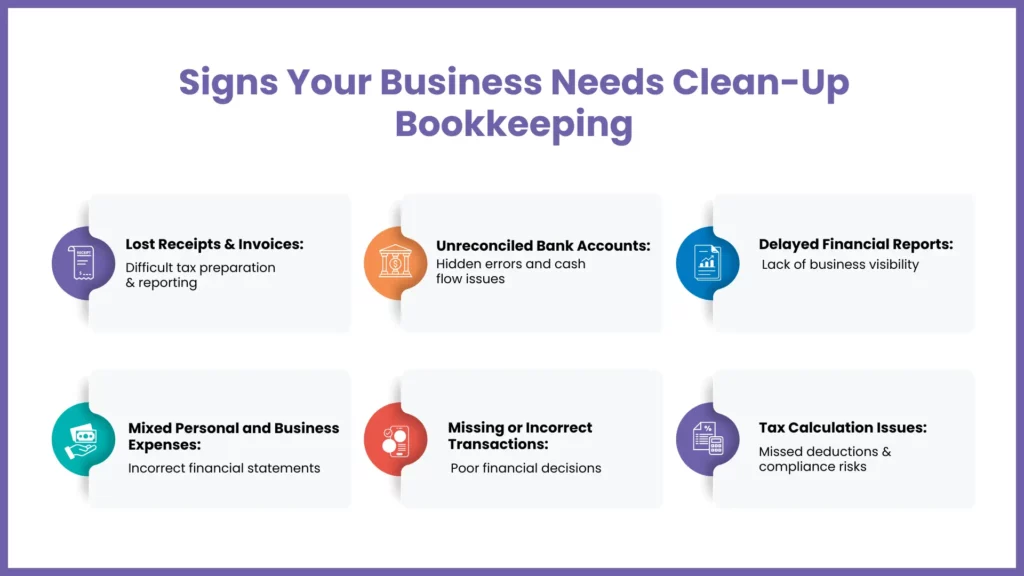
The following points can be the clear signs that you need bookkeeping clean-up process:
- Lost receipts or invoices: Tax filing and financial reporting become challenging when your financial documents are difficult to locate. You risk reporting income and expenses incorrectly if you don’t have reliable records.
- Mixing personal and business spending: Your personal and corporate transactions aren’t kept separate, which leads to incorrect financial statements and tax issues. Additionally, this raises the possibility of noncompliance.
- Unusual credit card and bank reconciliations: Failing to reconcile your transactions allows mistakes and inconsistencies to go undiscovered, which can result in mismanaged cash flow, erroneous reporting, and bookkeeping issues.
- Incomplete or inaccurate financial records: Understanding your financial situation gets challenging when transactions are overlooked or misclassified, which can result in poor decision-making and improper tax filing.
- Unable to create financial reports on time: There must be a need for change if you are having trouble producing cash flow statements, balance sheets, or profit and loss statements on time.
- Issue with tax calculation: Your inability to classify expenses for deductions or your uncertainty about tax predictions raise the possibility of fines and lost savings.
Clean-Up vs Catch-Up Bookkeeping: Understanding the Key Differences
Clean-up bookkeeping and catch-up bookkeeping are not the same, despite what some people believe. This is why:
- When you get behind and need to add transactions from previous months or years, this is known as catch-up bookkeeping.
- Clean-up bookkeeping is the process of recording transactions that need to be corrected because they are messy, erroneous, or incomplete.
Catching up and cleaning up your financial records are equally crucial for your business. You can take advantage of catch-up and clean-up services by using catchup bookkeeping services from a professional bookkeeping service provider.
To know more details about catch-up bookkeeping read our blog, What Is Catch-Up Bookkeeping and Why Small Businesses Need It
Essential Steps to Clean Up Your Business Books
Organizing your books doesn’t have to be difficult. When done systematically, all you have to do is go through each stage until your financial records are precise, well-organized, and prepared for making decisions.
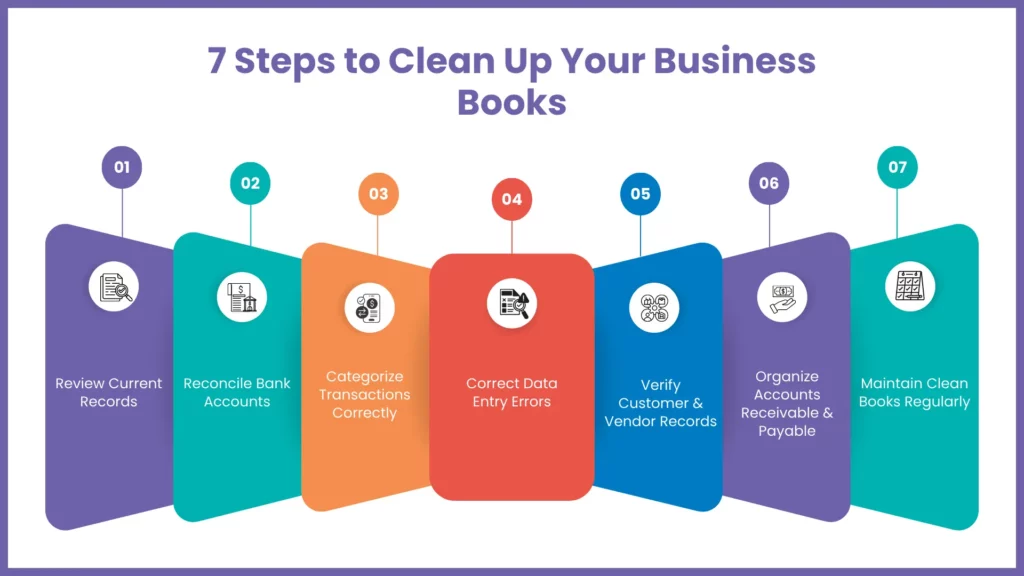
Read further to know how clean-up bookkeeping process works:
Examine the Current Records:
Check your most recent ledger, reports, and financial statements first.
- Look for common mistakes such as missing invoices, inaccurate balances, or transactions that don’t make sense.
- Look for differences between your bank statements and your accounting software.
- Determine which data gaps require additional research.
- To find inconsistencies, compare records with bank statements, IRS Forms 1099 and 941.
- You will have a clear road map of what needs to be fixed after such an evaluation.
Reconcile Bank Accounts:
Reconciliation means comparing every transaction on your credit card statement or bank account. As part of reconciliation, you will make sure that:
- All payments, withdrawals, and deposits are accurate.
- Finding and fixing any excess or missing transactions
- Notifying follow-up of any questionable charges or mistakes
- Your checking, savings, and merchant service accounts should all match every transaction.
- You will be able to verify the accuracy of your reported cash and credit balances once your bank accounts have been reconciled.
Accurate Classification of Transactions:
A common mistake is misclassifying transactions, which can result in errors in reports and reduce your tax deductions. In order to prevent it, you must:
- Examine the income and cost categories thoroughly.
- Transfer goods to the appropriate tax-deductible accounts.
- To ensure that comparable transactions are categorized consistently in the future, standardize the category standards.
- For precise deductions, use the IRS Schedule C categories.
Correct Data Entry Mistakes:
Duplicate entries, inaccurate sums, and misprints are some of the mistakes that can be found in disorganized books. It is simple to prevent these mistakes.
- To prevent overstated revenue or expenses, eliminate duplicates.
- Correct inaccurate numbers by comparing them to the original statements or receipts.
- Correct transactions that were posted to incorrect accounts.
- Eliminate duplicates and adjust quantities using the source papers as a guide.
- This stage is essential since these minor mistakes can accumulate to major problems, thus they should not be ignored.
Check Customer and Vendor Records:
Accurate contact and account information is just as important to a tidy bookkeeping system as numbers. For this reason, it is important to emphasize:
- Updating the tax IDs, addresses, and names of vendors.
- Look for delinquent invoices from customers or vendors.
- To prevent confusion, merge duplicate supplier or customer accounts.
- Make sure the appropriate U.S. vendors have W-9 forms in file.
Organize Receivables and Payables:
You can settle unpaid bills and invoices once you have found them. Understanding accounts payable and accounts receivable, which are essential for efficient cash flow management, is necessary to do this.
The distinction between the two is as follows:
- The money that your company owes suppliers or vendors for goods and services that were bought on credit is known as accounts payable, or AP. You can use it to control your vendor relationships and steer clear of fines and late payments.
- The money that your clients owe you for the products and services they have used but have not yet paid for is known as accounts receivable, or AR. You can make sure you collect unpaid invoices by effectively managing your accounts receivable.
You can maximize the amount of cash available for your business operations and guarantee prompt vendor payments by proactively managing both accounts payable and receivable or by outsourcing accounts payable.
Establish Procedures to Remain Organized:
Maintaining the cleanliness of your records is a routine that must be adhered to in order to prevent future issues with regulators.
- For continuous maintenance, make a monthly bookkeeping checklist.
- Make use of accounting software automation (payment reminders, recurring invoices, and bank feeds).
- Plan routine reconciliations to identify mistakes early.
- For convenience, keep documents and receipts digitally.
We are aware of how time-consuming and expensive it is to follow the instructions and clean books on a regular basis. However, you can accomplish a clean accurate bookkeeping with professional clean-up service help at a fraction of the price and time by using bookkeeping outsourcing services.
How much time does it take to clean up the bookkeeping?
Giving you a deadline for finishing an accounting cleanup is difficult. Everything relies on the:
- The evaluation process may take months or even years.
- Additionally, consider how disorganized the books are.
- Finally, the quantity of bank accounts and transactions to handle.
According to our observations, it could take a few days for a small company with a few month’s worth of jumbled data. It can take a few weeks for years of disorganized records.
Is It Better to Hire a Professional Cleaning Service or Do It Yourself?
You can try doing your own clean-up bookkeeping if:
If you are familiar with accounting software, you can do it yourself, however in the United States, professional assistance is preferred due to GAAP regulations and IRS compliance. Because of this, a lot of people are turning to accounting service providers that can save time, offer knowledge, and minimize mistakes, particularly when filing taxes or asking for funding. It is preferable to employ outsourcing companies for clean-up bookkeeping since they have experts who can identify problems you might overlook.
What Is the Price of Clean Up Bookkeeping Services?
The cost of clean-up bookkeeping services is influenced by a number of variables.
- How unorganized your books are, minor mistakes versus years of jumbled data
- Your company’s size (number of accounts, transactions, and vendors)
- Your accounting program (QuickBooks, Xero, etc.)
- Whether you use a fixed project rate or an hourly wage
People Also Ask:
How frequently should I perform bookkeeping clean-up?
At least once a year, small firms should evaluate their books. On the other hand, quarterly or monthly clean-ups can assist spot problems early and maintain accurate financial records all year long.
What paperwork is required for bookkeeping cleanup?
Bank statements, credit card statements, invoices, receipts, payroll records, tax paperwork, loan statements, and access to your accounting software are usually required.
Will tax preparation be aided by clean-up bookkeeping?
Sure. Maintaining accurate and well-organized financial records facilitates tax filing, lowers the possibility of mistakes, and helps guarantee that you claim all allowable deductions.
Which accounting software is suitable for bookkeeping cleanup?
Clean-up bookkeeping is supported by well-known accounting programs like Xero, QuickBooks Online, Sage, and FreeAgent, which let you reconcile accounts, examine transactions, and provide precise financial reports.
Conclusion:
Clean-up bookkeeping provides you with an accurate and transparent view of your company’s finances, going beyond simply fixing past errors. Cleaning up your books enables you to confidently make smarter financial decisions, whether you are getting ready for tax season, applying for funding, switching accounting software, or just seeking to take back control of your records. You may strengthen your company’s financial base by checking transactions, balancing accounts, fixing mistakes, and keeping proper records.
You don’t have to do it alone if the procedure seems burdensome or if your books have fallen behind. For small businesses, MYiva Accounting offers expert clean-up accounting services that guarantee your financial records are precise, well-organized, and completely compliant. Our skilled bookkeeping accountants can spot inconsistencies, balance accounts, and get your books back on track so you can concentrate on expanding your company rather than correcting previous mistakes.
Are you interested in getting total financial transparency and maintaining clean books? Connect with us via the contact form and get MYiva Accounting right now, and let our professionals assist you in maintaining accurate, compliant, and stress-free business finances.
