


Amazon sellers generally pay tax on their net business profit, rather than the total amount Amazon pays into their bank account. To calculate taxable profit, take your gross sales and subtract allowable business expenses, such as refunds, cost of goods sold, Amazon and FBA fees, advertising, shipping, and other ordinary business costs.
Imagine Sarah, who started selling home decor items through Amazon. She believed the $120,000 in annual sales shown on her Seller Central dashboard was comparable to her earnings. At tax time she learned otherwise: her real earnings had been reshaped by Amazon referral fees, FBA storage fees, returns, refunds, PPC advertising, shipping, and inventory purchases.
The problem was not that Sarah had failed to make sales. She had made strong sales. The problem was that she had not tracked where the money went. With accurate bookkeeping and a clear understanding of Amazon seller taxes, she could separate gross sales from real profit, support eligible deductions, and avoid unexpected tax bills.
This guide outlines how Amazon seller taxes work in 2026, what documentation to maintain, what expenses might be deductible, roughly how much tax to expect, and how to be ready for tax season.
What Are Amazon Seller Taxes?
Amazon seller taxes cover the federal, state, and local taxes on income from selling on Amazon, including federal income tax, self-employment tax, and state-level requirements. Amazon may handle sales tax collection on many marketplace sales, but sellers are still responsible for accurately reporting business income.
Do I Have to Pay Taxes for Selling on Amazon?
Yes. Even if Amazon does not send you a tax form, you generally must report your company income if you run a profitable Amazon business in the US. What you owe depends on profit, business structure, total revenue, location, and applicable state laws.
Federal Income Tax
Taxable Amazon business profit, after qualifying deductions, is subject to federal income tax at your marginal rate, which currently ranges from 10% to 37% by income and filing status. You may owe nothing if deductions, credits, and losses bring your liability to zero.
Self-Employment Tax
If you have net self-employment earnings of $400 or more as a sole proprietor, partner, or certain LLC owner, you generally owe self-employment tax of 15.3% (12.4% Social Security, 2.9% Medicare), calculated on 92.35% of net profit. This funds Social Security and Medicare, on top of income tax, and is one of the biggest surprises for first-year sellers.
How Much Tax Will You Actually Owe?
There is no single flat rate: your bill blends self-employment tax with your federal bracket, plus any state income tax. Many self-employed sellers budget 25% to 30% of net profit for combined federal taxes. On the $25,000 net profit used later in this guide, self-employment tax alone runs about $3,533 ($25,000 × 92.35% × 15.3%), before income tax is added. A tax professional or the IRS Tax Withholding Estimator can give you a precise figure.
Sales Tax: What Amazon Handles
Where marketplace facilitator laws apply, Amazon typically collects and remits sales tax on qualifying sales. You may still need to register, file returns, or report sales, especially if you also sell through your own website or other channels.
State and Local Taxes
Depending on where you’re registered, have workers, keep inventory, or operate, you may owe state income tax, franchise tax, gross receipts tax, annual business fees, or local business licenses. Requirements vary by state and city, so check local rules directly.
Form 1099-K: What It Means for Sellers
Amazon issues Form 1099-K once sales reach the IRS reporting threshold. Following the One Big Beautiful Bill Act (OBBBA), the federal threshold is back to more than $20,000 in gross payments and more than 200 transactions a year, reversing the phased-in $600 rule. A few states, including Massachusetts, Vermont, Virginia, and New Jersey, still enforce lower thresholds, so you can receive a 1099-K below the federal limit. Either way, you must generally disclose taxable income even without this form.
Your 1099-K Is Not Your Tax Return
The 1099-K reports gross payment volume, not profit, and Amazon sends a matching copy to the IRS. If your Schedule C net income looks very different from the 1099-K gross figure, the IRS may send a CP2000 notice asking you to explain the gap. Keep a simple reconciliation, 1099-K gross sales minus COGS, Amazon and FBA fees, refunds, and shipping, so it ties out to your Schedule C profit.
Amazon Seller Sales Tax: How It Actually Works
Sales tax is generally set by the shipping address, product category, and local or state law. A customer orders; the delivery address, not the seller’s residence, determines the tax. Amazon calculates the tax at checkout, collects it from the buyer along with taxable shipping charges, and remits it to the state under marketplace-facilitator laws; this amount is not part of your income. Amazon then pays you the remainder, after referral fees, FBA fees, storage fees, refunds, and advertising costs.
Sales tax nexus. Beyond marketplace collection, FBA sellers can have a “sales tax nexus”, a legal obligation to register and file in a state, created by physical presence (inventory in that state’s fulfillment centers) or economic nexus, which most states trigger once sales into that state cross roughly $100,000 a year (thresholds vary). Amazon collecting tax at checkout doesn’t automatically satisfy every state’s filing requirement, so sellers with inventory across multiple fulfillment centers should confirm registration state by state, ideally with a sales-tax automation tool or a tax professional.
Sellers should still keep sales-tax reports, monitor inventory storage locations, and track sales through their own website, wholesale accounts, or other channels, even where Amazon manages collection.
Amazon Seller Tax Documents and Forms You Need to Know
| Form | Who uses it | Purpose |
|---|---|---|
| Form 1099-K | Sellers meeting the reporting threshold | Reports gross Amazon transaction volume, not profit after fees, refunds, and other costs. |
| Schedule C (Form 1040) | Sole proprietors and single-member LLCs | Reports business income and deductible expenses on the owner’s return. |
| Schedule SE (Form 1040) | Sellers with net self-employment earnings of $400+ | Calculates self-employment tax for Social Security and Medicare. |
| Form 1065 | Multi-member LLCs and partnerships | Reports partnership income, gains, losses, and deductions; each owner gets a Schedule K-1. |
| Form W-9 | US sellers, contractors, service providers | Provides a taxpayer ID (EIN or SSN) for filing purposes. |
| Schedule K-1 | Partners and members of partnership-taxed LLCs | Reports each owner’s share of income, deductions, and credits. |
| Form 4868 | Any seller needing more time to file | Requests an automatic six-month filing extension. Extends the filing deadline only, not the payment deadline — an estimated payment is still due on time. |
Are Amazon Seller Fees Tax Deductible?
Understanding eCommerce tax deductions starts with your Amazon fees. Amazon seller fees are ordinary, necessary business expenses, so they are tax deductible, provided you keep settlement reports and other documentation to back up each expense.
Amazon seller fees are ordinary, necessary business expenses, so they are tax deductible, provided you keep settlement reports and other documentation to back up each expense.
Fees that may be deductible: Amazon referral fees; FBA fulfillment fees for picking, packing, and shipping; monthly and long-term storage fees; professional selling-plan subscription fees; return-processing fees; removal and disposal fees for unsold FBA inventory; and Amazon advertising fees for Sponsored Products, Sponsored Brands, and PPC.
Deductions Sellers Often Miss
Home office deduction: If you run your Amazon business from a space used regularly and exclusively for it, choose between the simplified method ($5 per square foot, up to $1,500 a year, no receipts required) or the regular method, which deducts the business-use share of actual rent, utilities, and insurance and often yields more if documented properly.
Mileage and travel: Driving to source inventory, meet suppliers, ship packages, or attend trade shows can be deductible via the standard mileage rate or actual vehicle expenses.
Depreciation: Equipment such as computers, product-photography gear, or shelving is generally deducted over time through depreciation, or potentially expensed in the purchase year under Section 179, subject to IRS limits.
Professional and software fees: Bookkeeping, accounting, legal fees, and inventory or repricing software subscriptions are fully deductible.
Amazon FBA Taxes: What’s Different for FBA Sellers
FBA taxes get more complex because Amazon stores, packs, and ships your inventory nationwide, which can create state tax, registration, or filing considerations beyond your home state, especially if you also sell elsewhere.
More fees to track: referral, fulfillment, storage, removal, return-processing, and inventory-placement charges. Gross sales are not profit, your Seller Central reports and 1099-K show gross payment volume; deduct COGS and allowable expenses to find taxable profit. Inventory requires careful tracking, since product costs are generally deducted when inventory sells, not when purchased, recorded as Cost of Goods Sold (COGS).
Quarterly Estimated Taxes for Amazon Sellers
Amazon sellers are often self-employed and may need to submit quarterly estimated payments rather than having tax withheld from each payment.
Who needs to pay? Sole proprietors, single-member LLC owners, and other independent sellers who expect to owe $1,000 or more in federal tax after withholding and credits.
What’s included? Federal income tax on business profits, self-employment tax, and state income tax where applicable.
Deadlines: April 15 (income from Jan 1–Mar 31), June 15 (Apr 1–May 31), September 15 (Jun 1–Aug 31), and January 15 of the following year (Sep 1–Dec 31). Use Form 1040-ES to compute and submit payments electronically.
Safe harbor tip: you generally avoid an underpayment penalty if your withholding and estimated payments equal at least 100% of last year’s total tax (110% if prior-year income exceeded $150,000), even if this year’s profit is higher.
Example: an FBA seller earning $80,000 in sales with $55,000 in inventory costs, Amazon fees, advertising, and other expenses is taxed on the $25,000 profit, not total sales.
How to Organize Your Books for Amazon Seller Taxes
Good Amazon bookkeeping habits make tax season predictable instead of stressful.
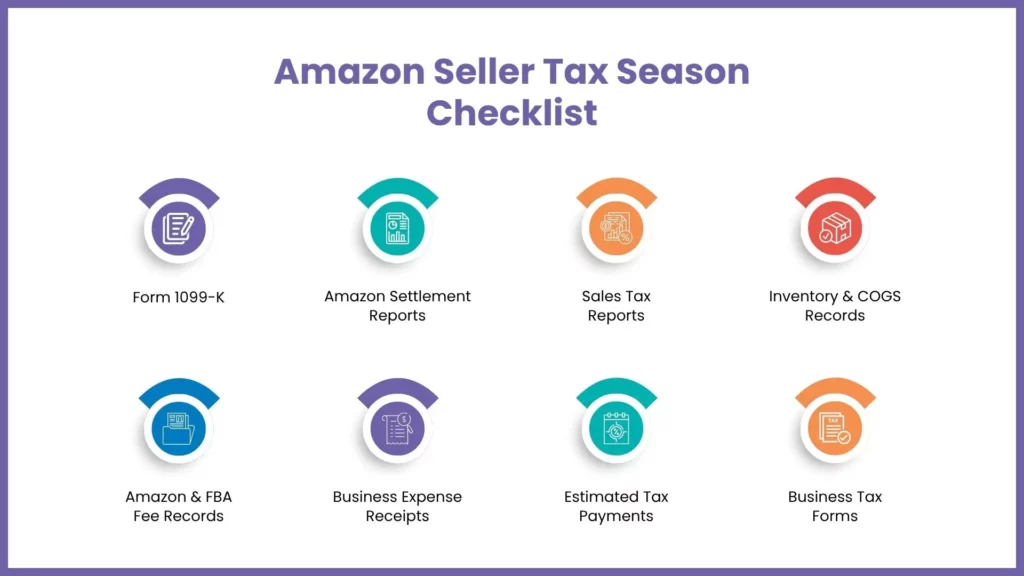
- Separate Amazon sales from payouts record gross sales, then track Amazon fees, storage costs, advertising, refunds, and sales tax separately from your bank deposits.
- Save every Amazon settlement report to reconcile sales, refunds, fees, and payouts against your accounting records.
- Review your Amazon sales tax report by state from Seller Central’s Tax Document Library and keep it with your own state filings, especially if you sell through other channels.
- Track inventory and COGS keep supplier invoices, unit costs, freight, duties, and quantities received.
- Categorize FBA write-offs into distinct buckets, referral fees, fulfillment, storage, sourcing, shipping, advertising, photography, software, and supplies, rather than one “Amazon expense” line.
- Reconcile bank and credit card accounts against Amazon settlement activity monthly to catch missing fees, duplicate transactions, and misclassified personal costs.
- Keep digital copies of statements, invoices, receipts, and supplier records for at least three years, and up to six in some cases, per IRS guidance.
Common Amazon Seller Tax Mistakes to Avoid
- Treating Form 1099-K, or your Amazon payout, as profit. Both figures still include fees, refunds, and costs that haven’t been deducted yet; reconcile them with your bookkeeping before filing.
- Forgetting quarterly estimated taxes, which frequently triggers IRS penalties and interest if deadlines are missed.
- Ignoring sales tax nexus and assuming Amazon’s marketplace collection covers every state filing obligation without verifying registration rules state by state.
- Waiting until tax season to organize books, instead of reconciling Amazon transactions monthly to catch missing refunds, fees, and inventory costs early.
- Missing the filing or extension deadline. A late return can trigger a failure-to-file penalty of 5% of unpaid tax per month, up to 25%, on top of any failure-to-pay penalty; filing Form 4868 for an automatic six-month extension avoids the larger penalty even if you can’t pay in full right away.
Amazon Seller Tax Obligations by Business Structure
Sole Proprietorship or Single-Member LLC: income and expenses go on Schedule C with your personal Form 1040. Net profit over $400 is generally subject to both income tax and self-employment tax via Schedule SE.
Partnership or Multi-Member LLC: Form 1065 reports the business’s income and deductions; the entity itself generally doesn’t pay federal income tax. Each partner gets a Schedule K-1 and may owe self-employment tax on eligible earnings.
S Corporation: files Form 1120-S and passes income through to shareholders via Schedule K-1. Owners who actively work in the business must take a reasonable salary, subject to payroll tax, before any remaining profit is distributed.
C Corporation: files Form 1120 and is taxed as a separate entity; shareholders may owe personal tax on later dividends. Owner-employees are generally treated as employees for payroll purposes.
When to Hire an Amazon Tax Professional
Consider hiring an Amazon tax expert, one of the specialized ecommerce accountants, once you expand beyond basic, single-state sales, have FBA inventory in several states, sell on multiple marketplaces, or find it hard to reconcile payouts, fees, and inventory records.
Get help before filing if you’ve missed a deadline, received an IRS or state notice, changed your business structure, or are preparing for a loan, investor review, or sale. Choose someone experienced in inventory accounting, ecommerce bookkeeping, and multistate tax.
Amazon seller taxes explained for 2026, deductions, 1099-K, and quarterly estimates. Get expert help from MyIVA Accounting today.
People Also Ask:
Do Amazon sellers have to pay taxes?
Yes. US Amazon sellers must report business income to the IRS even without a Form 1099-K. What’s owed depends on profit, entity structure, deductions, state rules, and other reported income.
How much tax will I pay as an Amazon seller?
There’s no fixed rate. Self-employed sellers typically owe 15.3% self-employment tax on 92.35% of net profit, plus federal income tax at their marginal bracket (10% to 37%) and any state income tax. Many sellers budget 25% to 30% of net profit for combined taxes, then refine that with a tax professional.
Does Amazon report seller income to the IRS?
Once a seller exceeds the federal threshold, more than $20,000 in gross payments and 200+ transactions a year, Amazon issues Form 1099-K to both the seller and the IRS. Some states apply lower thresholds.
Are Amazon FBA fees tax deductible?
Yes, when they’re ordinary and necessary business expenses, generally including fulfillment, referral, storage, return processing, removal, disposal, and advertising fees, as long as you keep supporting documentation.
Where should Amazon sellers find Form 1099-K?
In Seller Central, under Reports, then Tax Document Library, by selecting the relevant tax year and opening the available document.
Conclusion
Amazon seller taxes are determined by your actual profit, not total sales or the amount deposited into your bank account, which is why consistent accounting for eCommerce companies matters as much as the tax filing itself.
Sellers may still owe federal, state, estimated-tax, and reporting obligations even though Amazon often collects and remits sales tax. Review your books regularly, track COGS, and consult an ecommerce tax professional when multistate inventory or nexus questions arise.
MyIVA Accounting helps Amazon and online retailers maintain precise, tax-ready financial documentation, from sales and fee reconciliation to inventory management, profit reporting, and tax support. Whether you need ongoing bookkeeping services, catch up bookkeeping to get months of records current, or a full clean up bookkeeping pass before filing, MyIVA can bring your books in line with what the IRS expects, an eCommerce CPA-level review without the overhead of hiring in-house.
