


Selling online has never been easier, but managing the finances behind an eCommerce business is more challenging than many business owners expect. With sales coming from multiple platforms, payment processors, and countries, keeping accurate financial records can quickly become overwhelming. Mixing refunds, marketplace fees, inventory costs can turn simple bookkeeping into a time-consuming task.
The good news is that it doesn’t need to be difficult. You need to remain on top of your finances, meet your tax obligations, and obtain important insights into the performance of your firm with the appropriate bookkeeping procedures and tools.
We will be understanding the fundamentals of eCommerce bookkeeping in this comprehensive guide, outline typical pitfalls to avoid, and offer helpful advice to help you maintain accurate, well-organized, and growth-ready accounts.
What Is eCommerce Bookkeeping?
The practice of documenting and overseeing all of an online business’s financial activities is known as eCommerce bookkeeping. Across platforms like Shopify, Amazon, eBay, Etsy, and WooCommerce, it involves keeping track of sales, refunds, payment gateway fees, marketplace commissions, inventory costs, and business expenses.
As your eCommerce business expands, accurate bookkeeping will help you analyze profitability, keep an eye on cash flow, comply with tax laws, and make wise business decisions.
How Do Accounting and Bookkeeping Differ?
The practice of keeping track of your daily financial transactions, including sales, purchases, expenses, and payments, is known as bookkeeping for an eCommerce business. These documents are used by accounting to create financial statements, calculate taxes, assess company performance, and offer strategic recommendations.
To put it simply, accounting transforms your financial records into insights that assist you in making better company decisions, while bookkeeping maintains the accuracy of those records. For an eCommerce business to be successful, both are necessary.
Why is eCommerce Bookkeeping Different?
Compared to regular bookkeeping, eCommerce bookkeeping is more complicated since online businesses deal with special financial procedures that need close monitoring. Among the main variations are:
- Multiple Sales Channels: It is necessary to reconcile transactions from your own website, Shopify, Amazon, eBay, Etsy, and WooCommerce.
- Large Transaction Volumes: Online retailers sometimes handle hundreds or thousands of orders, which makes manual bookkeeping impossible.
- Payment Gateway Reconciliation: After deducting costs, payments made via Stripe, PayPal, Klarna, and other providers must match sales.
- Marketplace Fees and Commissions: Referral fees, fulfillment fees, subscription fees, and advertising expenditures are levied by selling platforms and need to be accurately documented.
- Inventory Management: To determine actual profitability, inventory levels, COGS, and stock acquisitions must be monitored.
- Real-Time Financial Reporting: Better business decisions are made possible by accurate bookkeeping, which offers current insights into sales, expenses, cash flow, and profit.
Common Bookkeeping Issues and Solutions for eCommerce Companies
Even with the best of intentions, many eCommerce companies make common bookkeeping errors that can later lead to expensive issues. You can maintain accurate and compliant accounts by being aware of these typical bookkeeping errors:
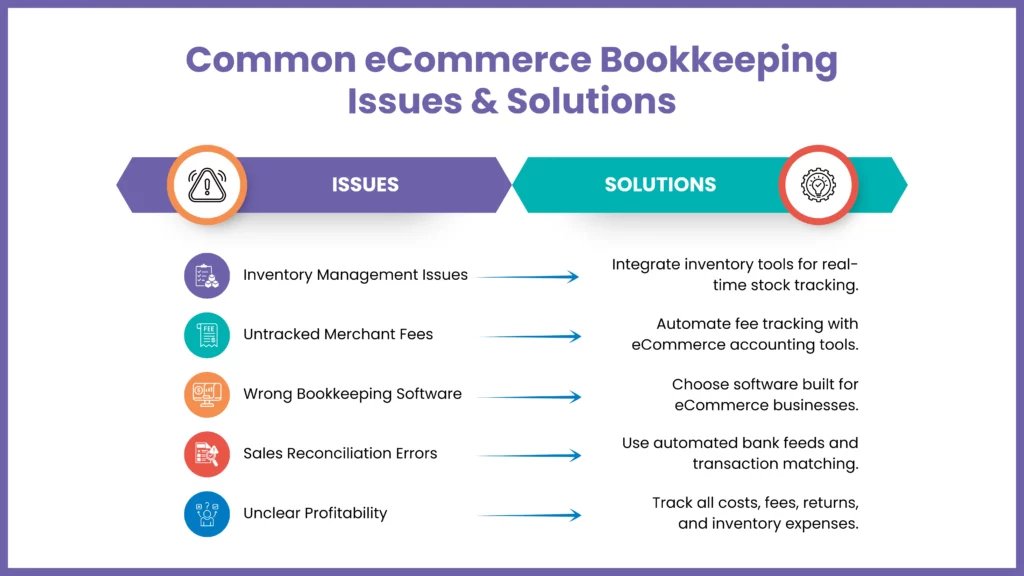
Managing Inventory Across Multiple Platforms:
It’s simple to lose track of stock levels when you sell through several channels. For instance, you may oversell if a sale on Amazon does not instantly update your Shopify inventory.
How to Fix It: For smooth, real-time inventory changes, our Shopify accounting services may assist in setting up and integrating programs like TradeGecko, Katana, or Cin7.
Tracking Merchant Fees and Platform Charges:
Different fees are charged by each sales channel; some are fixed, others are variable, and some are complex (such as fulfillment, payment processing, or referral fees). These costs reduce your earnings, but they can be challenging to properly monitor.
How to Fix It: Use programs like A2X, Link My Books, or Synder to automate fee tracking. In order to provide you with an accurate image of your actual revenue, these technologies import fee data straight from your sales platforms into your accounting software.
Choosing the Right Bookkeeping Software:
Not every accounting program is designed for online sales. You require software that can manage inventory tracking, fee reconciliation, multi-channel sales, and tax compliance.
How to Solve It: For smaller enterprises, choose eCommerce-friendly software such as Wave, Xero with eCommerce connections, or QuickBooks Commerce. Seek out software that works well with your inventory management and sales channels.
Reconciling Sales and Bank Statements:
Reconciling your books with your bank statements can be laborious and error-prone due to sales originating from various platforms and payments being processed through several gateways.
How to Solve It: Use software with automatic bank feeds and transaction matching, and schedule weekly or monthly reconciliations. This keeps your books correct and helps you identify inconsistencies early.
Calculating True Profitability:
Profit is more than just sales less expenses. To obtain the complete picture, you must account for shipping, returns, discounts, platform fees, sales tax, and inventory costs.
Use this formula to calculate true profitability:
True Profit = Gross Sales − (COGS + Shipping + Returns + Discounts + Platform Fees + Sales Tax + Inventory Costs)
How to Fix It: Make use of expense tracking and thorough income statements. To determine which items and platforms are most profitable, break down your expenses by category and channel.
Important Financial Statements That Every Owner of an eCommerce Business Should Understand
Cash Flow Statement: A cash flow statement shows how money moves in and out of your business. It helps eCommerce owners understand whether they have enough cash to manage inventory purchases, operating expenses, and growth investments.
By examining the cash flow, business owners can track their revenue and profit. eCommerce business owners need to be aware of this. They will know how their money is being used. This will allow them to maintain a good profit margin.
Balance Sheet:
The balance sheet of a business lists its assets and liabilities. The owner’s equity is also included. This statement has two columns. One column lists the company’s assets, while the other lists its liabilities.
The assets of your eCommerce company include money, goods, and machinery. Unpaid business loans and mortgages are among the liabilities.
Risk management:
In eCommerce bookkeeping, risk management comprises locating and mitigating potential financial risks that may affect the business.
This involves assessing the risks related to fraud, cybersecurity, payment processing, and market volatility. Effective risk management strategies protect the financial integrity and long-term health of the eCommerce sector.
Income Statement (Profit & Loss):
A business’s earnings during a specific time period are displayed in an income statement. This could be a month, a quarter, or a year. The statement will show both operational and non-operating income. The money you make from ordinary business operations is known as operating income.
This comes from your inventory sales in an online retail business. The money you earn from sources unrelated to your firm is known as non-operating income. An example would be the gains from stock or real estate investments.
Sales Reporting:
Sales reporting involves tracking and analyzing sales data to gain additional insight into the eCommerce company’s operations. Creating reports that provide thorough information on sales trends, customer behavior, product performance, and revenue from different sales channels is known as sales reporting in eCommerce bookkeeping. Sales reports help business managers make informed choices about pricing, inventory management, and marketing strategies.
Top Tips for Organized Bookkeeping
- An organized bookkeeping system is essential for any eCommerce business. The first step is to establish a routine. Set aside time each week to review and update your financial records.
- Make use of different categories for each transaction. This makes it simple to track sales, expenses, and inventory. For simple access, consider labeling or color-coding files.
- Utilize technology to simplify tasks. Cloud-based bookkeeping software reduces human error and saves time by automating many tasks.
- Regularly reconcile bank statements and balances. This ensures accuracy and highlights discrepancies before they become significant issues.
- Don’t forget the papers! Keep digital receipts and invoices in one place. Having everything at your fingertips will make tax season much less stressful.
- Once a month, review your finances to identify trends or areas that need quick attention. Being proactive avoids surprises and enhances decision-making abilities.
Real-World Example: A US-based Shopify retailer selling consumer products struggled with tracking inventory costs and marketplace fees.
The business owner initially attempted to use spreadsheets to keep track of everything. However, handling inventory, sales, and fees by hand proved too much as the company expanded. They frequently had cash flow surprises and stockouts, which led to stress and financial uncertainty.
At that point, they made the decision to use our expert bookkeeping service, which focuses on eCommerce companies. Our skilled bookkeepers assisted in setting up automated systems that track merchant fees, synchronize sales channels, and update inventory in real time using programs like QuickBooks Commerce, A2X, and TradeGecko.
With our help, they began to receive transparent financial reports and regular reconciliations. This offered them the assurance to know precisely where their funds were going and when to place new stock orders. Additionally, it prevented costly surprises and early error detection.
What happened? They were able to confidently qualify for a business loan to expand their product range, cash flow improved, and stockouts were eliminated, all while concentrating on building their brand rather than being bogged down in paperwork.
Recommended Tools for Ecommerce Bookkeeping
| Category | Recommended Tools |
|---|---|
| Accounting Software | QuickBooks Online, Xero, Wave |
| Inventory Management | Cin7, Katana, Inventory Planner |
| Bookkeeping Automation & Reconciliation | A2X, Link My Books, Synder |
| Receipt & Document Management | Dext, Hubdoc, AutoEntry |
| Sales Tax Compliance | Avalara, TaxJar, Vertex |
eCommerce Bookkeeping’s Future: Trends to Keep an Eye on
It is anticipated that eCommerce bookkeeping will experience significant transformation in the future. Technology is enabling more simplified and efficient processes. Artificial intelligence, which automates time-consuming processes and provides insights formerly exclusive to highly qualified eCommerce accountants, is playing an increasingly significant role.
Cloud-based solutions are likewise becoming more and more popular among online retailers. They make it easier than ever for business owners to manage their accounts by giving them real-time access to financial data from anywhere. Additionally, the integration of several platforms will make it easy to track sales across multiple channels.
Another trend that is gaining traction is the expansion of subscription-based accounting services created specifically for online retailers. Professional bookkeeping services include regular bookkeeping as well as financial forecasts and strategic advice specific to your business goal.
Grow Your Ecommerce Business With Accurate Financials
Let our ecommerce bookkeeping specialists handle the complexity of reconciliations, reporting, and financial management so you can focus on scaling your online store.
People Also Ask:
What is eCommerce bookkeeping, and why is it crucial?
Keeping track of every financial transaction your online business does, including sales, expenses, fees, taxes, and more, is the main goal of eCommerce bookkeeping. It’s crucial because it helps you stay in compliance with tax regulations, prevent cash flow issues, and comprehend the actual health of your company. Even a profitable company can have significant financial surprises if its bookkeeping is poor.
What distinguishes traditional bookkeeping from eCommerce bookkeeping?
In contrast to traditional bookkeeping, eCommerce bookkeeping handles a variety of payment methods, numerous sales channels, intricate fee schedules, and location-specific state sales tax. Because of this complexity, accurate record-keeping necessitates the use of specific instruments and procedures.
Should I do bookkeeping on my own or hire a professional bookkeeper?
You can use eCommerce-specific software to begin bookkeeping yourself if your company is small and straightforward. However, employing a professional eCommerce bookkeeper can save time, lower errors, and offer knowledgeable advice as bookkeeping grows more complex and sales volume rises.
How can I determine my eCommerce business’s actual profitability?
To determine true profitability, deduct all costs from your total sales, including platform fees, sales tax, shipping, returns, cost of products sold, and inventory costs. This makes it easier to see how much money your company really makes after all expenses are covered.
Conclusion:
Maintaining accurate bookkeeping is the first step towards starting or expanding a profitable eCommerce business. You may avoid cash flow issues, maintain compliance, and make better decisions with the support of sound financial systems and procedures.
Don’t hesitate to hire an expert eCommerce accountant who is familiar with sites like Amazon, Shopify, Etsy, and Walmart if the bookkeeping aspect seems intimidating. Their knowledge can help you save time, feel less stressed, and concentrate on expanding your company.
